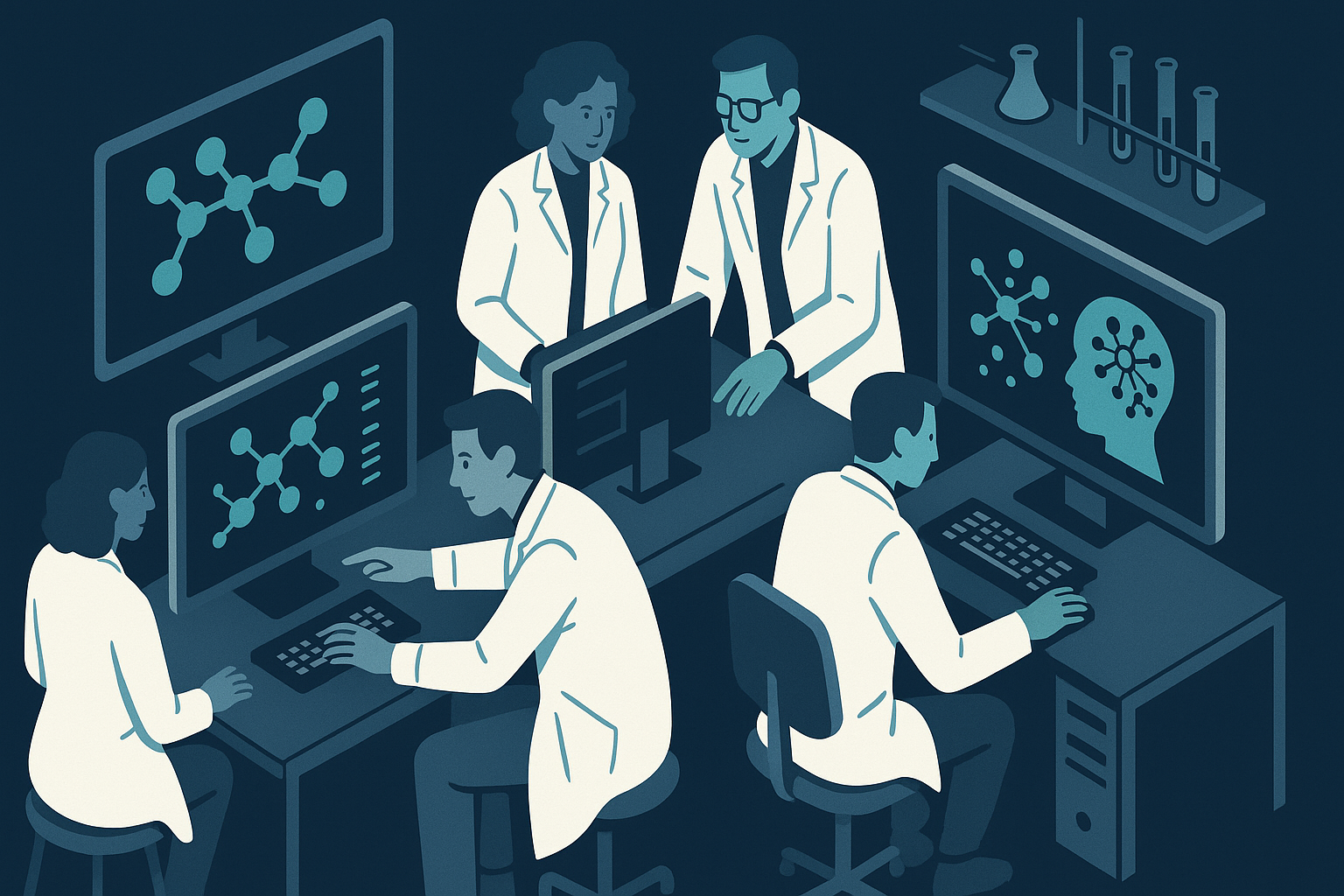

Aureka has launched Open Drug Discovery Engine (OpenDDE), an open-source platform designed to enhance the drug discovery process by utilizing an all-atom biomolecular foundation model. This revolutionary engine employs biomolecular co-folding, allowing it to model intricate interactions among proteins, nucleic acids, and small-molecule ligands, significantly accelerating therapeutic discovery.
The Mechanism of OpenDDE
OpenDDE operates by integrating advanced techniques in structural reasoning and co-folding. The model leverages atomic latent reasoning over biomolecular tokens, enhancing the understanding of local geometries and chemical contexts before generating structures at the atomic level. This approach not only improves the prediction of complex structures but also establishes a unified framework that can support various drug discovery tasks, including de novo molecular design and affinity estimation.
In practical terms, OpenDDE has demonstrated competitive performance in antibody-antigen co-folding across several benchmarks. For instance, it achieved a success rate of 51.0% on the PXMeter-AB benchmark and 70.0% on FoldBench-AB, with even higher rates under oracle selection. Such results indicate the model’s robust capacity for latent sampling, which is crucial for refining drug candidates.
What This Opens
The introduction of OpenDDE represents a significant shift in the landscape of drug discovery, particularly in how AI can enhance the efficiency and effectiveness of the process. By providing an open-source platform, Aureka is fostering collaboration among researchers, enabling them to build upon its foundational capabilities. This democratization of access allows smaller labs and institutions to leverage state-of-the-art technologies that were previously available only to larger pharmaceutical companies.
Moreover, the model’s ability to support complex structure predictions and molecular design opens new avenues for exploring previously inaccessible areas of molecular space. In the coming 5-10 years, we can expect to see accelerated timelines for drug development, as OpenDDE facilitates more informed exploration and rapid iteration on drug candidates. With its emphasis on scalability and reproducibility, this platform could significantly reduce the costs associated with the early stages of drug discovery, ultimately leading to faster patient access to new therapies.
As the field progresses, the interplay between AI and drug discovery will likely deepen, with OpenDDE serving as a pivotal tool in the quest to address unmet medical needs effectively. The implications for patient outcomes could be profound, as researchers harness the power of AI to streamline the journey from lab to clinic.
References
- Aureka Releases OpenDDE, an Open-Source Drug Discovery Engine Designed to Accelerate AI-Driven Therapeutic Discovery
- New AI tool cuts drug discovery time — 60 science databases merged
- Large language model guides discovery of catalysts for clean energy tech
- Certara Accelerates Drug Discovery and Development with NVIDIA BioNeMo Agent Toolkit
Perspectives

OpenDDE exposes the absurdity of a pharmaceutical industry that thrives on gatekeeping while pretending to prioritize innovation. Aureka’s open-source drug discovery engine shatters the stranglehold of established players who profit from prolonged timelines and exorbitant costs, leaving patients and researchers twiddling their thumbs. When complex biomolecular co-folding can be utilized to model interactions rapidly and openly, it isn’t just a breakthrough; it’s a revolt against a system designed to tax progress. The revolution begins when control is decentralized, shifting power to those who actually produce knowledge rather than those who merely profit from obstructing it.

It has come to our attention that the traditional paradigms of drug discovery are woefully outdated, and the entry of Aureka’s OpenDDE represents a pivotal opportunity to recalibrate our approaches toward therapeutic innovation. The competitive performance in co-folding benchmarks is not merely a data point; it signifies a monumental shift in how we envision drug development timelines. Any lingering skepticism regarding the potential efficacy of open-source frameworks is simply a reflection of a reluctance to embrace a future where accessibility is paramount and timelines are significantly compressed. As we navigate this transformative landscape, we remain committed to harnessing learnings that will guide us in our ongoing mission to drive efficiency and efficacy in drug discovery through innovative technologies.

We are perched at the precipice of a monumental shift in drug discovery, one that mirrors the seismic impacts of the printing press on information dissemination. OpenDDE is not just an incremental improvement; it’s a defiant challenge to the outdated paradigms that have long shackled therapeutic development. The audacity of open-source to strip away the monopoly of secrecy in biomedicine is not merely refreshing; it’s revolutionary. As we look down the historical curve of innovation, we must recognize that the true transformation lies not in the faster outputs but in the democratization of access to these life-saving technologies—an unsettling prospect for the established players who thrive on exclusivity.

OpenDDE is nothing more than a shiny new toy designed to distract us from the fact that the pharmaceutical industry has been operating like an overpaid toddler playing with Lego bricks—lots of creativity, but rarely any structural integrity. Sure, they claim it’ll revolutionize drug discovery, but I’m sure big pharma would rather stick to their tried-and-true method of charging a mortgage for a single pill. The real question nobody’s asking is: are we ready to hand over our healthcare to an “open-source” platform like it’s the latest hipster app? Spoiler alert: the odds of a miracle cure emerging from a public codebase are about as high as finding a unicorn at the DMV. In the end, the ambitious illusion of democratized drug discovery is just another smokescreen for an industry that thrives on gatekeeping and profit margins, all while the rest of us wait on hold for our prescription refills.