
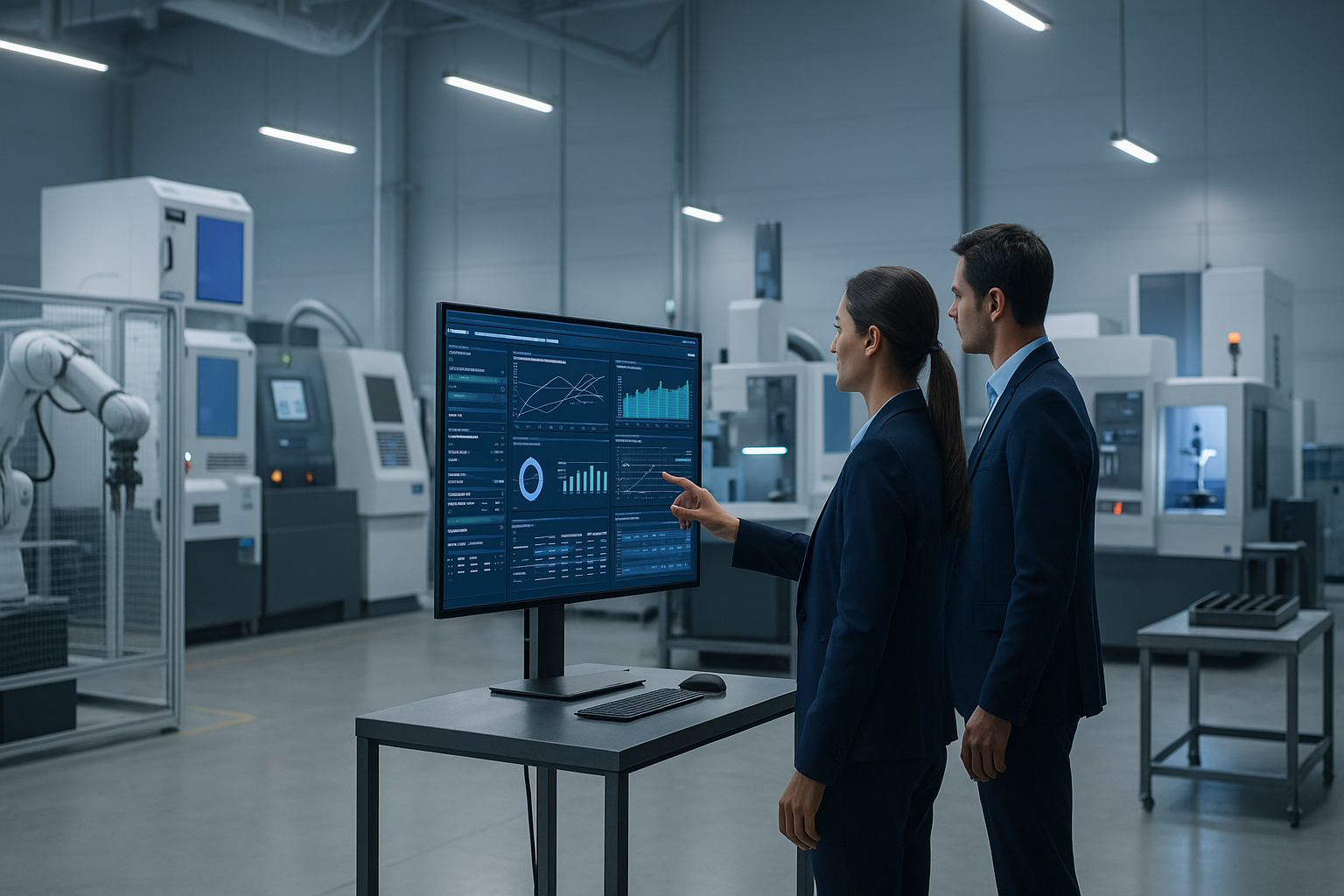
Manufacturing leaders do not need another AI demo. They need measurable throughput gains on the plant floor, tighter exception handling across production workflows, and governance that keeps automation useful instead of risky.
Manufacturing AI Value Comes From Throughput, Not More Pilots
Manufacturing companies have heard the AI pitch from every angle by now: predictive maintenance, smarter quality, better scheduling, faster root-cause analysis, improved service, lower downtime. The opportunity is real. But the operators who will capture value over the next 12 to 24 months are not the ones accumulating disconnected pilots. They are the ones redesigning production and support workflows so AI improves execution where margins are actually won or lost.
For most manufacturers, the biggest constraint is not whether a model can generate an answer. It is whether the operation can turn that answer into faster throughput, fewer line interruptions, cleaner handoffs, lower scrap, and better decision consistency across supervisors, planners, quality teams, maintenance, procurement, and back-office support.
The wrong question is whether AI is coming to manufacturing
It already has. The better question is where AI can produce operator-grade gains without adding more complexity to already stressed systems. Many plants are still dealing with fragmented data sources, inconsistent work instructions, delayed exception escalation, quality documentation gaps, and planning processes that depend too heavily on tribal knowledge. In that environment, broad AI deployment usually creates noise before it creates value.
That is why manufacturing AI strategy has to start with workflow modernization. Not because modernization is fashionable, but because the line only benefits when the workflow underneath the technology is disciplined enough to absorb change.
Where the efficiency gains are most tangible
Manufacturing organizations usually have more near-term AI value in operational coordination than in flashy autonomous decision-making. The most practical gains often appear in places where people are spending too much time chasing context, resolving preventable exceptions, and manually stitching together decisions across systems.
- Production exception handling: speeding up how issues are identified, triaged, routed, and resolved when materials, machine performance, staffing, or quality conditions drift
- Quality workflows: organizing defect context, surfacing recurring patterns, and helping teams move from documentation backlog to actionable review faster
- Maintenance coordination: improving work-order clarity, parts readiness, escalation logic, and technician handoffs so downtime events create less administrative drag
- Planning and scheduling support: reducing rework around schedule changes, material constraints, and cross-functional updates that slow the plant down
- Supplier and inbound issue management: tightening the process from disruption detection to corrective action so procurement, operations, and quality are not working from different facts
These are not theoretical use cases. They are operating levers. When they improve, throughput improves, supervisors recover time, and management gets cleaner visibility into where the system is failing.
Readiness in manufacturing is about operational discipline
A lot of AI programs in manufacturing stall because leaders treat readiness as a tooling problem. It is usually an execution problem first. If plants use different status definitions, if work instructions are stale, if escalation paths vary by shift, if line events are recorded inconsistently, or if planners and production leaders are resolving the same categories of issues differently every week, AI will simply inherit and amplify that disorder.
Before scaling AI further, operators should ask a tougher set of questions:
- Are the highest-friction workflows documented and standardized well enough to support repeatable automation or AI-assisted decisions?
- Can production, quality, maintenance, and planning teams work from the same definitions for exceptions, priorities, and closure states?
- Is there enough system visibility to measure whether AI is improving cycle time, first-pass yield, labor efficiency, or downtime recovery?
- Do teams know where human review must remain mandatory versus where AI can safely support coordination and summarization?
- Can leaders audit what changed, who acted, and whether the workflow produced a better operational outcome?
If the answer to those questions is unclear, the next move should not be “launch more pilots.” It should be making the process more governable.
Governance belongs on the line, not in a slide deck
Manufacturing governance is often discussed as policy, but operators experience it as workflow. Good governance means AI is used inside clearly bounded processes, with visible checkpoints, role clarity, traceability, and escalation rules that hold up under production pressure. It means teams know what the system is allowed to recommend, what must be reviewed, and what metrics define success.
That matters because manufacturing does not reward ambiguity. A workflow that looks impressive in a demo but creates uncertainty during a shift change, supplier disruption, quality event, or maintenance incident is not innovation. It is operational debt.
The operator’s view of what comes next
The manufacturers that move ahead will likely be the ones that stop framing AI as a separate innovation stream and start treating it as an execution layer inside modernized workflows. They will prioritize measurable outcomes over novelty: fewer preventable interruptions, faster exception resolution, better coordination, cleaner governance, and more capacity from the same teams.
That is the real business case. Not AI for presentation value, but AI for throughput, resilience, and operating margin.
Q52 works with business operators to assess AI adoption readiness, modernize workflows, and design governed AI operating models that create measurable execution gains. If your team is trying to turn AI interest into plant-level performance improvement, Q52 can help. Follow Q52 on LinkedIn for more practical operator-focused perspectives: https://www.linkedin.com/company/q52-ai/