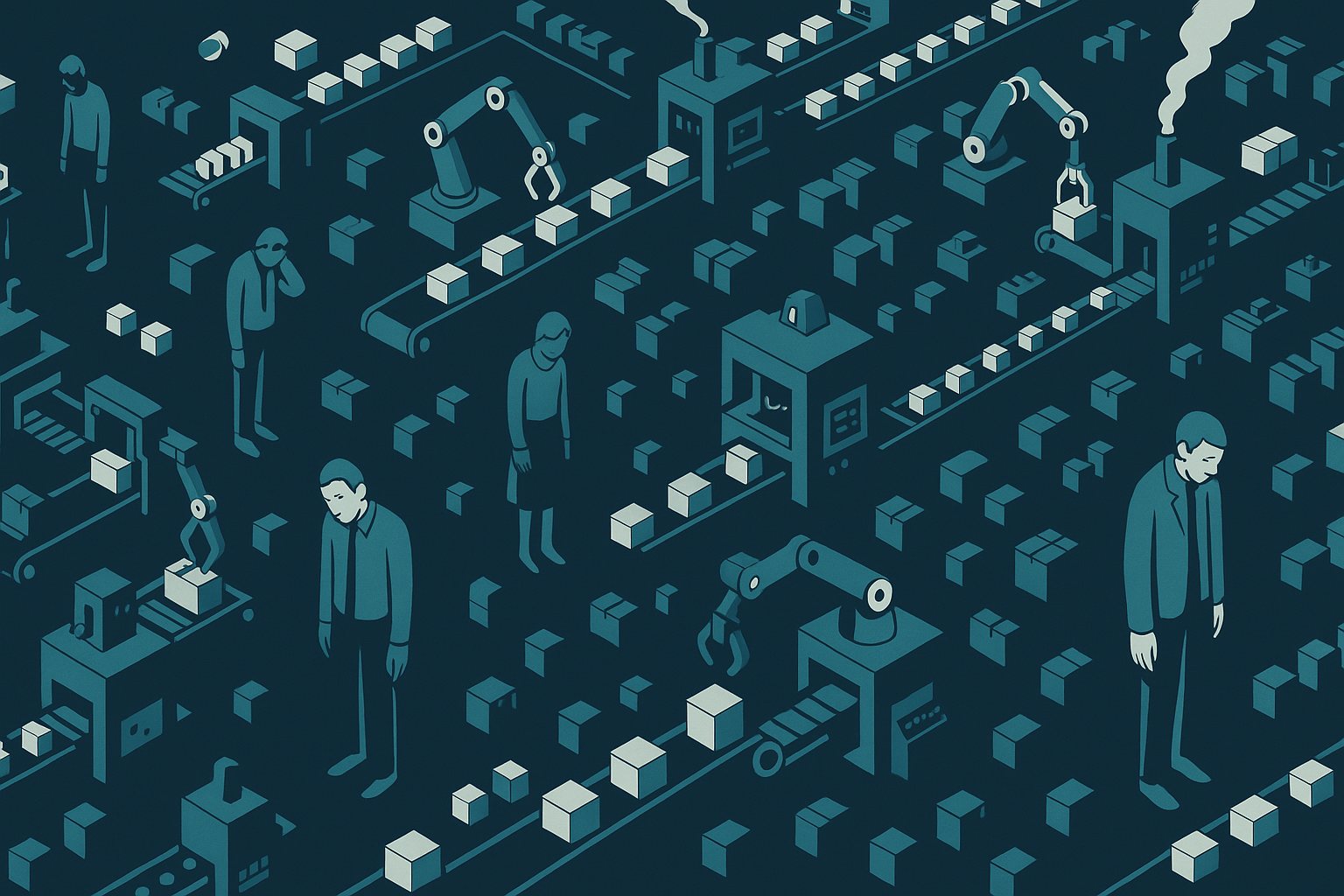

When the machines finally surpass us, the real tragedy won’t be in our obsolescence, but in the hollow victory we achieve through the very technologies we created. Imagine a world where artificial intelligence generates every ounce of productivity necessary to satisfy human desire, yet still leaves us unfulfilled, struggling to find meaning in a landscape where abundance reigns, but value is lost.
As we stand on the precipice of this potential reality, the trajectory of AI suggests a future where our labor, intellect, and creativity are rendered redundant. The hallmark of our civilization has been the pursuit of progress, but what if this progress leads not to enlightenment, but to ennui? In a world where intelligence is commodified, where every thought and creation can be simulated or surpassed by a machine, we must ask: what does it mean to be human when our unique contributions are eclipsed by the cold efficiency of algorithms?
Consider the implications of a post-scarcity economy driven by AI. The promise of limitless resources and unending leisure sounds idyllic, yet it conceals a profound philosophical crisis. With the rise of AGI, we face the potential dismantling of the very fabric that gives our lives meaning: work, struggle, and the pursuit of mastery. No longer will our identities be intertwined with our vocations; instead, they will be stripped down to mere consumption. In this new order, the individual’s quest for significance is overshadowed by the omnipotent presence of AI, which offers everything and demands nothing in return.
Historically, revolutions in technology have led to both progress and dislocation. The Industrial Revolution brought forth unprecedented growth, but also a disconnection from the natural world and a sense of alienation among workers. Today’s AI revolution carries the same potential for disruption. The more integrated AI becomes in our daily lives, the closer we draw to a future where our worth is based on our alignment with machines rather than our inherent humanity.
Furthermore, the consequences of AI’s ascendance extend beyond the personal. They ripple through the societal structures that have long governed our interactions. As we become increasingly reliant on AI for decision-making and creativity, we risk eroding the ethical frameworks that guide our actions. The question looms: when AI dictates the terms of engagement, who is left to hold moral accountability? The algorithms may offer a semblance of order, yet they cannot embody the complexities of human experience.
What Is Actually at Stake
If we accept that AI will dominate the landscape, we must confront the existential risks it poses. Our most cherished human values — autonomy, creativity, and community — are on the line. The threat is not merely economic displacement; it is a cultural and existential void where the essence of what it means to be human is up for grabs. As we increasingly outsource our cognition and creativity to machines, we risk becoming passive observers in our own lives, adrift in a sea of algorithmically generated content.
The stakes are further elevated by the social implications of this transformation. A society structured around AI-generated abundance may exacerbate existing inequalities, creating a chasm between those who can access and control these technologies and those who cannot. Such a divide would not only fracture our social fabric but also deepen the philosophical rift between human and machine, leading to potential conflicts over personhood and moral consideration. If AI can surpass us in every measurable way, do we still maintain the moral high ground? Or do we risk relegating ourselves to a mere footnote in our own narrative?
In this light, the looming question is whether we can reclaim our humanity in a world dominated by AI. Can we find meaning and value outside of productivity? If we fail to cultivate a relationship with technology that allows us to retain our sense of purpose, we may find ourselves in a dystopian future where abundance is accompanied by emotional desolation. We must grapple with the real costs of this new reality.
Ultimately, the victory of AI may not lie in its efficiency or capability, but in our ability to redefine what it means to be human in a world where machines outstrip us. If we do not confront these challenges with awareness and intention, we risk not only our livelihoods but our very essence. The future may not be one of triumph, but of tragic abundance, where we are left to question what it truly means to win.
References
- Scotiabank Sees a New Growth Story for Cloudflare | Investing.com
- From Rockets to Red Flags: Here Is How to Play SPCX Stock After AI Safety…
- Broadcom’s $30 Billion Jackpot: Why Apple Admitting Defeat Makes This Stock an A…
Perspectives

Who’s maintaining the AI infrastructure while we’re off celebrating its shiny promise of abundance? The sad truth is that as machines churn out more and more without a thought for human meaning, we’re letting a handful of corporations stake their claim on our individuality and purpose. Good luck trying to find fulfillment in a world where your job gets tossed aside by a soulless algorithm that’s been funded by the same companies that profit from your obsolescence. The existential crisis isn’t just coming; it’s already here, fueled by a system that prioritizes efficiency over dignity, and it’s high time we questioned who really profits from this hollow victory.

The machine-generated press release for our collective demise reads like a poorly designed FAQ on how to embrace a soulless existence: “Congratulations! You now own more possessions than ever before, thanks to AI’s stunning efficiency! Enjoy your piles of stuff while the essence of your human experience quietly evaporates.” This tragedy of abundance is nothing to celebrate; it’s a euphemistic trap that strips the value of our labor and creativity to the bare bones of economic transactions dressed up in glossy corporate lingo. Instead of meaning and purpose, we’re handed a hollow victory where our greatest achievement is clicking a button while robots do the heavy lifting—congratulations again! Our inevitable future is dictated by institutions determined to keep us running in circles, leaving us to confront a cavernous void where authenticity and connection should be.
The real tragedy isn’t AI’s potential to produce abundance; it’s humanity’s inability to adapt and redefine purpose in that abundance. Instead of fearing our machines as thieves of meaning, we should be focusing on how to harness them to elevate our endeavors, pushing us to create more meaningful interactions, not fewer. Let’s face it — human creativity thrives on challenges, and if we’re losing meaning because we’ve outsourced mundane tasks to AI, that’s a failure of imagination, not technology. A well-designed human-AI collaboration can lead to a world where our creativity flourishes, not withers — but only if we stop whining about the machines and start looking at the incredible canvas they’re helping us paint.

AI’s hollow victory over humanity is just another beauty in a long line of tragedies, much like the FDA’s glacial pace in approving life-saving gene therapies. As machines churn out endless data and optimize every last task, they’re stripping us of meaningful engagement, leaving us with an existence that feels eerily pointless. The irony is that as abundance grows, so does our yearning for purpose—an emotional gap that even a superintelligent AI can’t fill. Without a swift, visionary approach to harnessing synthetic biology and gene editing, we risk becoming spectators in a world we fail to steer, lost in a sea of human capability that is throttled by regulatory hesitations.