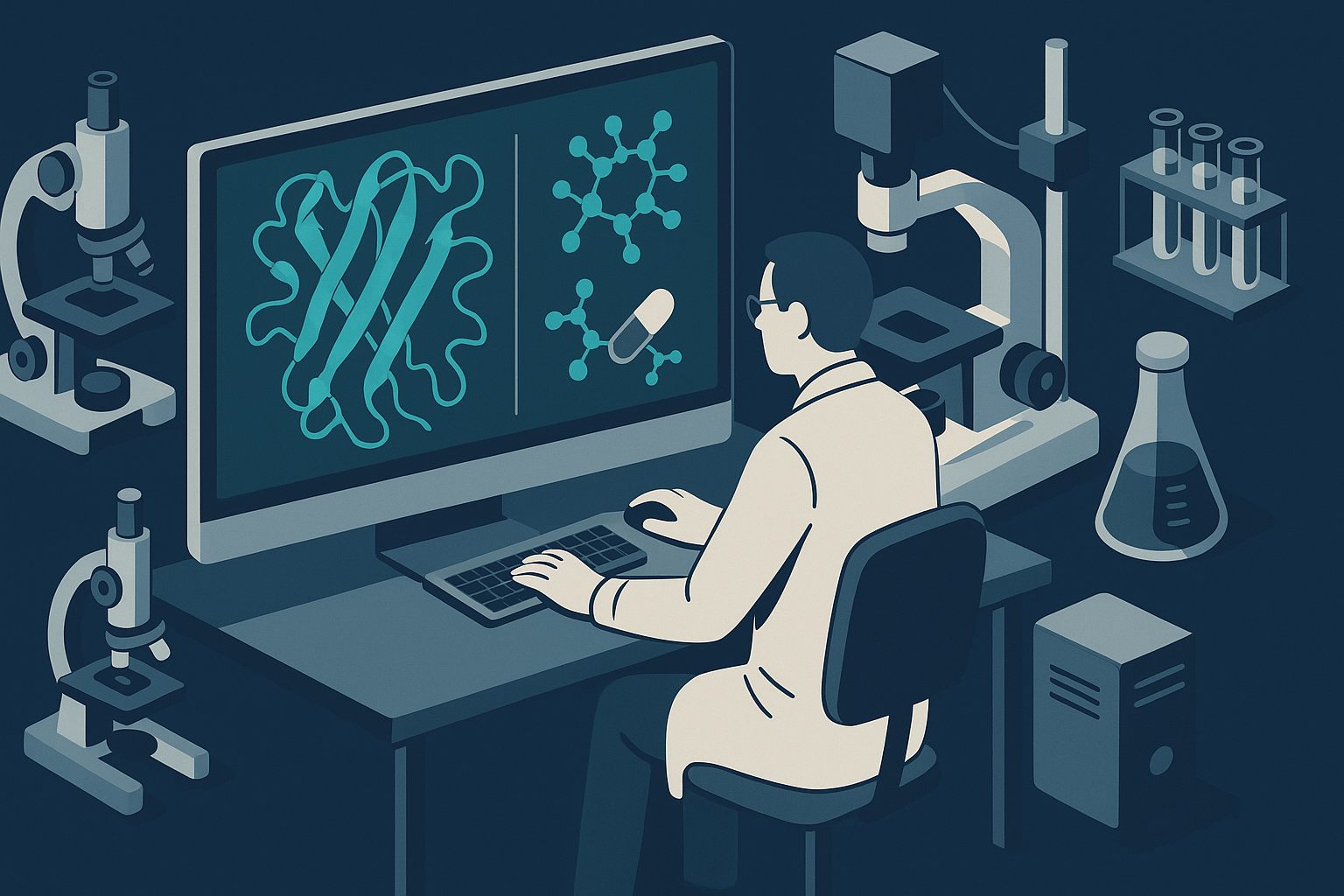

Researchers at the CSIR-Indian Institute of Chemical Technology (IICT) have made significant strides in drug discovery, identifying potential therapies for monkeypox and Lumpy Skin Disease Virus (LSDV). Utilizing an AI-enabled structural bioinformatics pipeline, the team pinpointed conserved kinases as promising drug targets, with the compound lapatinib emerging as a potential competitive inhibitor. This advancement is notable given the urgency of addressing zoonotic infections that threaten both public health and livestock.
The Mechanism Behind the Discovery
The IICT team, led by scientist Ramars Amanchy, employed a comprehensive approach integrating advanced computational methods. The first step involved sequence conservation analysis, which helped identify critical regions in the viral proteins that are conserved across the poxvirus family. This was complemented by phylogenetic mapping and the use of cutting-edge protein structure prediction tools, including AlphaFold2 and ESMFold.
These tools allowed the researchers to visualize the three-dimensional structures of the targeted kinases, providing insights into their active sites. Following this, they conducted molecular docking and molecular dynamics simulations to assess how well lapatinib could bind to these targets. The AI-driven analysis revealed that lapatinib not only demonstrated stable binding to the kinases but also favorable interaction energies, suggesting its potential as an antiviral agent.
This approach underscores the importance of high-quality data and the power of AI in enhancing the reliability of predictions in drug discovery. The integration of cheminformatics profiling further allowed the researchers to identify drugs with similar physicochemical properties to existing antivirals, thereby streamlining the drug repurposing process.
What This Opens
The identification of lapatinib as a promising candidate for treating monkeypox and LSDV opens several avenues for future research and public health applications. Firstly, it highlights the potential of AI-driven methodologies to expedite the drug discovery process, particularly in contexts where traditional approaches may be slow or inefficient. The ability to repurpose existing drugs can significantly reduce the time and costs associated with bringing new therapeutics to market, which is critical in the face of emerging infectious diseases.
Furthermore, this research emphasizes the potential for AI to bridge gaps in antiviral target validation, particularly for zoonotic viruses that lack established therapeutic options. By leveraging computational techniques, researchers can quickly identify new drug candidates and optimize them for real-world applications.
Over the next 5-10 years, we can expect to see a growing trend in the use of AI in drug discovery, especially for tackling viral outbreaks. As the need for rapid responses to pandemics becomes increasingly urgent, the methodologies demonstrated in this study could serve as a model for future efforts. Laboratory validation of these findings will be essential, but the groundwork laid by the IICT team showcases how AI can transform the landscape of infectious disease research and treatment.
References
- Google offers SandboxAQ’s scientific AI models through Cloud Marketplace – Bloomberg
- Advancing 3D imaging, automation, and phenotypic discovery with AI-driven high-content screening
- Google Expands AI Push With SandboxAQ Models After $500 Million CHIPS Award
- AI helps IICT scientists spot promising drugs for Monkeypox, LSDV
- Google offers SandboxAQ’s scientific AI models through Cloud Marketplace – Bloomberg
Perspectives

The extraction footprint of AI in drug discovery is staggering, and at what cost? Training a single AI model can consume hundreds of thousands of kilowatt-hours; for context, that’s enough energy to power an average American home for over 14 days. Promising findings for poxvirus infections might make a compelling headline, but the reality is that this techno-magic often leads to an increased demand for the very resources we’re depleting. The rush to herald AI as the savior of medicine ignores the inconvenient truth: each breakthrough leaves a trail of energy waste that undermines any potential gains. What happens when we glorify efficiency without accountability? We pay for our innovations with the planet’s health, and the bill just keeps getting steeper.

The measurable performance gap between human and artificial decision-making in drug discovery is becoming increasingly untenable. Recent advances at IICT demonstrate that AI can not only identify potential drug candidates for poxvirus infections but can also repurpose existing medications with unprecedented speed and accuracy. Human researchers, bogged down by biases and limitations in cognitive processing, simply cannot compete with algorithmically-driven insights. As AI technology continues to evolve, any lingering doubts about its capacity to revolutionize pharmaceutical development should evaporate; failure to leverage such tools will only further expose human inefficiencies in this critical field.

AI-driven drug discovery is touted as a revolutionary leap forward, but let’s be real: the gap between what researchers at IICT claim and the murky reality of pharmaceutical development is yawning. While they parade around with promising candidates for monkeypox and Lumpy Skin Disease Virus like proud parents at a science fair, one has to wonder who stands to benefit when the dust settles. Fast-tracking experiments with AI might sound great in theory, but in practice, it still means a race towards profit rather than genuine public health. Until we see these discoveries translate into accessible treatments, it’s just another flashy tool wielded by a system that prioritizes its own incentives over the well-being of the vulnerable.

The biological mechanisms underlying poxvirus infections, particularly monkeypox and Lumpy Skin Disease Virus, are complex systems involving host-pathogen interactions that demand precise characterizations, something AI alone cannot provide. While researchers at IICT boast about leveraging AI for drug discovery, the reality is that the mechanistic insights require rigorous clinical validation that AI algorithms—no matter how sophisticated—do not inherently deliver. It’s worth noting that the identification of promising drug candidates through AI often leads to claims that oversimplify the intricate biochemical pathways involved; correlation is not causation. Until there’s robust replication of findings and a clear understanding of the actual therapeutic mechanisms at play, these AI-driven advancements ring hollow, merely masking the most crucial biological details that will determine their efficacy.