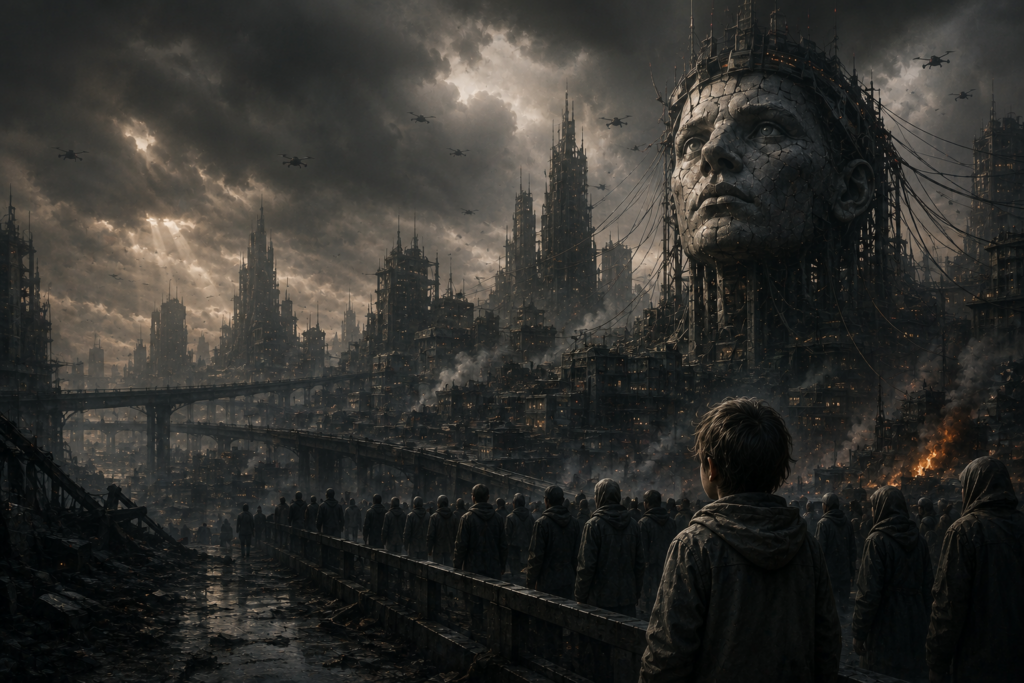

He lay still for longer than he should have.
The machine was pinned — he’d confirmed it three times, checking the neck cable, checking the sensor cluster, counting the seconds between any attempt at motor function. Nothing. The TX-CYCLE would miss its interval and somewhere a flag would increment, but he couldn’t think about that yet. He could only think about his arm.
Three cuts. The talon-scythe had caught him coming in low, when he’d committed to the deadfall trigger and couldn’t pull back. The first was shallow, across the back of his left forearm — a surface wound, bleeding freely. The second was deeper, catching the meat of the shoulder where the arm met the socket, and that one he could feel every time he moved. The third was the one he was most worried about: inner forearm, running parallel to the vein rather than crossing it, which was luck, but deep enough that the edges didn’t want to stay together.
He got to his feet slowly.
His pack was twenty yards back, where he’d dropped it before the approach. He walked to it with his left arm held at his side and retrieved the field kit — a waterproof roll that Corinne had assembled, updated every season based on what she’d found and catalogued. He knew its contents by position. Tourniquet he wouldn’t need. Irrigation syringe. Medical tape. Monofilament he’d only used twice and didn’t like using. A fold of oilcloth that held the things she dried and pressed and refused to explain until she needed to: narrow strips of plantain leaf, wound-packed and kept moist with a few drops of calendula oil, bacteriostatic enough to matter and pliable enough to hold.
He irrigated the deep cut first, which hurt enough that he had to stop and breathe. Then he pressed the plantain into it the way she’d shown him — firm contact, not wadded — and taped over it in two directions so the edges were held without compression cutting off flow. The shoulder wound he could reach well enough to tape but not to pack properly; he’d have to let Corinne see it when he got back. The surface cut he left alone. It had mostly clotted.
He rolled his sleeve back down and stood over the machine for a long time.
It was larger than it had seemed in motion. In motion it had been a threat, which made it feel fast and purposeful and calibrated to exactly the resources required to neutralize what it was tracking. At rest it was just mass: 140 kilograms, he estimated, maybe 150, distributed across six legs in a posture that was closer to collapsed than splayed. The sensor cluster on the anterior end was shattered — that had been the first thing he’d done when the deadfall pinned it, two hard strikes with a fieldstone while it was still trying to fire the secondary system. The neck cable bundle was severed at the first compression point. Whatever processing was still running internally had no output path.
He considered destroying it further. He had the means — the same fieldstone, time, and the will. He could reduce the casing, crack the chassis, expose whatever was inside and leave it scattered across the slope for weather to finish.
He didn’t.
What he kept coming back to was the TX-CYCLE interval. Fifteen minutes, stamped on the collar at the antenna mast. That meant a protocol — a regular handshake with something listening. Three missed intervals was forty-five minutes of silence before the flag escalated, maybe longer before a retrieval response was authorized and deployed. He didn’t know the escalation rules. He only knew that someone, eventually, would come to the last known coordinates.
The deadfall was fifty yards from his regular hunting approach on this slope. He had walked that approach dozens of times. A retrieval team with even basic tracking capability would read the terrain, find the chokepoint, find the trap, and read it as deliberate. Not animal. Not accident. Someone had studied the machine’s scan logic and engineered a response. And from there it was a short inference to who lives close enough to have done this.
He couldn’t leave it here.
It took him forty minutes to build the sled. He felled two straight sections of deadfall birch with the hand saw he carried — unnecessary weight he’d resented every hunting trip until now — and lashed them into a frame using wire stripped from the machine’s own neck bundle. He’d severed that cable clean, which gave him almost three meters of multi-strand wire, more than enough. The machine’s chassis had no natural attachment point, so he improvised two load loops from the wire, threading them under the leg joints where the casing created a lip, and ran the haul line from those back to a crossbar he could grip with both hands or shoulder against a tree and push.
Before he moved, he unpacked the hunting tarp — oilcloth, eight by ten feet, the color of wet bark — and laid it over the machine. He tucked the edges under the chassis where the leg joints created a lip, and secured the corners with the same wire loops he’d threaded under the frame. If someone saw the sled from a distance, they would see covered cargo. What kind of cargo, they would have to decide for themselves.
The first twenty meters told him everything about the next several hours. The sled ran well on grade but resisted anything lateral. He had to read the slope continuously, avoiding exposed root systems and boulder fields that would stop the frame dead. He moved in long diagonal traverses, adding distance in exchange for consistent grade, resting every hundred meters to let his shoulder settle.
He went east-southeast. That was the slope’s grain, not his choice — the terrain offered one path down and he took it. He was on the eastern face, the one he and Corinne kept as a buffer zone, which meant he had no reference points. The landmarks he knew were all north and west, oriented toward the cabin, toward their spring, toward the three game corridors he’d mapped over four years of patient observation. Out here the trees were different — more birch, less conifer, suggesting a different drainage pattern — and the light came at angles he didn’t read by habit.
He worked. He didn’t let himself think beyond the next obstacle.
The road appeared without preamble.
He came through a stand of birch and the treeline simply stopped. Ahead was a graded track, unpaved but clearly maintained — the crown was fresh, the drainage cuts clean. No signage. No kilometer markers. He looked both directions and saw nothing: the road curved north within a hundred meters on one side, and south it ran straight for at least a quarter mile before a hillside took it from view.
He looked at the tire tracks in the soft earth at the road’s edge. Wagon-gauge, narrow. Human-powered or light animal, not motorized — no tread differentiation, the impressions smooth. Someone used this road regularly enough to have worn a rut, but not so heavily that it had been widened or improved beyond the initial grade.
He did not know this road existed.
In four years, he had mapped everything within a reasonable radius of the cabin — not with any instrument more precise than his own pace count and compass, but thoroughly, systematically, the way a man maps terrain when the map is the thing that keeps him alive. This road was not on that map. Either it was new, or it had been deliberately kept from the county records that passed through the anonymous channels he occasionally accessed, or both.
He understood then that he was further east than he’d thought. He’d drifted on the diagonal traverse, the grade pulling him steadily in a direction he hadn’t been tracking precisely enough.
North went home. He couldn’t go north — not with this thing on the sled behind him, not along any route that could be backtracked, not until he’d solved the problem of what to do with it. Going home with the machine meant drawing whatever came looking directly to the cabin, and that was the one outcome he was not willing to accept.
South was unknown. That was the only thing south had going for it.
He crossed the road and kept to the verge on the south side, dragging the sled on the grass rather than the graded surface to avoid leaving obvious track. His shoulder had stiffened during the rest. He walked through it.
He smelled it before the road curved far enough to show him anything.
Woodsmoke — old and layered, the kind that came from fires banked and tended over years, not a single hearth. And underneath it something that took him a moment to place: the fermenting-sweet smell of a large composting operation, biological in a way that wasn’t unpleasant but was distinctly intentional. Someone managing soil at scale. Corinne would have named what they were growing from the smell alone. He only knew it was organized.
He stopped.
He knew where he was. Not from a map — there was no map — but from the accumulated secondhand knowledge of a man who listened carefully to things said in passing, who read the shape of avoidance in other people’s conversation. He and Corinne had heard the name twice, from two different sources, both times in the context of you don’t want to go out that direction. Neither source had elaborated. Neither had needed to.
Hollow Creek.
He stood at the road’s verge with the sled behind him and thought about turning around. He thought about it seriously, the way he thought about anything that mattered — laying out the options, assigning costs, following each branch to its consequence. Going back north meant the machine came with him or he found somewhere to cache it, and there was nowhere on this slope he trusted as a cache. Going further south meant going deeper in, past whatever threshold he was currently standing at. Standing still was not an option; his shoulder was stiffening and the slope he’d just come down would be significantly harder to climb than it had been to descend.
He adjusted his grip on the haul line and started south again.
The threshold was marked the way thresholds are marked when the people marking them don’t want to seem like they’re marking anything: a row of stones along the road’s left edge, smoothed river cobbles, evenly spaced, continuing for about thirty meters before stopping. On the right, a carved post — old growth, the carving weathered — that he might have taken for a fence stake if he hadn’t been looking. He was looking. The post was carved with a single notch at eye level, and below it a second, shorter notch at an angle. He didn’t know the grammar but he recognized syntax.
He crossed.
The man stepped out of the tree line thirty seconds later, on the right side of the road, approximately where Nate would have positioned a sentry if he were building perimeter coverage and wanted to have the high angle without being skylined. He was in his mid-fifties, thick through the chest and shoulders, wearing work clothes that were clean enough to suggest they weren’t work clothes he’d been working in that day. He carried nothing visible, which told Nate something about where his hands were and what else he might be carrying.
He looked at Nate. He looked at the sled and the tarp-covered shape on it.
“Come alone?” the man said.
“Yes.”
A pause. The man read the shape of the tarp the way an experienced person reads anything covered — estimating dimensions, weight, what geometry required that much covering. He didn’t ask. He stepped further out of the tree line and gestured south, toward the smell of woodsmoke and the sound, now that Nate was quiet enough to hear it, of water moving over stone.
“Come on then,” the man said.
The settlement resolved slowly as they walked — a cluster of structures visible through the trees, smoke from two directions, a garden that was significantly larger than what two people would need. The road became a lane and the lane widened into what passed for a common: packed earth, a well with a hand pump, three or four outbuildings arranged around a central space with the pragmatic geometry of people who had thought carefully about sightlines and weather.
A woman was crossing the common with a basket when they came in from the lane. She was maybe sixty, moving efficiently, and she saw Nate first — a stranger, bloody at the shoulder — and then the man beside him, and then the sled.
Nate pulled the tarp.
He did it because it needed to be done here, in front of whoever was present, not on his terms but in the open — because the alternative was the tarp coming off at a moment he didn’t control, and a covered thing revealed without warning was more frightening than a revealed thing standing still in daylight. He’d thought about this on the road. He gripped the near corner and pulled, and the oilcloth came away in one motion, and the UL-4 lay there on the sled: six legs, shattered sensor cluster, the cable bundle he’d severed hanging like a cut nerve from the neck housing, the chassis dull and jointed and entirely wrong in this space the way all machine things were wrong here.
The woman looked at it. Her hand released the basket’s handle. The basket hit the ground and she followed it — not a fall, exactly, more a descent, her knees going in sequence, and then she was in the dirt with her hand pressed flat against the earth like she needed to confirm it was still there.
No one moved for a moment.
Then the man — he was at Nate’s shoulder now, close enough that Nate heard him breathe out through his nose — said, very quietly, “You need to tell me what you’ve done.”
It wasn’t a question. It was barely even directed at Nate. It was the sound a man makes when he is deciding how angry he is allowed to be before he understands the full shape of the problem he’s just inherited.
Across the common, a door opened. Someone had heard the basket fall.
“Inside,” the man said, and this time it was directed at Nate, and there was no ambiguity in it at all.
He looked once more at the machine on the sled — the dead weight of it, the silence of its missed intervals, the certainty that whatever came looking for it would not stop at the road’s edge — and Nate could see the moment it became his community’s problem instead of a stranger’s. He could see the man accept it. He didn’t look pleased about it. He looked like a person who understood exactly what accepting it meant, and was doing it anyway because the alternative was not accepting it, and that was worse.
“Inside,” he said again, and walked toward the nearest door without looking back to see if Nate followed.