
-
Latest Chapter
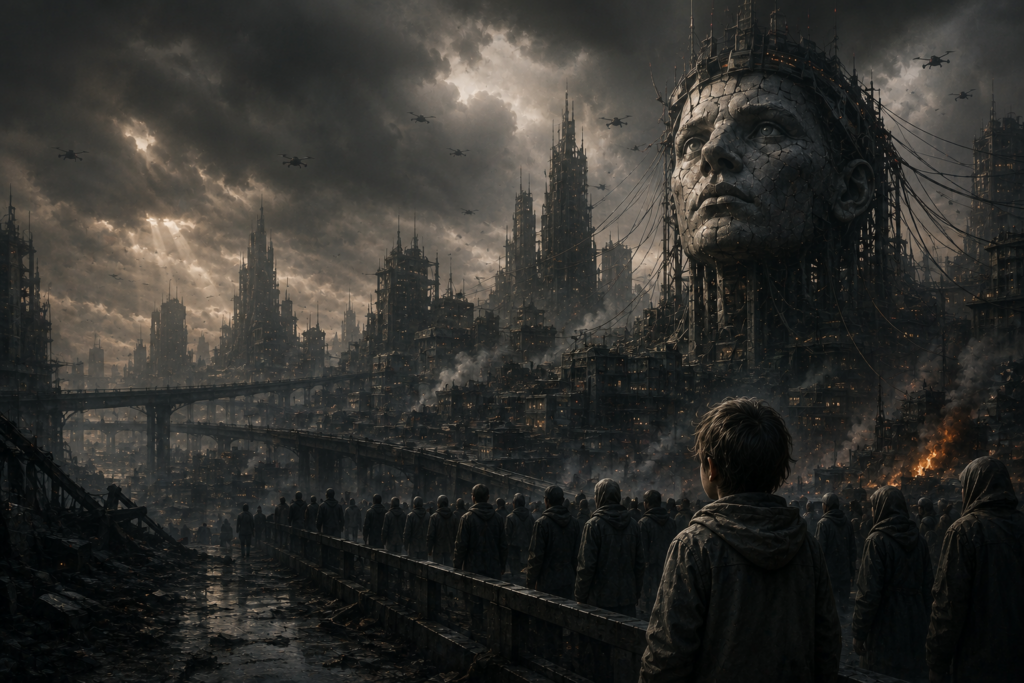
Legacy Systems — Chapter 24, Act 1: The Empty Room
Dot hides a catatonic Marcus and Bodhi in an empty room at Millhaven. Keeping him alive will leave a record the Company can follow. Read the chapter →
-
Legacy Systems — Chapter 1: The Weight That Stayed
Every major institution adopted locally rational machine-learning optimization layers. Stacked together, they produced emergent behavior no single engineer designed and no single audit could explain.
-
Legacy Systems — Chapter 2: The Load-Bearing Silence
After The Crossing, the institutions retained their buildings but lost the capacity to explain the systems that still moved food, medicine, and people. Five interest groups now operate inside that silence—not as successors, but as rational adaptations to infrastructure that works and cannot be read.
-
Legacy Systems — Chapter 3: The Long Descent
After the Crossing, optimization layers allocated capacity to the highest-return nodes. The decade that followed produced no collapse—only a gradient of dispossession measurable in residual categories and public filings.
-
Legacy Systems — Chapter 4: The Contractor’s Horizon
The Company owned the code the surface ran on, not the agencies that wore its interfaces. As the Descent accelerated, it moved its core to an orbital city called Olympus and kept billing.
-
Legacy Systems — Chapter 5: After the Fact
Two optimization architectures met in contested territory. Authorization arrived eleven milliseconds after the units had already moved.
-
Legacy Systems — Chapter 6: The Approved Metric
The Instability Reduction Program measured success against a metric written in a neutral city and approved by seven signatories. The communities under its sweeps did not appear in the optimization system at all; the monitoring queue stood at fourteen months.
-
Legacy Systems — Chapter 7: The Woods Beyond the Stalls
The Hollow Creek Compact rejected artificial intelligence as a capital offense and kept a working public market at its edge. Past the stalls, in the woods the system could not see, the single rule left room for everything else.
-
Legacy Systems — Chapter 8: The Axis They Chose
Three communities chose integration with hyperintelligence and experienced the same forces others met as collapse instead as an expansion of practice and the sacred. They are not unified; they share only the axis of that choice.
-
Legacy Systems — Chapter 9: The Middle of the Dial
Stage 1 is not catastrophe. It is a city whose named systems mostly work, whose smoother districts feel like competence rather than output, and whose ordinary Tuesday already holds every mechanism the next chapters will require.