Anthropic is easy to reduce to “the Claude company.” That misses the operational point. What matters now is not just model quality, but how Anthropic is packaging long context, tool use, web search, computer use, deployment flexibility, and trust-oriented controls into a stack that can support real business workflows.
For operators, that matters because the hard part of AI adoption is rarely generating text. It is building systems that can work across messy documents, live tools, human review steps, and risk controls without turning every implementation into a bespoke engineering project.
Why Anthropic matters in live operating environments
Anthropic is strongest where organizations need AI to do more than answer questions. It is increasingly relevant for teams that need an agent to:
- work through long policy or process documents
- use tools against internal systems or approved external services
- search for up-to-date information when static model knowledge is not enough
- preserve a human review step for sensitive actions
- fit inside a security and governance conversation instead of sitting outside it
That combination is useful in environments like legal operations, healthcare administration, cybersecurity triage, internal support, and software delivery.
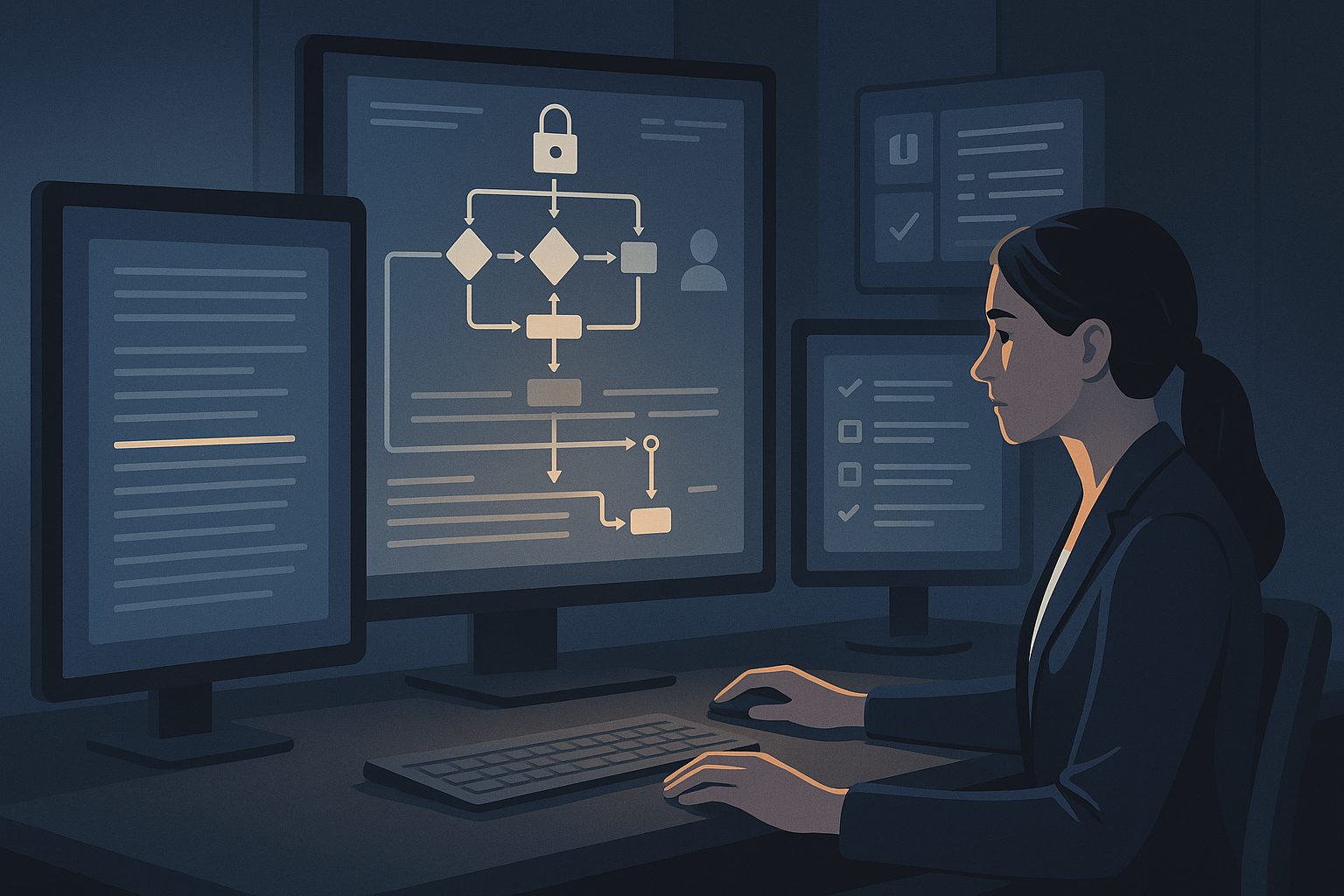
Imagine a compliance team reviewing vendor packets, policy exceptions, and changing regulatory guidance. A plain chatbot helps a little. A governed AI workflow helps more: retrieve internal standards, compare them against uploaded documents, pull current external guidance when needed, flag gaps, draft an analyst-ready summary, and route edge cases to a human approver. That is the level where Anthropic starts to matter.
The timely signal right now
Anthropic’s February 2026 announcement for Claude Opus 4.6 matters less as a benchmark story and more as a capability story. The company positioned it around agentic coding, computer use, tool use, search, and finance—basically, the parts of AI that touch live work instead of static demos.
Its current platform documentation reinforces that direction:
- Claude models are available across Anthropic, AWS Bedrock, and Google Vertex AI
- current flagship models support up to 1M-token context windows for complex documents and codebases
- tool use, web search, and computer use are first-class parts of the stack
- prompt refinement, eval-oriented development practices, and deployment guidance are increasingly explicit in the docs
That makes Anthropic more relevant to implementation teams than to prompt hobbyists.
Where the business value becomes concrete
The operational value is not “better chatbot responses.” It is better workflow design.
1. High-context decision support
Anthropic is well suited for operating environments where the source material is large, fragmented, and easy to mishandle. Long context windows help when teams need to reason across contracts, SOPs, codebases, case files, knowledge bases, or policy libraries without excessive chunking and stitching.
That can reduce review time and improve consistency in tasks like policy interpretation, contract or intake packet analysis, internal knowledge support, engineering review, and executive briefing synthesis.
2. Tool-connected workflows instead of isolated chat
Anthropic’s tool use support matters because most business value comes from systems that can act inside a process. A useful agent may need to query a database, call an internal service, open a case, fetch web evidence, or hand work to another system. That turns Claude from an answer engine into a workflow component.
3. Better fit for guarded autonomy
Computer use is still a beta-style capability and should be treated carefully, but it points toward a practical model for semi-autonomous operations: the system can navigate interfaces, collect state, and complete bounded tasks while humans stay in control of meaningful approvals. For enterprise teams, that is often the right posture. Not full autonomy. Not pure chat. Controlled execution.
4. Governance and trust posture
Anthropic continues to position security, data handling, jailbreak resistance, and enterprise deployment options as core differentiators. Whether a buyer fully agrees with the marketing or not, the focus is directionally correct. AI adoption slows down when security, legal, and operations teams cannot see how the system will be governed. Anthropic at least gives those stakeholders a more legible starting point.
Why it matters versus alternatives
Compared with a narrow SaaS copilot, Anthropic offers more architectural headroom. Compared with assembling a fragmented stack from scratch, it can reduce integration and orchestration burden at the model and tooling layer.
That does not mean Anthropic is automatically the best choice. It means Anthropic is especially relevant when an organization wants strong reasoning and long-context performance, tool-enabled agents rather than chat-only interfaces, deployment flexibility across managed and hyperscaler channels, and a more explicit trust and control narrative for enterprise adoption.
If the main need is ultra-low-cost inference for simple classification, other providers may fit better. If the main need is a highly modular routing fabric across many model vendors, a provider like OpenRouter may play a more central role. But if the question is how to stand up high-trust AI workflows without losing sight of governance, Anthropic belongs on the shortlist.
Realistic operating patterns
- Cybersecurity operations: summarize alerts, retrieve internal runbooks, gather current external threat context, and prepare analyst-ready investigation notes
- Healthcare administration: assist with intake review, policy-backed coordination workflows, and exception handling while keeping humans in the approval loop
- Software delivery: support code review, architecture exploration, debugging, and agent-assisted development workflows with large-codebase context
- Knowledge operations: turn scattered documentation into decision support for support, operations, legal, and project teams
These are the implementations that tend to survive procurement and executive review because they tie AI to throughput, consistency, and risk reduction.
Bottom line
Anthropic matters because it is becoming more than a model vendor. It is becoming a plausible operating layer for organizations that need AI to reason across large context, use tools responsibly, and fit inside a real governance model.
That is a more useful lens than asking whether Claude sounds smart in a demo. The real question is whether the provider helps your organization deploy AI in ways that are usable, reviewable, and operationally defensible. Anthropic increasingly does.
If your team is evaluating where Anthropic fits—and where workflow design, governance controls, or implementation discipline matter more than raw model enthusiasm—Q52 can help. Our Operational Enablement services and the Q52 Diligence Framework help assess AI readiness, implementation risk, governance needs, and operational fit before those decisions get expensive.
Sources: