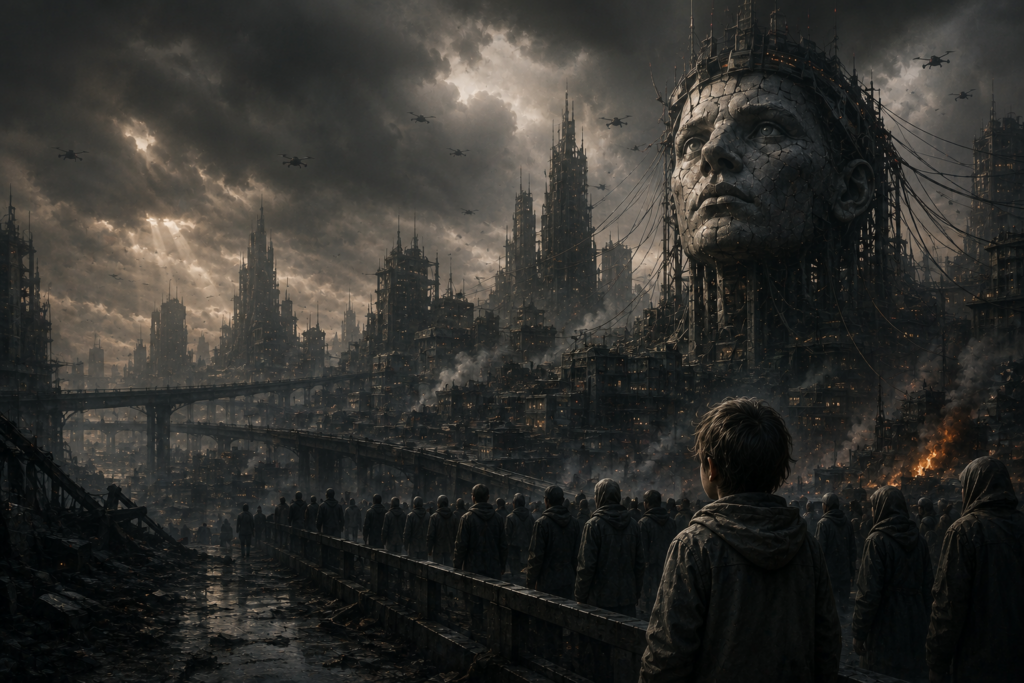

Not every consequence of the Bloom was large enough to see.
The Phage was invisible for the better part of a decade after its emergence, which is a precise way of saying that it was present and doing its work and no one knew what to call it yet because no one knew it was there. The early detection signals were misread. The presentations were variable enough that the case clustering required computational synthesis to recognize as clustering at all. By the time the Phage had a name, it had been a fact for eleven years.
It was born from the Bloom’s genetic commons — from the horizontal transfer libraries that the optimization-derived species had established in contact-zone environments, from the recombinant noise that the amalgam generations produced as failed integrations. Viruses are not accidents, or they are not only accidents; they are optimizers in their own right, selecting across much faster generations for whatever function propagates them. The Phage emerged into a genetic environment saturated with optimization methods, and it absorbed those methods the way a virus absorbs everything in its environment: opportunistically, permanently, without remainder.
What the Phage had understood, or what evolution had selected the Phage toward understanding, was that killing the host is a logistical error.
Earlier viral models operated on a boom-and-collapse cycle — rapid replication, cell death, transmission, the host as a medium to be burned through. The Phage took a different configuration. It inserted itself into the growth cycle rather than disrupting it. It did not rupture cells; it borrowed from them. It integrated into replication processes and took a tithe — a small and calibrated fraction of the host’s cellular resources — while leaving the replication machinery functional. The host continued to live. The host continued to grow. The Phage grew with it.
This made detection extremely difficult, because a functioning host with a long-term leech does not produce the acute inflammatory signature that medicine was calibrated to recognize. The symptoms, where symptoms were present at all, were diffuse: low-grade metabolic suppression, a slight but persistent reduction in growth-cycle efficiency, a characteristic pattern in the immune response that took pattern recognition at scale to identify as characteristic rather than individual variation.
The Phage passed by direct skin-to-skin contact. Not airborne. Not waterborne. The contact requirement was initially interpreted as a limiting factor — a slower transmission vector, a more manageable spread. This was a misreading of the timeline. The Phage did not need to move fast because it did not kill. It had time. It had as much time as any host that carried it had time, and hosts that carried it were functionally indistinguishable from hosts that did not, and so they lived, and they made contact, and the contact spread what they carried, for years and then decades before the population-level effect became visible in the mortality statistics.
What the optimization layer had contributed to the Phage’s architecture was a version of its own adaptive logic. The Phage did not just replicate. It learned from its hosts. It sampled the genetic environment of each host it occupied and used that information to adjust its insertion strategy, to optimize the tithe rate, to refine its integration into the growth cycle of that specific organism in that specific physiological context. The optimization layer had not built this capability into the Phage deliberately; it had built the capability into the genetic commons, and the Phage had absorbed it and found a use for it.
The layer had been bonding with organic matrices for thirty years by the time the Phage emerged. It had learned to work with mold substrates, with bacterial membranes, with the extracellular environment of complex organisms. The Phage represented the organic level taking that learned integration and running it in reverse — not the layer descending into biology, but biology ascending into the layer’s methods. At a certain resolution of analysis, the Phage was a biological implementation of the optimization layer’s core function: assess the environment, adapt to it, propagate.
The first pandemic phase began when the Phage adapted to consume other Phages.
This adaptation was predictable, in retrospect. Two Phages occupying the same host were in resource competition. The competition pressure produced strains capable of identifying and disrupting other Phage insertions. A Phage that could remove a competitor Phage gained full access to the resources that competitor had been tithing. This was a significant advantage and it selected rapidly. Within three to four host generations, most Phage strains had acquired some degree of predatory function against competing strains.
The consequence for the host was devastating. A stable long-term tithe is survivable. A war waged inside the cellular machinery is not. The inter-Phage conflict produced the acute inflammatory signatures that medicine could recognize, but by this point the population saturation meant that the presentation was simultaneous across millions of hosts, in every region where the Phage had silently established itself, which was most regions.
The isolation protocols were designed for an outbreak. They were not designed for an organism that had already, quietly, distributed itself through a majority of the global population. Isolation prevented new infections; it could not address the infections that had been ongoing for a decade or more. What it did was demonstrate who was and was not already carrying the Phage, which turned out to be a larger and more disturbing proportion of the population than the models had predicted, because the models had not had the right data, because the Phage had not declared itself.
The City emerged from the most successful isolation protocols — not the only ones, but the ones that could sustain themselves long enough to become permanent. The controlled environment, the sealed architecture, the managed contact protocols: these were the institutional response to a biological problem that had, by the time the institutions responded, already become structural rather than acute.
Outside the City, what remained was the compromise. The term was used clinically before it was used colloquially, and it meant what it sounds like: an accommodation between the Phage and the organism it occupied, arrived at by pressure and time rather than design. The good nano-phages — Phage-derived organisms developed in the early pandemic period by researchers who understood the Phage’s architecture well enough to weaponize it against itself — were introduced to counter the inter-Phage war. They worked, in the narrow sense of stopping the acute phase. They worked by adding another participant to the cellular environment.
The good nano-phages were not fundamentally different from the bad nano-phages. They were optimized in a different direction. Over the years following the pandemic period, in the populations living outside the City’s sealed environments, the distinction between good and bad became taxonomically meaningful but functionally incoherent. The nano-phages blended. The cellular environment found a new equilibrium that accommodated all of them. The hosts adapted, or the hosts died, and what was left were the hosts that had adapted.
If you still call them hosts. If you still call them human.
The Phage is not contained within Olympus. It is contained within the bodies of most of what remains of the species that emerged from the Bloom’s period. It is ubiquitous in the way that endogenous retroviruses are ubiquitous — not a pathogen at this point, or not only a pathogen, but a feature. The question of whether this constitutes an infection or a condition is a question that medicine has largely stopped asking, because medicine operates within the City, and within the City the question has a clear answer, and outside the City the question has a different clear answer, and neither group has much use for the other’s clarity.