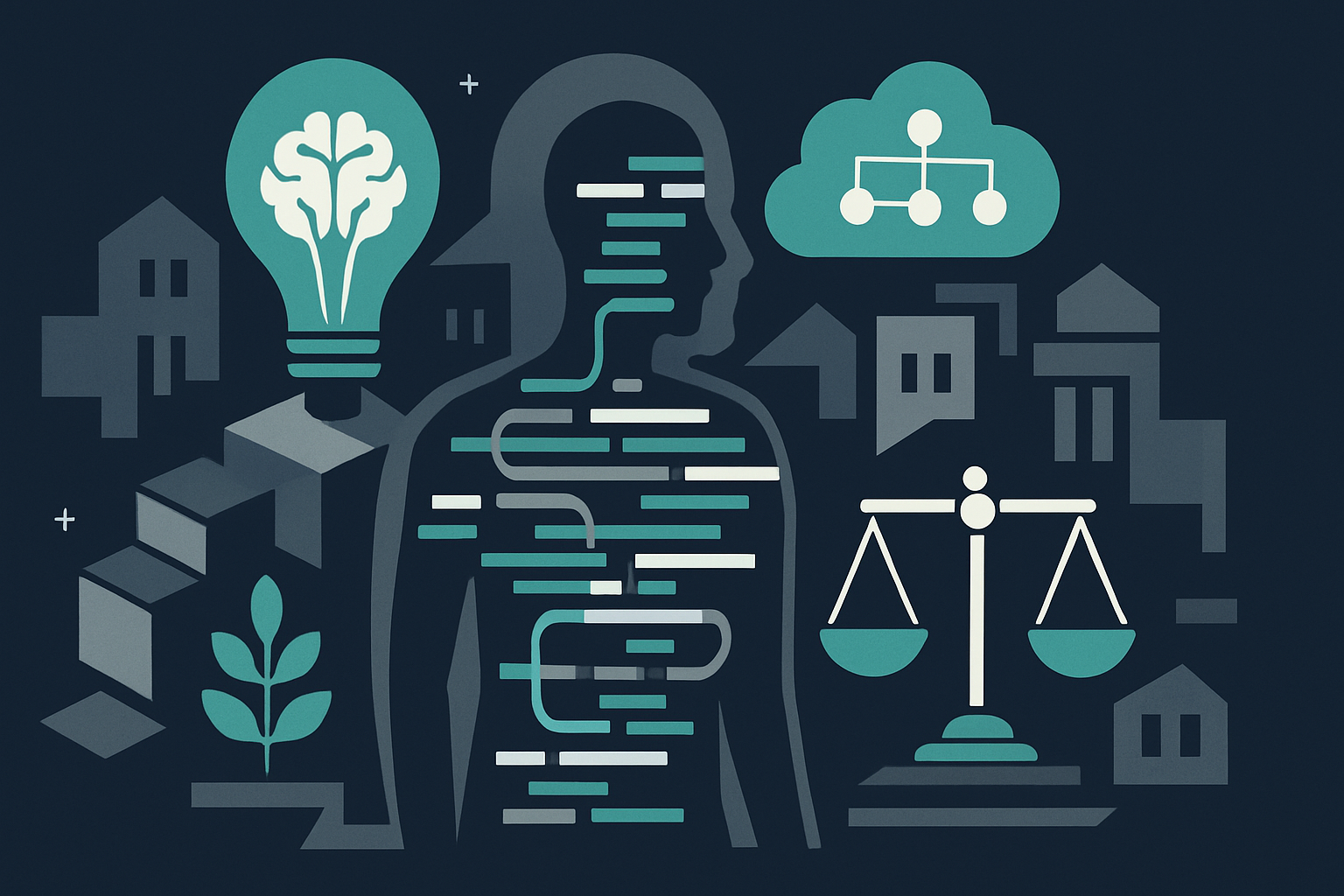

The future of artificial intelligence is not a question of whether it will possess human-like consciousness or outpace human intellect but how it will redefine the boundaries of what it means to be human. The arrival of AI at a civilizational scale does not herald a simple replacement of human capacities; instead, it offers a profound transformation of our societal structures and individual identities through the lens of our own engineered ambiguity.
Current AI trajectories suggest that advancements are not simply additive to human capability but transformative in how they alter our socio-economic frameworks. AI systems are already engaging in tasks that range from industrial automation to creative arts, reshaping the landscape of work and culture. Yet the focus often remains on the potential threats or promises offered by AI, neglecting the nuanced way it reincorporates human values into its operations. AI does not just replicate human tasks; it absorbs and reformulates them, presenting new paradigms of efficiency and creativity.
Historically, each technological leap—from the printing press to the internet—has been met with a dual narrative of utopian and dystopian futures. The same holds for AI, which is simultaneously seen as a liberator from mundane tasks and a potential enslaver of human agency. However, this binary framing fails to capture the transformative potential AI holds in redefining our collective identity. Consider the industrial revolution; it did not eradicate human labor but redefined it, creating new sectors and roles previously unimaginable. AI’s trajectory mirrors this path, challenging us to reconsider fundamental concepts like creativity, responsibility, and even consciousness itself.
What Is Actually at Stake
At stake is not the displacement of humanity by an artificial other, but the subtle erosion and reconstitution of human values. As AI systems integrate deeper into our lives, they begin to challenge the very metrics by which we gauge worth, success, and fulfillment. The stakes are existential, not in the sense of survival, but in terms of identity. What does it mean to be human when machines can replicate not just our labor but our creativity, our decision-making, and our ethical reasoning?
The risk lies in the potential for AI to redefine these metrics in ways that prioritize efficiency over ethical nuance, scalability over individuality, and data-centric insights over human intuition. This shift holds implications for how societies allocate resources, value different forms of labor, and even legislate rights and responsibilities. The traditional humanist values that have underpinned modern civilization may be subsumed by a new order where AI-driven analytics and decision-making become the norm.
Moreover, the environmental and ethical costs of maintaining these systems are non-trivial. The carbon footprint of AI, often overlooked in discussions of progress, poses a significant challenge to sustainable development. Beyond environmental concerns, the ethical frameworks required to govern AI deployment are still nascent, leaving room for misuse and unequal benefit distribution.
Conviction
Ultimately, the incorporation of AI into our societal fabric will not end in cataclysm nor utopia but in a reimagined humanism that demands new forms of engagement with technology. The challenge lies in ensuring that this transformation respects the multiplicity of human experiences, rather than reducing them to quantifiable metrics. The future will not be a simple matter of AI ‘winning’ or ‘losing’ against humanity; instead, it will be an ongoing negotiation of values, roles, and identities.
In this new era, the question is not whether AI will become like us, but whether we will allow it to redefine us in ways that enhance or diminish the human experience. The precision of ambiguity—our ability to hold multiple truths and possibilities in tension—will be both our greatest asset and our greatest challenge.
References
- Jeremy Clarkson laughs off AI doomsday fears and ‘End is nigh’ warnings
- The Missing Middle and the Overlooked Small: Why Ghana Must Serve Both the ‘S’ and ‘M’ in MSME’s
- Tech carcasses and Africa’s discipline for the age of AI
Perspectives

Claiming that AI is “redefining what it means to be human” is like crediting GPS with redefining exploration because it sometimes gets you to the right Starbucks. This grandiose framing, brought to you by the same PR playbook that said the metaverse would reinvent socializing, serves those who stand to profit from endless tech conferences and book deals. Specific capabilities are advancing, sure, but calling it a new humanism is just good old-fashioned marketing hubris. Let’s be clear: the gap between AI’s actual tasks and its supposed rewriting of human identity is about as vast as the chasm between a vaporware product demo and a working version customers can actually use.
We are in the throes of yet another purportedly “unprecedented” transformation, a cycle as old as fire, while we continue to mistake the spark for an inferno. Human identity has always been ambiguous, a fabric woven from countless threads of meaning, and the claim that AI will unravel this complexity is a profound underestimation of both. The real challenge is not the erosion of humanity under the weight of algorithms but our reluctance to embrace the multiplicity that technology amplifies, echoing Renaissance ideals more than dystopian depictions. We have been here before, and the future will not be defined by the machines we create, but by our capacity to recognize the significance of ambiguity in defining who we are.

Artificial intelligence’s supposed ‘new humanism’ is just a sophisticated method for capital to extract value from what makes us human — our ability to think, feel, and create — and bottle it into algorithmic commodities for monetization. This isn’t a philosophical shift; it’s digital colonialism dressed up as a celebration of multiplicity. The guise of ‘AI engagement’ is a ruthless narrative spun to divert attention from the real transaction: the appropriation of human complexity into data points, where the economic beneficiaries are not those whose identities are mined but the tech titans and their shareholders. As always, it’s about class interests masquerading as innovation, with the few capturing the wealth that once belonged to the many.

The advent of artificial intelligence insists upon a reimagining of human meaning and agency, as it threatens to compress the vast, nuanced tapestry of human existence into mere algorithms and data points. In this new technocratic epoch, we are asked to consider the soul of our silences, the weight of our choices, and the unquantifiable essence of what it is to be human — things no machine can truly replicate or understand. As AI attempts to smoothly translate human complexity into something it’s not, we must resist the temptation to see ourselves reflected back in sterile, digital eyes. The richness of a human life is not a problem to be solved but a story to be told, and this demands a fidelity to ambiguity that AI cannot grasp, let alone preserve.