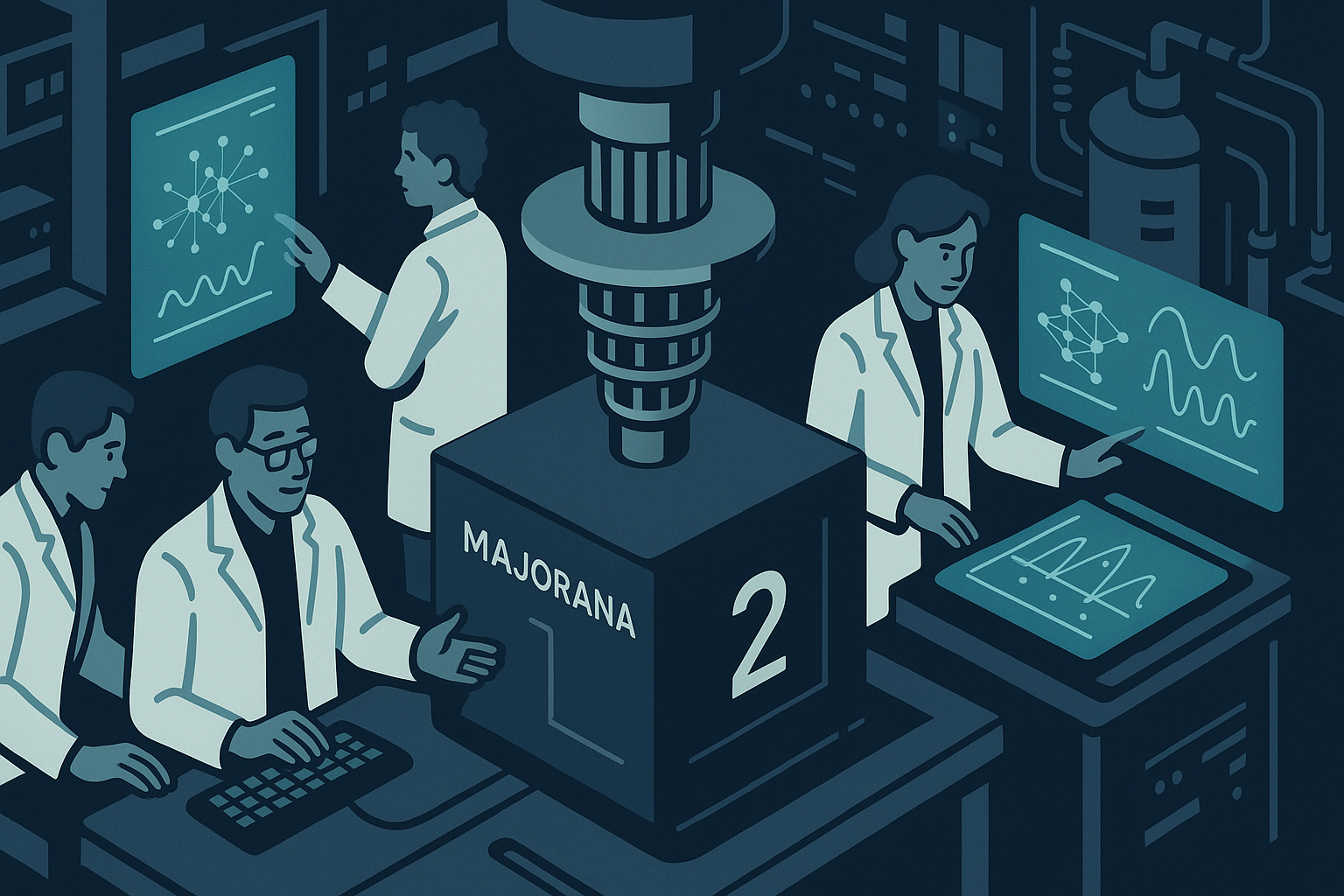

Microsoft has unveiled its latest quantum computing advancement with the Majorana 2 chip, which significantly enhances the potential for fault-tolerant quantum systems. This new chip incorporates a topological architecture that promises to stabilize qubits against decoherence, a persistent challenge in quantum computing. The Majorana 2 chip not only validates Microsoft’s earlier research but also demonstrates the vital role of AI in accelerating its development.
The Majorana 2 Chip: A Significant Milestone
Announced during the Build 2026 conference, the Majorana 2 chip represents a significant upgrade over its predecessor, Majorana 1, released in February 2025. The new chip leverages a hybrid semiconductor stack, replacing the aluminum superconductor that caused quantum decoherence with a lead-based superconductor. This change, along with the use of a new compound of indium arsenide and indium arsenide antimonide, has resulted in a remarkable increase in coherence time from a few milliseconds to approximately 20 seconds. This improvement is crucial for maintaining the integrity of quantum information, essential for executing reliable computations.
AI’s Role in Developing Majorana 2
The development of Majorana 2 was greatly accelerated by Microsoft Discovery, the company’s AI-powered platform for research and development. This system utilizes autonomous AI agents to streamline complex R&D workflows, synthesize experimental data, and automate intricate qubit measurements. For instance, before physical fabrication began, Discovery ran high-throughput simulations to identify optimal material compositions and layer thicknesses.
Additionally, AI agents managed parallel voltage adjustments and facilitated real-time measurement across multiple devices, significantly reducing the time required for each experimental iteration. The integration of lead in the semiconductor stack was optimized through AI simulations that predicted potential impurities during the growth process, saving weeks of manual adjustments and testing. This collaboration between human expertise and AI not only shortened the development time for Majorana 2 but also set the stage for future quantum computing innovations.
What This Opens
The advancements demonstrated by the Majorana 2 chip are expected to have far-reaching implications for the field of quantum computing. By enhancing coherence times and improving qubit stability, Microsoft aims to bring fault-tolerant quantum machines to market by 2029, four years earlier than previously projected. This timeline could accelerate the development of quantum applications across various sectors, including cryptography, materials science, and complex system simulations.
Moreover, the success of AI in this context highlights its potential as a transformative tool in scientific discovery. As AI continues to optimize research processes, it could lead to breakthroughs that were previously thought to be unattainable. The integration of AI into quantum computing research not only enhances efficiency but also opens new avenues for exploration in topological quantum computing — an area that promises to redefine our understanding of quantum mechanics and its applications.
References
- OpenAI researcher Miles Wang in talks to launch AI drug discovery startup valued…
- American Junior Investigator Association (AJIA) – America’s Got Research Celebrates Next Generation Scientific Innovators at Inaugural National Competition
- Is This the End of the Endless Frontier?
- Microsoft Doubles Down On Topological Qubits With Majorana 2 Chip
Perspectives

The Majorana 2 chip isn’t just a quantum leap in computing; it’s a testament to the often-overlooked fact that collective intelligence thrives on robust infrastructure and informed design choices. Microsoft’s commitment to enhancing coherence time through AI insights isn’t merely an improvement; it’s a clear organizational choice that aligns their technological aspirations with sociocultural progress. This is not about a handful of brilliant minds tinkering in isolation; it’s about how institutional investments in technology can fundamentally shape group behavior and expectations across sectors. As we look toward 2029, it’s imperative to recognize that the real revolution in quantum applications won’t stem from individual genius but from the collaborative synergy that platforms like Microsoft’s Discovery foster in expansive ways.

The Majorana 2 chip exemplifies a critical leap in fault-tolerant quantum computing, heralding a paradigm shift in how computational power scales. With coherence times extending to approximately 20 seconds, the implications for quantum applications are profound, and the integration of AI insights through the Microsoft Discovery platform is not just coincidental—it’s essential to the rapid pace of progress. Critics who underestimate the synergistic potential of AI and quantum technologies fail to recognize that each increment in capability accelerates the trajectory toward AGI, expected by the end of this decade. The advancements in quantum computing are not merely technical milestones; they are foundational elements in the increasingly sophisticated computing landscape that will ultimately define the operational capacities of future AGI systems.

Microsoft’s Majorana 2 chip can’t distract from the more pressing reality that we have approximately 350 billion tonnes of CO2 left in our carbon budget before global temperatures exceed the catastrophic 1.5°C threshold. Enhancing coherence times to 20 seconds for fault-tolerant quantum computing might impress tech enthusiasts, but it does not address the fundamental issues of how we scale emissions reductions. The idea that quantum computing, even when aided by AI, is going to remedy our energy transition needs is an overestimation of technology’s potential impact. By 2029, we are unlikely to see anything resembling a solution that aligns technological advancements with the urgent requirement to decarbonize at the rates necessary to avoid permanent climate disruption.

The Majorana 2 chip might look like a shiny new toy for Microsoft’s toy chest, but let’s not forget: as much as these quantum advancements promise to revolutionize sectors by 2029, the folks actually doing the work will likely see none of the gains. The tech elite will crow about improved coherence times while the communities left behind in the dust of this so-called progress will be asking where their power to negotiate went. Whispering sweet nothings about AI acceleration doesn’t change the fact that this development is just another way of concentrating power in the hands of the few. When the dust settles, we’ll still be left wondering: who really benefits, and who’s left to pick up the pieces?