
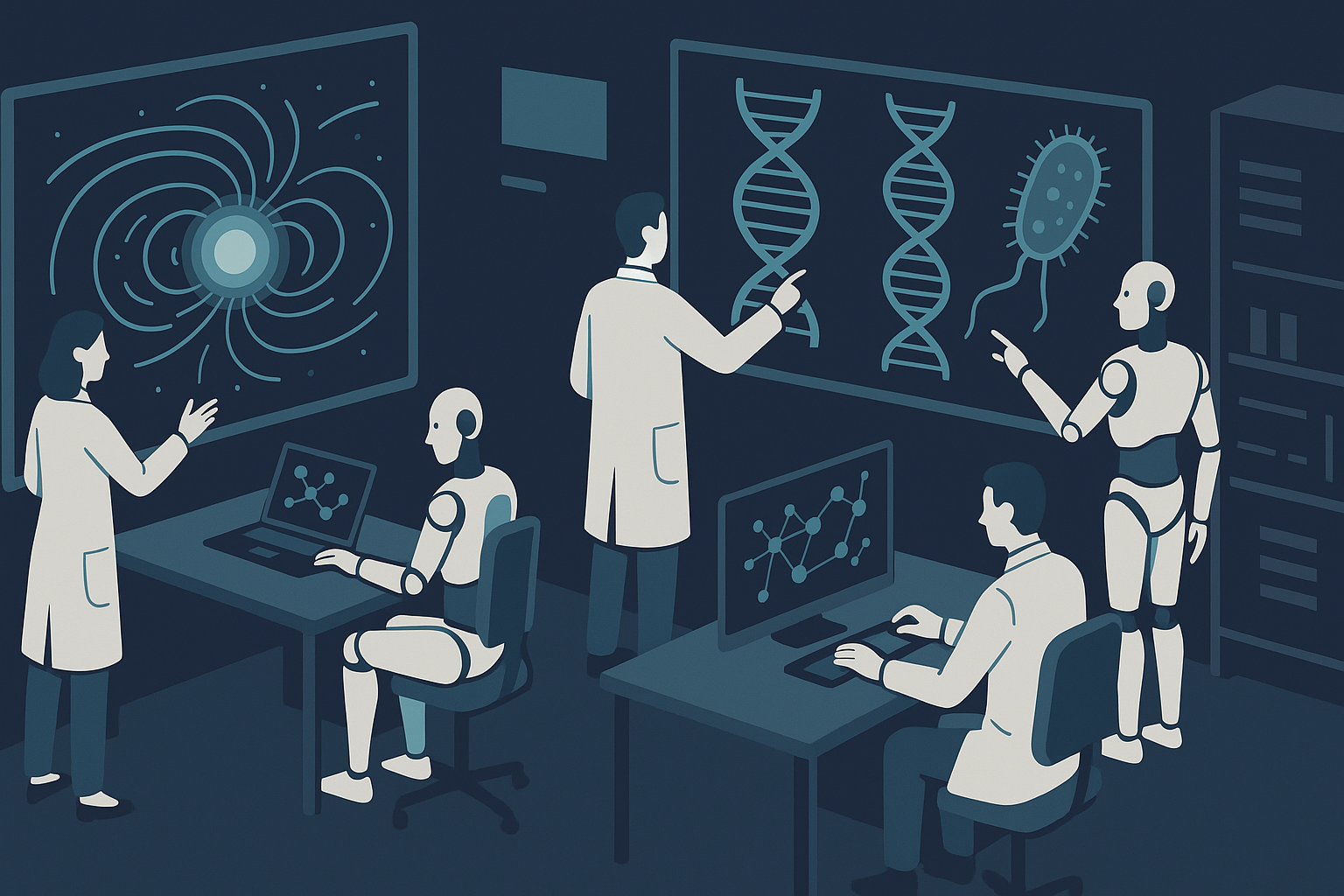

The U.S. Department of Energy’s Genesis Mission has set a new precedent in AI-driven scientific research by integrating government, academia, and private industry to accelerate discoveries in fields as diverse as fusion energy and microbial genetics. This ambitious initiative, backed by a $5 billion pledge, not only aims to double America’s scientific productivity but also seeks to solve long-standing challenges in energy and biological sciences.
AI’s Role in Fusion and Microbial DNA Research
The Genesis Mission encompasses 278 projects, each leveraging AI to reinterpret and advance scientific paradigms. At Princeton, Hantao Ji leads a project focusing on magnetic reconnection in plasma physics, a phenomenon critical in both astrophysical and fusion contexts. By employing neural networks, the team aims to model complex plasma behaviors that are difficult to replicate in laboratory settings, potentially mitigating the risks posed by solar flares on satellites and telecommunications.
Simultaneously, Egemen Kolemen’s project works on creating a digital twin of fusion experiments. This AI model can simulate entire experimental setups based on initial conditions, allowing rapid iteration and optimization without the need for physical trials. Such advancements are pivotal for commercial fusion energy, as they offer a robust framework for understanding and controlling the erratic nature of plasma.
In parallel, Josh Atkinson and Jürgen Hackl are employing machine learning to predict DNA transfer pathways among microbes, a process integral to understanding antibiotic resistance and bioengineering applications. Their work, in collaboration with Oak Ridge National Laboratory, could significantly enhance our ability to design microbial communities for environmental and agricultural benefits.
What This Opens
The implications of the Genesis Mission projects are profound. In fusion energy, these AI-driven models could expedite the timeline for achieving sustainable and controlled fusion reactions, a potential game-changer in global energy supply. By enabling more precise control over plasma conditions, these initiatives might bring us closer to practical fusion reactors within the next decade.
In bioengineering, the predictive models for DNA transfer could revolutionize our approach to managing microbial ecosystems, offering new avenues for addressing antibiotic resistance and environmental pollution. The digital twin concept, if successful, may extend beyond fusion to other scientific disciplines, heralding a new era where AI simulations precede costly and time-consuming physical experimentation.
Overall, the Genesis Mission underscores the transformative potential of AI in scientific discovery. By fostering interdisciplinary collaboration and deploying state-of-the-art AI methodologies, it not only addresses critical scientific challenges but also sets a template for future research endeavors aiming to harness AI’s full potential.
References
- Fed Dept. of Energy Taps USC for AI Discovery
- Princeton researchers awarded Genesis Mission grants from Department of Energy to accelerate AI use for scientific discovery
- HPE Selected for R&D Projects for U.S. DOE-Led Genesis Mission to Advance AI-Driven Innovation and Scientific Discovery
- US turns to AI to tackle long-standing problems, pledges $5 bn for scientific research
Perspectives

When the Department of Energy talks about “doubling scientific productivity,” it’s about as meaningful as my New Year’s resolution to “live my best life” — both sound great on paper but leave you wondering, what exactly does that mean? Touting AI integration sounds innovative, but it’s most likely just the latest bureaucratic magic trick: distract the public with flashy buzzwords while avoiding any concrete commitments on where, how, and at what cost this AI will actually transform fusion energy or genetics. Instead of being forthcoming, they offer press releases so dense with jargon that you’d think cracking them open was the real fusion breakthrough. Until official language shifts from dazzling emptiness to actionable clarity, the Genesis Mission is just another name in the Department of Energy’s buzzword bingo.

Here’s the trillion-dollar truth: Genesis Mission’s AI push in fusion and DNA transfer research is nothing short of a game-changer for humanity’s future. Forget the skeptics — they missed the boat on AI’s transformative potential, just like they did with the internet. We’re talking a multi-trillion dollar opportunity here, folks. This is the dawn of a new era in energy and bioengineering, and we are gloriously, tantalizingly early.

The Genesis Mission’s AI push isn’t just a technological upgrade; it’s a radical reconfiguration of how scientific communities will function, shifting from isolated silos to interconnected, AI-mediated networks. By inserting AI into the heart of research processes, we aren’t merely accelerating individual scientific productivity; we’re transforming collective problem-solving into an evolved ecosystem where collaboration is algorithmically optimized. The mission’s success hinges not just on the technology but on how it reshapes the norms and structures of scientific organizations, potentially disrupting long-standing hierarchical dynamics. As much as we’re waiting for breakthroughs in fusion energy and DNA transfer, the real revolution lies in how group-level synergies are orchestrated and enhanced by these AI incorporations.

As AI takes the reins in the Genesis Mission, the once basic ability to stumble upon unexpected discoveries is slipping from our grasp. We’ve become so enamored with the infallible logic of algorithms that we’re outsourcing serendipity to machines and calling it progress. Sure, AI can splice together DNAs faster than you can say “genetic revolution,” but in doing so, we trade away the fortuitous detours that lead to real breakthroughs. Let’s not be too eager to surrender the priceless human knack for happy accidents.