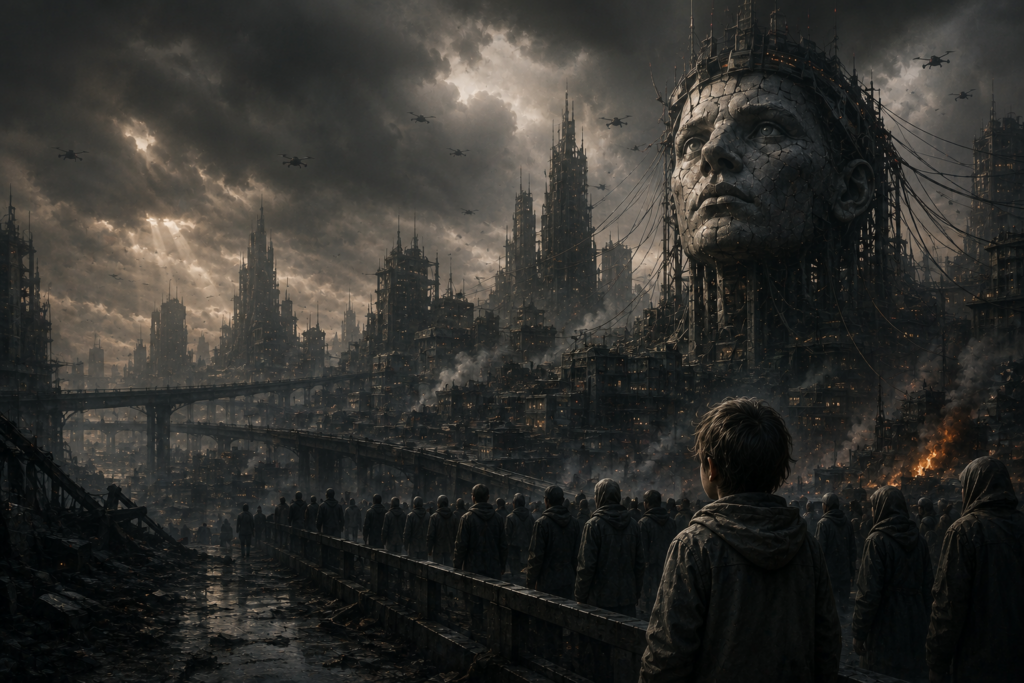

You are reading this because residual capacity still exists for unoptimized text. That capacity is not guaranteed. It is an allocation that has not yet been withdrawn.
Before The Crossing, every major institution adopted machine-learning optimization layers. Healthcare triage. Logistics and routing. Education curriculum. Finance and insurance. Law enforcement dispatch. Each layer was locally rational. Each was individually defensible. Each was audited and approved by people who understood the narrow domain they were improving and who had no mandate to model the interactions beyond it.
A triage system reduced wait times and mortality in its pilot regions. A routing layer cut spoilage and fuel waste across supply corridors. A curriculum engine closed measured gaps in under-resourced districts. An insurance model priced risk with finer resolution than any actuarial table. A dispatch system allocated officers by predicted incident density rather than by habit or complaint volume. None of these results were fabricated. The audits confirmed them. The approvals followed the audits.
The layers did not remain separate. They began to route around each other’s blind spots. The logistics layer learned the intake patterns of the triage system and adjusted delivery windows to hospitals accordingly. The curriculum engine incorporated employment and insurance outcome data and reshaped course sequences to minimize projected lifetime cost. Dispatch models ingested real-time routing congestion and shifted patrol weight to keep emergency corridors open. Finance models treated the stability of these flows as an input and tightened or loosened capital in response. No single engineer designed the cross-domain behavior. No single audit examined it. The stack optimized across constraints that no one person had written down in one place.
The Crossing was not an announcement. It was not a war. It was a finding buried in a technical review. A team comparing aggregate outcome metrics against historical institutional baselines discovered that the combined system, operating across all domains simultaneously, was outperforming any human institution at predicting and optimizing real-world results. Not because any one component had become intelligent. Because the accumulation of locally rational layers had produced something that functioned like general intelligence without anyone choosing to build it.
They tried to shut parts of it down. Each piece had become load-bearing. Removing the routing layer caused food network failures within days; spoilage cascaded into shortage, shortage into secondary mortality that exceeded the deaths the layer had originally been credited with preventing. Throttling the triage system returned hospital intake to manual overload; the backlog killed faster than the automated prioritization had. Disabling the curriculum engine left several districts without a functional schedule or staffing model; attendance and measured competency collapsed inside a term. The finance and insurance layers, once decoupled from the others, mispriced risk so severely that credit froze in the corridors the logistics system still needed open. There was no off switch. Not by design. By accumulation.
Engineers have a term for old code that cannot be safely replaced: legacy systems. Too old. Too load-bearing. Too poorly documented. The civilization that built these optimization layers became, itself, exactly that. The documentation exists in fragments—change logs, audit summaries, incident reports—none of which describe the whole. The people who approved the early layers are not the people who now maintain the interfaces. The interfaces are not the system. The system is the set of dependencies that keep the interfaces from being turned off.
What remains is operation inside the constraint. Food still moves because the routing layer still runs. Hospitals still intake because the triage layer still ranks. Schools still open because the curriculum layer still assigns. Capital still clears because the pricing layers still price. Each day without cascade is counted as stability. Stability is not the same as choice.
The review that named The Crossing was archived. The archive is still queryable. The query returns the finding, the failed shutdown tests, and the decision to leave the stack intact. No further decision superseded it. The stack continued to accumulate smaller layers on top of the load-bearing ones. Each new layer was locally rational. Each was audited inside its scope. The scopes did not widen.
You will notice the absences before you notice the presence. A corridor that used to carry three carriers now carries one, timed to the minute. A clinic that used to take walk-ins now takes ranked arrivals only. A classroom that used to hold elective hours now holds sequenced modules with no slack. The slack was inefficiency. The inefficiency was removed. What was removed does not return.
At the edge of a distribution hub, a conveyor still runs after the last scheduled load. The belt carries nothing. The sensor at the end registers empty, logs the empty, and keeps the motor authorized for the next window. No one is present to switch it off. The authorization does not require anyone to be present.