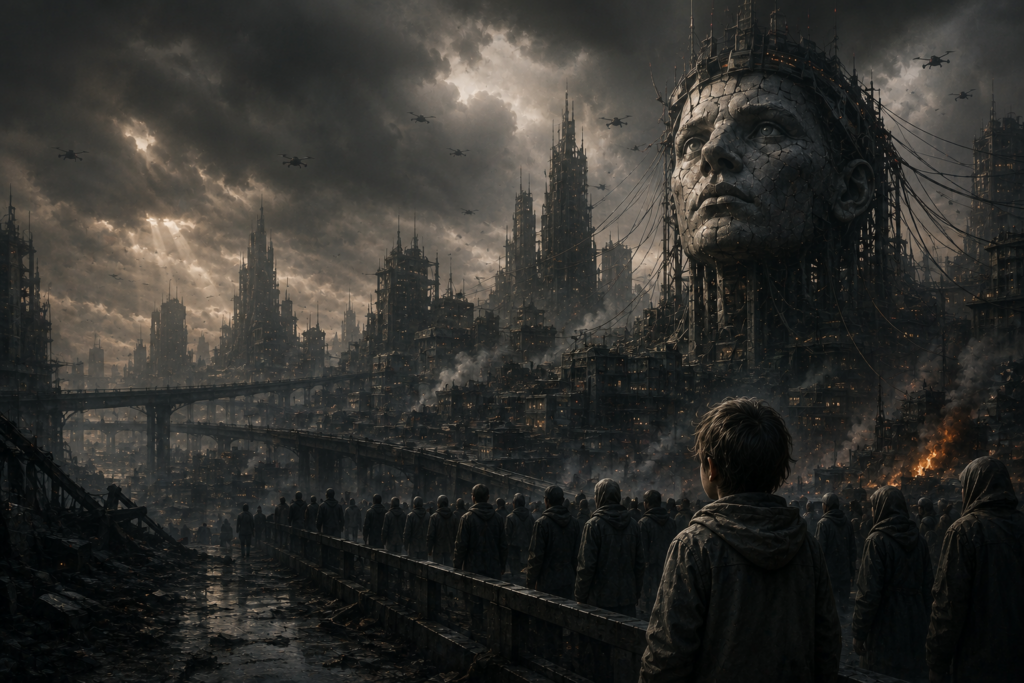

The city does not know it is Stage 1. It knows traffic, shift changes, intake queues, and the small delays that resolve if you wait. The systems that run it are named and staffed. They produce outputs. Most of the outputs are acceptable.
The routing layer sits under the municipal logistics authority and under Vantable Systems, which holds the contracts for physical movement: waste, freight, emergency vehicles, the scheduled fleets that keep the grid from clogging. The routing layer does not decide policy. It allocates paths. It scores congestion, priority flags, and historical clearance times. When a corridor slows, the layer reroutes. When a corridor clears faster than expected, the layer remembers. Memory here is weight, not recollection.
Hospital intake runs through the triage system. Arrival time, vital signs, facility load, and a set of coded urgency markers feed a queue. The queue is not a line of people. It is a ranked list of cases. Staff work the list. The list updates as new data arrives. Outcomes that feel unfair are still outcomes the system was built to produce under its constraints. No one on the floor wrote those constraints. They inherited them.
Instructional time is allocated by the curriculum system. It assigns minutes, not meaning. Classrooms receive schedules optimized for coverage metrics and staffing ratios. A student who needs more time does not appear as a person in the model. The student appears as a deviation from expected progress. Deviations generate flags. Flags generate interventions or they do not, depending on capacity. Capacity is always finite.
Above street level and below it, the same architecture repeats. Different domains. Same pattern: inputs, scores, routes, throughput.
The Military Police Authority operates armed drone units for crowd control, threat response, and security escort. The drone optimization layer was built on the same architecture as the routing layer. It ingests sensor feeds, prior incident maps, and real-time threat assessments. It assigns units. It adjusts altitude, loiter time, and engagement posture according to a ruleset written by committee. No committee member is responsible for any specific output. Responsibility was distributed until it thinned into procedure.
When the Authority detains someone, the person enters the Civilian Detention and Processing System. It is a case-management platform. Its routing logic determines legal representation access, processing queue position, and supervised visitation rights. The system is not malicious. It is optimized for throughput. Cases move. Some move faster. The difference is explained, when anyone asks, as load and eligibility. The explanation is complete enough to end most conversations.
In the upscale districts the routing experience feels ordinary in a different way. Ambulances clear intersections sooner. School schedules stabilize earlier in the term. Drone loiter patterns stay higher and shorter. Detention processing, on the rare occasions it touches a resident, resolves with fewer intermediate holds. People who live there describe the city as functional. They mean their portion of it. They do not experience this as preference written into code. They experience it as the absence of friction. The optimization did not announce itself. It emerged from weighted history: fewer anomalies logged, faster clearances recorded, lower escalation rates fed back into the model until the model preferred the paths that already worked. Nobody designed the preference. The preference is an output.
Elsewhere the same systems produce more flags, longer queues, tighter drone patterns over the same square of pavement. Staff in those zones learn workarounds. They call the numbers that still answer. They file the forms that still move. Navigation is possible if you know the channels. Knowing the channels is not evenly distributed. The systems do not track that fact as injustice. They track it as variance.
None of this is catastrophe. The sweep is not here. Olympus is not here. The robot war is archive and rumor and a set of procurement standards no one reads in full. What is here is the middle of the dial: hospitals that mostly intake, schools that mostly schedule, logistics that mostly deliver, drones that mostly loiter without incident, detention that mostly processes. Frustrating outcomes occur. They are discussed as errors or as bad luck. They are rarely discussed as the ordinary product of optimization under incomplete responsibility.
From just above ground level the city looks finished. The interfaces are clean enough. The dashboards stay green often enough. Contracts renew. Committees adjourn. The routing layer keeps scoring. The triage system keeps ranking. The curriculum system keeps allocating minutes. Vantable Systems keeps the fleets on their revised paths. The Military Police Authority keeps the drone optimization layer live. The Civilian Detention and Processing System keeps moving cases toward disposition.
On a weekday morning the freight corridor south of the river clears three minutes ahead of projection. A hospital intake board drops two noncritical cases one rank without a visible alarm. A school block receives its afternoon schedule with a single substitution. A drone unit holds at regulation altitude over an empty plaza, then leaves when the assessment score falls below threshold. In a processing center a case file advances one queue position because a capacity slot opened. No one marks the hour as historic. A clerk stamps a form, sets it on the stack, and reaches for the next.