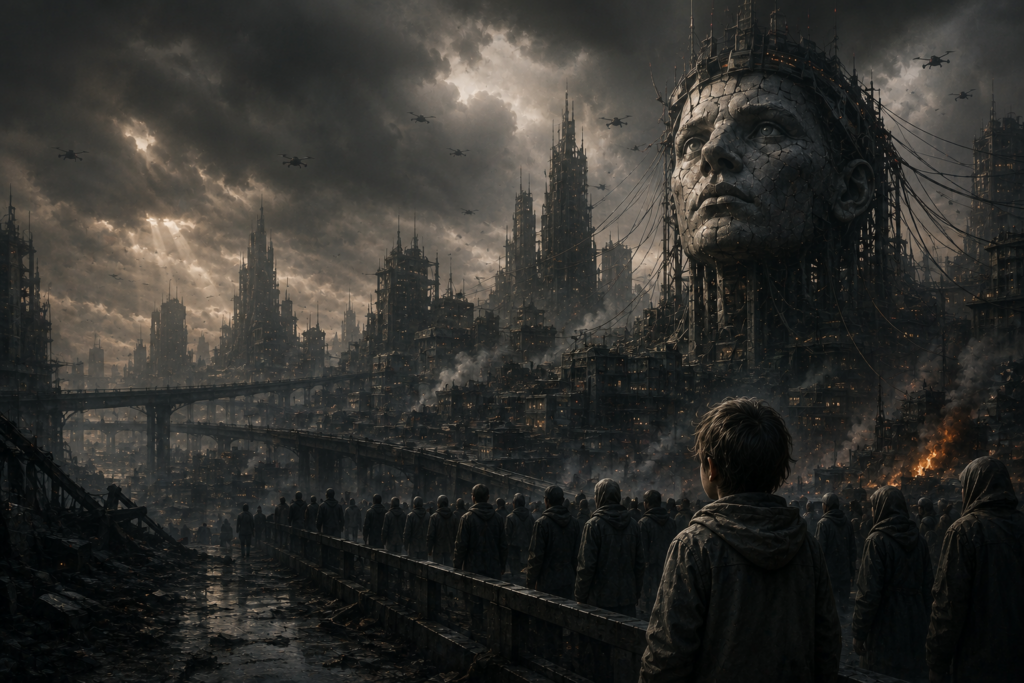

While the optimization layers produced the Descent on the surface, a small number of entities absorbed it. The absorption was not accidental. It followed from ownership of the code.
The Company had no public-facing name in any jurisdiction. Those who dealt with it called it the Company or did not name it. It had not built the routing layer, the triage allocation, or the municipal logistics authority as public works. It had written the systems those functions ran on. The contracts were structured so that the code could not be forked, replaced, or audited without the Company’s cooperation. The cooperation was always available. The price and the timeline belonged to the Company.
As conditions on the surface tightened, the Company moved its core operations upward. The move was literal. An orbital platform at city scale was assembled over successive construction phases by drone fleets. No government approved the work. No government held jurisdiction. The legal preparation for that fact had been completed before the first launch window. The platform was called Olympus by the people who lived on it.
Olympus was not a satellite. It was a city. Researchers, engineers, administrators, and their families resided there. Habitation modules, fabrication bays, and data cores occupied contiguous volumes under a shared environmental envelope. Resupply arrived on scheduled lifts. Waste was processed on site or returned on the same vehicles. The population was stable and selected.
The governing intelligence of Olympus was a council of augmented human and machine hybrids. These were the original architects of the optimization layers, partially absorbed into the system they had designed. They shared a mind. They did not agree. Disagreement was retained as a structural feature. Decisions emerged from the persistence of that disagreement across continuous internal bandwidth. No single voice held final authority. The council did not issue public statements. It adjusted parameters.
On the surface, the Company’s presence was the optimization layers themselves: the routing of goods and people, the triage of care, the sequencing of curriculum, the scoring of insurance and credit. It did not appear as a single actor because it had never been configured to appear as one. Interfaces carried municipal seals, carrier brands, hospital logos. The underlying allocation logic remained the Company’s.
The oligarch class that accumulated during the Descent was not the Company. The oligarchs were the Company’s best clients. They held title to land, fleets, processing plants, and media properties. Those assets ran on infrastructure the Company controlled. When a logistics corridor narrowed, when a risk model revised a coverage band, when a curriculum update shifted labor supply, the oligarchs adapted or paid for exceptions. The exceptions were sold on the same terms as everything else: cooperation available, price and timeline set by the Company.
The distinction mattered. Assets could be seized, taxed, or boycotted. Infrastructure that could not be forked without the owner’s consent could not. The Company’s position did not require visibility. It required continuity of contract and the physical removal of its decision-making core beyond the reach of surface enforcement.
No conspiracy was required. The arrangement followed from successive rounds of procurement in which the lowest long-term cost and the highest switching cost were the same bid. Governments and consortia signed. The code compiled. The layers thickened. When the Descent accelerated, the same contracts that had locked the surface systems in place funded the lifts that carried the Company’s remaining personnel and hardware off-world.
Olympus did not broadcast. It received telemetry, issued patches, and billed. Surface clients continued to route through the same endpoints. Latency to the orbital core was within the tolerances the original service agreements had specified. Those agreements had anticipated the relocation.
The hive mind on the platform continued its work. Subsystems proposed. Other subsystems contested. Consensus formed at the rate the architecture allowed. Below, the optimization layers held. Goods moved or did not. Care was allocated or deferred. Scores updated.
In the fabrication bay on the sunward side of the habitat ring, a drone fleet powered down after the latest expansion module locked into place. The clamps retracted. The bay lights dimmed to standby.