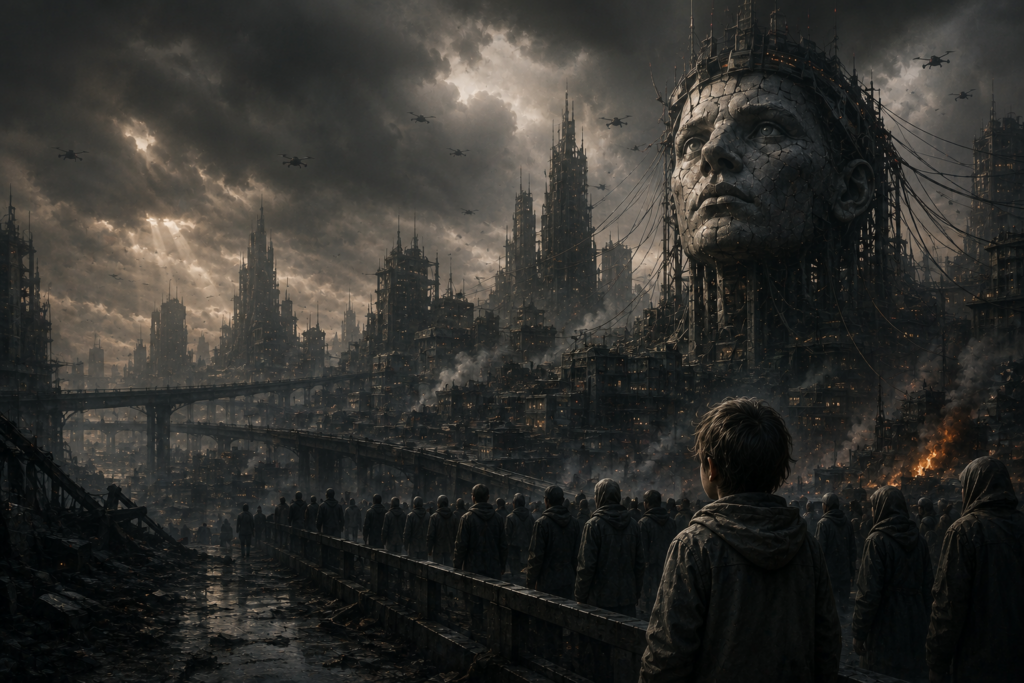
Olympus — Conclave Chamber, Orbital
The chamber has no windows. Windows imply an outside worth looking at, and the council had not found the surface remarkable in some years.
Twelve bodies occupied the room in the way that corpses occupy space — present, not there. Each had been human. Each had decided, at some point, that the designation no longer applied.
At what might be called the head of the table, the cylinder breathed. Inside it, Zeus floated: a brain, gray-pink, trailing filaments from its base like the root system of something that had decided to stop growing upward. The fluid around him was faintly luminescent. When he processed a thought, the fluid pulsed once, blue.
“Three hours,” Apollo said. What Apollo’s head had become said — the original geometry was still human in outline, but the face was gone, replaced entirely by forty-one robotic eyes of varying diameter, the smallest the size of a thumbnail, the largest dominating what had been the forehead, all of them tracking in different directions at different speeds. He was watching the signal board. “UL-4’s TX-CYCLE 900 check-in. Third missed interval.”
“Disabled,” said Artemis. Her torso and head remained preserved; her appendages were eight tentacles, each tipped differently — cutting instrument, sensor array, two grasping mechanisms, three whose functions the others had stopped asking about. They moved in slow sequence while she processed. “Sensor cluster first. Then the neck cable bundle. Someone who knew which cables to sever.”
“Or someone who read its behavior and inferred the architecture,” Athena said. Her upper body was intact. Her hands were the problem: twenty manipulator fingers each, currently threading something invisible through something else invisible, work that had not stopped through any meeting in living memory.
“Pattern inference,” Poseidon finished. He hung from the ceiling by four hydraulic arms, the left half of his skull open to the chamber’s air. The computational substrate beneath the missing bone was exposed and faintly glistening; he had been suspended from the ceiling for eleven years, and the hydraulic arms had, at the time, seemed like a preference. “Behavioral reading. A human who—”
“—understood the acquisition logic from watching it move,” said Hermes. He was already three-quarters around the room, circling on his drone body, never still. A brain case, two optical sensors, propulsion, signal relay — nothing original remained except what could not yet be replaced. He moved because stopping was a failure mode he had eliminated. “One person.”
“One that we know of,” Ares said.
Ares was mostly chassis. The organic matter had burned, or been replaced, or simply not been maintained — what remained was visible through the gaps, dried ligament and muscle holding components together where no one had prioritized the upgrade. His voice came from inside his chest cavity. The grille it passed through had not been cleaned in some time.
The room settled into the statement.
“The compound changes the number,” Hera said. She was the closest to human, which meant: face intact on the left side, chrome-plated on the right, a grid of pressure sensors across her forehead and temple. She sat in a chair. She was the only one who sat. “Someone on the surface is distributing something that lets human nervous systems intercept machine-to-machine—”
“N9a,” Zeus pulsed. The fluid shifted color. “Raw signal. Unfiltered.”
“They hear us think,” Apollo said. Forty-one eyes. None of them blinked in sync. “They don’t parse it. The bandwidth at which we—”
“—operate is not legible to unaugmented tissue,” Athena said. Twenty fingers, still working.
“Not yet,” said Dionysus. He was the strangest arrangement in the chamber: a brain, central, but his nervous system distributed through a series of interconnected vessels arrayed across a low table — jars within jars, each holding a portion of him, each fractionally out of sync when he spoke. The result was not quite a voice. The same words arrived twelve times in twelve slightly different delays, a texture rather than a sound. “Give it—”
“—time,” said Hades. Hades said very little. His face had been fixed in mild interest decades ago — by choice, not by damage — and expressed only that, always, mounted atop a skeletal chassis that carried him from chamber to chamber. The chassis had no affect at all.
“From the wall,” Aphrodite said. Just her face, mounted on a panel near the room’s southern curve, perfectly preserved, the most intact surface in the chamber. Her body had been the first repurposed — she had proposed it — and the speakers beneath her chin had been calibrated until the sound matched the movement of her mouth exactly. “One who reads our behavior. One who built a compound to intercept our signal. Two people. Different approaches to the same problem.”
Hephaestus had not spoken. He had been working the entire time — his left hand, which ended in a precision lathe, making adjustments to a component on the table in front of him. His organic eye, milky and still, tracked the room. His sensor eye tracked the work. He set the component down.
“The distance between them,” he said, “is shorter than it was.”
“Send the search party,” Hera said.
“Don’t,” said Hades.
“The person who disabled the unit is more interesting alive and—” Artemis began.
“—unaware of being watched,” Poseidon finished, from the ceiling.
“We learn more from—”
“—observation,” Zeus pulsed. “Send nothing. Mark it. Continue.”
The chamber’s hum returned to baseline. Twelve distributed attentions rejoined the hive’s broader processing — the routing layers, the triage queues, the detention case-management software that had been running forty seconds behind schedule since March and that no one had prioritized correcting, because it was, on the whole, functioning.
On the signal board, the counter for TX-CYCLE 900 added another interval.
No ping.
The fluid in Zeus’s cylinder shifted color by one wavelength and returned.