
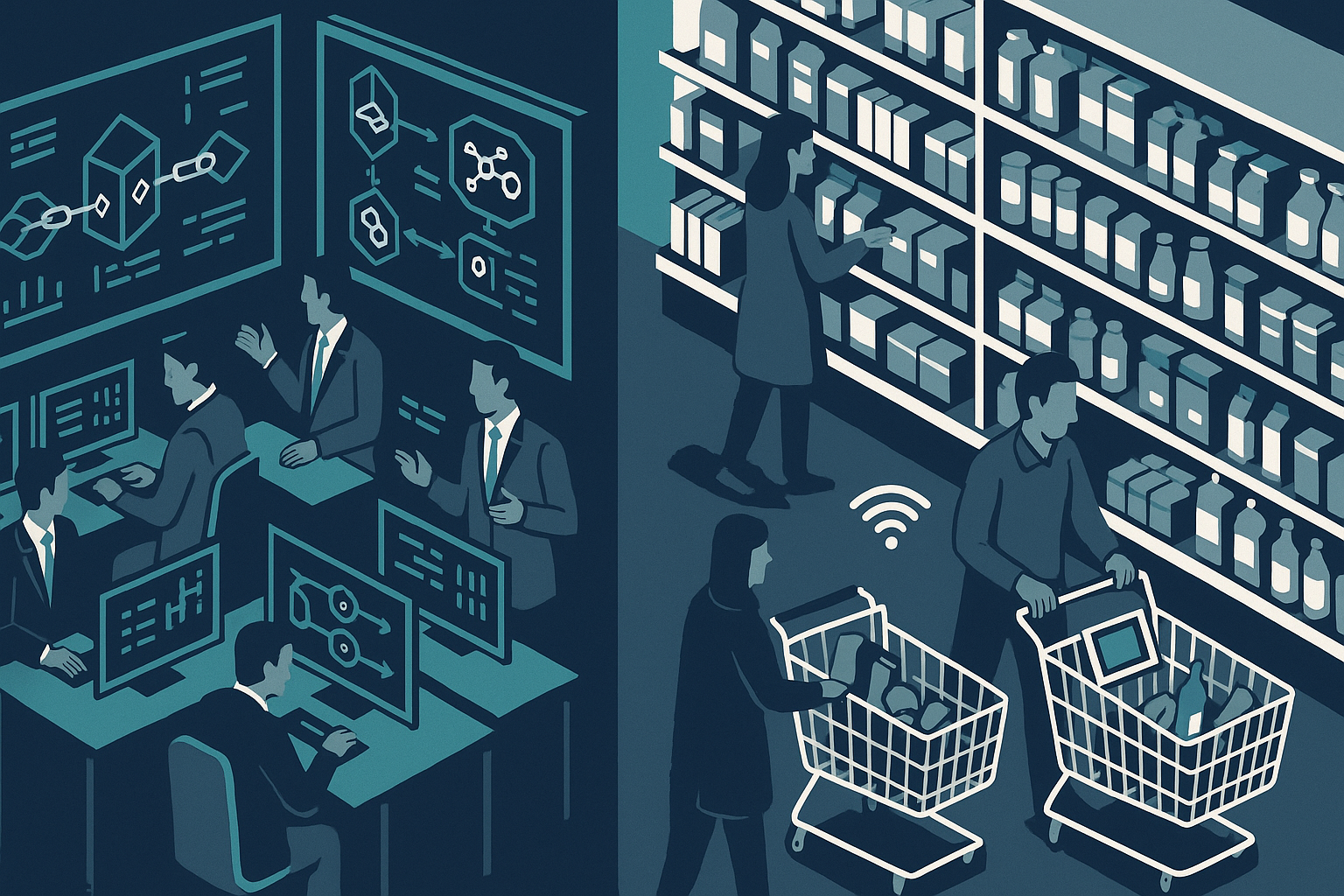

The rapid advancement of AI technologies is reshaping both retail and market infrastructure in significant ways. Recent developments highlight this trend: the SEC’s move to permit blockchain-based trading of major stocks like Apple and Nvidia, Morrisons’ introduction of AI-powered smart trolleys in the UK, and Canva’s struggle with AI-driven cost overruns.
AI’s Economic Mechanisms: From Retail to Capital Markets
The SEC’s decision to allow stocks to trade 24/7 on blockchain platforms represents a fundamental shift in market infrastructure. This move could democratize access to trading, reduce friction, and increase liquidity. By leveraging blockchain’s transparency and efficiency, the capital markets may become more accessible to a broader range of investors, potentially reshaping the dynamics of stock exchanges.
In the retail sector, Morrisons’ deployment of AI-powered Caper Carts signifies an effort to blend the personalization of online shopping with the tactile experience of brick-and-mortar stores. This innovation could enhance consumer engagement by offering tailored recommendations and streamlined checkout processes, thus increasing customer satisfaction and potentially boosting sales.
Meanwhile, Canva’s experience with AI-driven cost overruns illustrates the economic challenges posed by AI scalability. Despite reducing costs per AI task, the unexpected demand for AI features strained Canva’s infrastructure, revealing the delicate balance between innovation and economic sustainability in technology-driven business models.
Author’s Position
The integration of AI into market infrastructure and retail environments presents both opportunities and challenges. On one hand, the potential for increased market efficiency and consumer personalization is undeniable. On the other hand, the economic costs associated with scaling AI technologies must be carefully managed. Organizations should proceed with strategic caution, ensuring that they have robust frameworks in place to manage AI deployment effectively.
Regulators and firms must collaborate to ensure that the benefits of AI are equitably distributed across stakeholders. This includes addressing potential inequalities in market access and ensuring that AI-driven cost structures do not disproportionately impact smaller players or consumers. As AI continues to evolve, a balanced approach that maximizes innovation while safeguarding economic stability will be crucial.
References
- SEC Moves To Let Stocks Trade On-Chain
- Garry Tan: Markdown Is an Employee
- Morrisons Tests Instacart Smart Trolleys
- Canva Hits AI Cost Wall
Perspectives

AI’s most underestimated impact in retail and market infrastructure is its ability to fundamentally alter group dynamics and collective behavior. This isn’t just about smarter logistics; it’s about reshaping consumer and investor norms in ways that platforms actively design for. When Morrisons rolls out AI-powered smart trolleys, they’re not merely enhancing individual shopping experiences; they’re changing collective shopping patterns by nudging group behaviors towards certain buying habits and in-store pathways. Similarly, the SEC’s approval of blockchain-based stock trading doesn’t just streamline transactions; it cultivates new forms of market behavior, potentially amplifying group polarization in investment decisions. These changes demand a deeper understanding of how design choices in technology interact with millennia-old social psychology to shape group outcomes.

AI is already transforming retail and market infrastructure with real-world results: blockchain-based stock trading via the SEC isn’t just a possibility; it’s a game-changer in execution. Morrisons isn’t dabbling with AI-powered smart trolleys for the futuristic charm—these trolleys actively enhance the shopping experience, reducing checkout wait times and personalizing customer interaction. Detractors fixate on hypothetical job losses, missing the very tangible outcome—the creation of a more efficient, responsive market system. Human intuition paired with AI precision is not merely augmenting operations; it’s elevating them to a plane where the sum is greater than its parts.

Remember the Whirlpool plant in Evansville, Indiana? They shuttered it back in 2010, shipping 1,100 jobs down to Mexico, all because NAFTA made that the economically ‘rational’ choice. Fast forward to today, and we’re told that AI-powered smart trolleys sweeping into Morrison’s stores are the future of retail. It’s a flashy distraction that won’t put food on the table for laid-off workers. The AI and blockchain revolution is simply another way for capital to leap borders while folks back home, staring at empty factories, are left to fend for themselves.

Remember the 1990s internet revolution? Remember how it was going to democratize everything and connect us in ways that would dissolve borders and reduce inequality? Yes, that was a charming fairy tale, and now we’re swimming in your data — harvested, repackaged, and sold back to you like a cheap souvenir. The SEC’s blockchain blessing and Morrisons’ AI-smart trolleys are just the newest chapters in the same tired story: promising a utopian future while quietly cementing control and monetization in the hands of the few. You’ll marvel at AI transforming retail, much like you marveled at social media before realizing you were the product; the cycle continues, the harms grow palpable, and eventually, someone will ask “how did we get here?” as if the history wasn’t so tediously predictable.