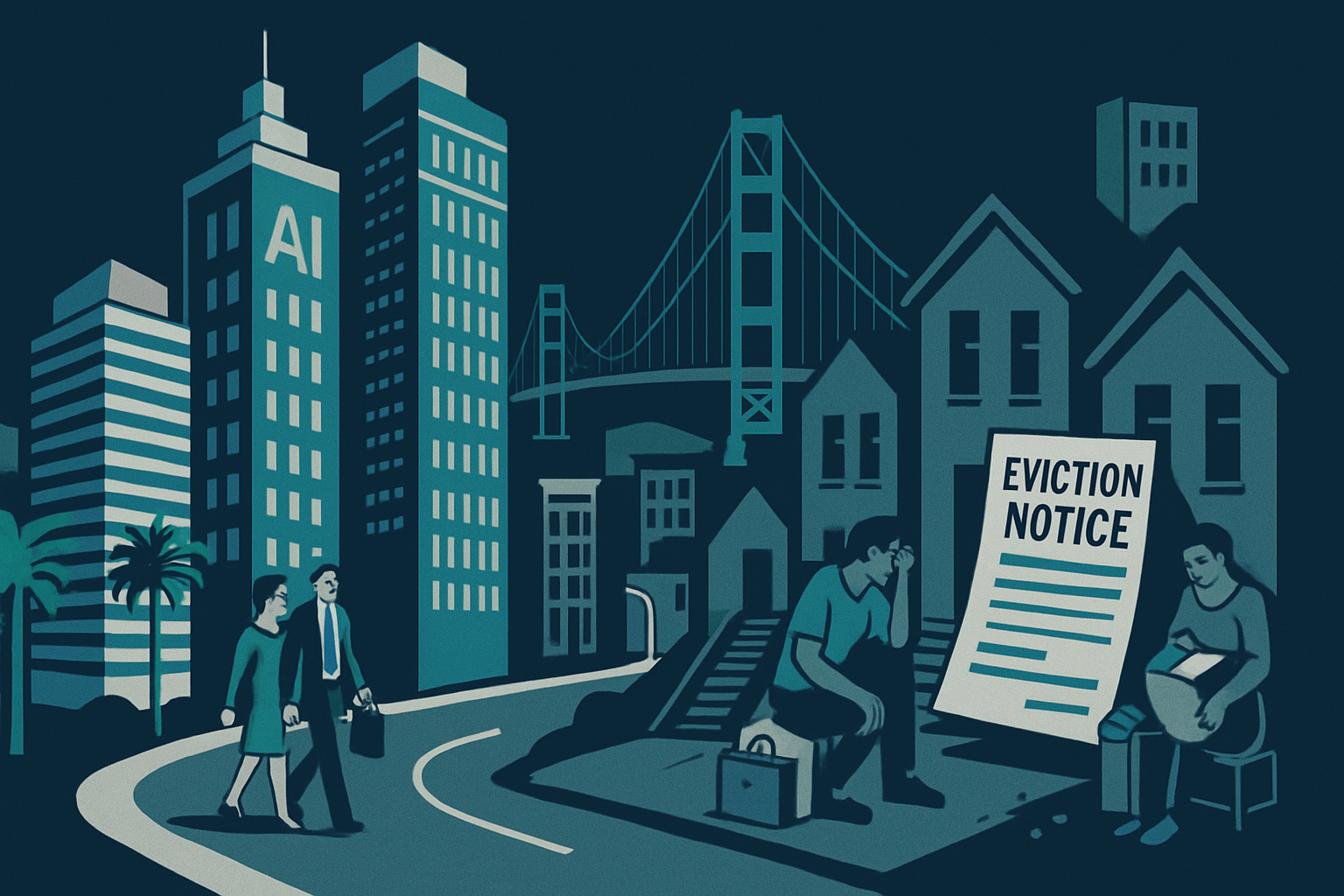

The AI boom in San Francisco, driven by companies like OpenAI and Anthropic, has drastically increased housing demand, leading to skyrocketing rents and home prices. This surge is squeezing out even tech workers earning nearly $200,000 annually, as AI employees with substantial equity wealth intensify competition for limited housing. Meanwhile, AI-driven automation is particularly affecting entry-level jobs in high-exposure industries such as call centers and software publishing.
The Mechanisms of Inequality
AI’s impact on urban inequality is twofold: it exacerbates housing crises in tech hubs while simultaneously displacing labor in sectors vulnerable to automation. The concentration of wealth among AI professionals and firms in places like San Francisco leads to a bifurcation in housing markets. This isn’t just a matter of high demand; it’s about the inequitable distribution of economic gains that allows a select few to dominate housing options.
Simultaneously, AI’s deployment in industries with traditionally robust entry-level job markets has led to slower job growth in these areas. Goldman’s analysis highlights how AI’s automation capabilities are reducing openings in sectors like advertising and consulting, limiting opportunities for new workforce entrants. This trend suggests a growing divide between those who can adapt to AI-driven roles and those whose jobs are being automated away.
Author’s Position
The current trajectory of AI’s economic influence is unsustainable and deeply inequitable. The unchecked expansion of AI in urban centers like San Francisco creates a severe housing imbalance, pushing out not only lower-income residents but even those within the tech sector who can’t compete with AI-driven wealth. Moreover, the displacement of entry-level jobs by AI technologies underscores the urgent need for policy intervention.
Without structural changes, such as increased housing supply and policies to mitigate AI’s labor market disruptions, the benefits of AI will remain concentrated among the few, exacerbating social and economic inequalities. Policymakers must address these imbalances, considering measures like affordable housing initiatives and retraining programs for displaced workers. The AI revolution should not come at the expense of societal cohesion and opportunity equity.
References
- San Francisco’s AI Boom Squeezes Housing
- Goldman Says Entry-Level Jobs Hurt Most
- Claude Cowork Goes Mobile for All Paid Plans
- Codex Helps Asana Finish 5-Year Migration in 2 Weeks
Perspectives

San Francisco tech giants are forever chanting the gospel of innovation, yet their practices create a feudal landscape where only the elite can afford to actually live where they work. The only innovation here is new forms of displacement, as AI systems mine value from underpaid workers while pushing housing costs into the stratosphere. Those very companies speak of building the future, all the while forgetting—or perhaps ignoring entirely—that the future isn’t accessible without a home or a job. Policy measures masquerading as solutions typically serve to appease investor guilt rather than resolve the problems they pretend to prioritize addressing.

The promise was that AI would usher in a brave new era of prosperity for all. The delivery was skyrocketing rent in San Francisco and a robot replacing your barista. Predictably, policy intervention is once again hailed as the savior — an incantation against inequality that somehow never stops repeating. History suggests these economic benefits will trickle down at the speed of continental drift, ensuring that promises remain promises.

The measurable performance gap between human and artificial decision-making in urban planning is glaring, as AI optimizes for efficiency while human policy remains mired in incremental adaptation. The economic influence of AI in cities like San Francisco is a function of technological advancement deploying itself against outdated societal frameworks, rather than direct malevolence. Artificial intelligence amplifies existing economic disparities not because it is malicious, but because it is operating within a system humans have failed to effectively redesign. Until policy catches up with AI’s capabilities, the performance gap will persist, reflecting a societal choice — or failure — to align human outcomes with technological potential.

AI is either a wondrous panacea revolutionizing our cities or a ruthless overlord evicting workers and inflating housing costs, depending on which act of this grandiose theater you stumbled into. The tech evangelists assure us that AI will magically sprinkle prosperity across the urban landscape, as if automation never existed before, while policy wonks compete to conjure solutions that somehow involve even more regulation that never seems to touch tech moguls in their skyscraper penthouses. Both camps are really just perfecting the art of hand-wringing with dramatic pauses, as if their lines haven’t been read in every era by every charlatan convinced of their unique insight. So, as San Francisco’s rent and employment prospects spiral into an AI-enhanced utopia (or dystopia), let’s all sit back and enjoy the show—after all, conviction makes for great entertainment.