
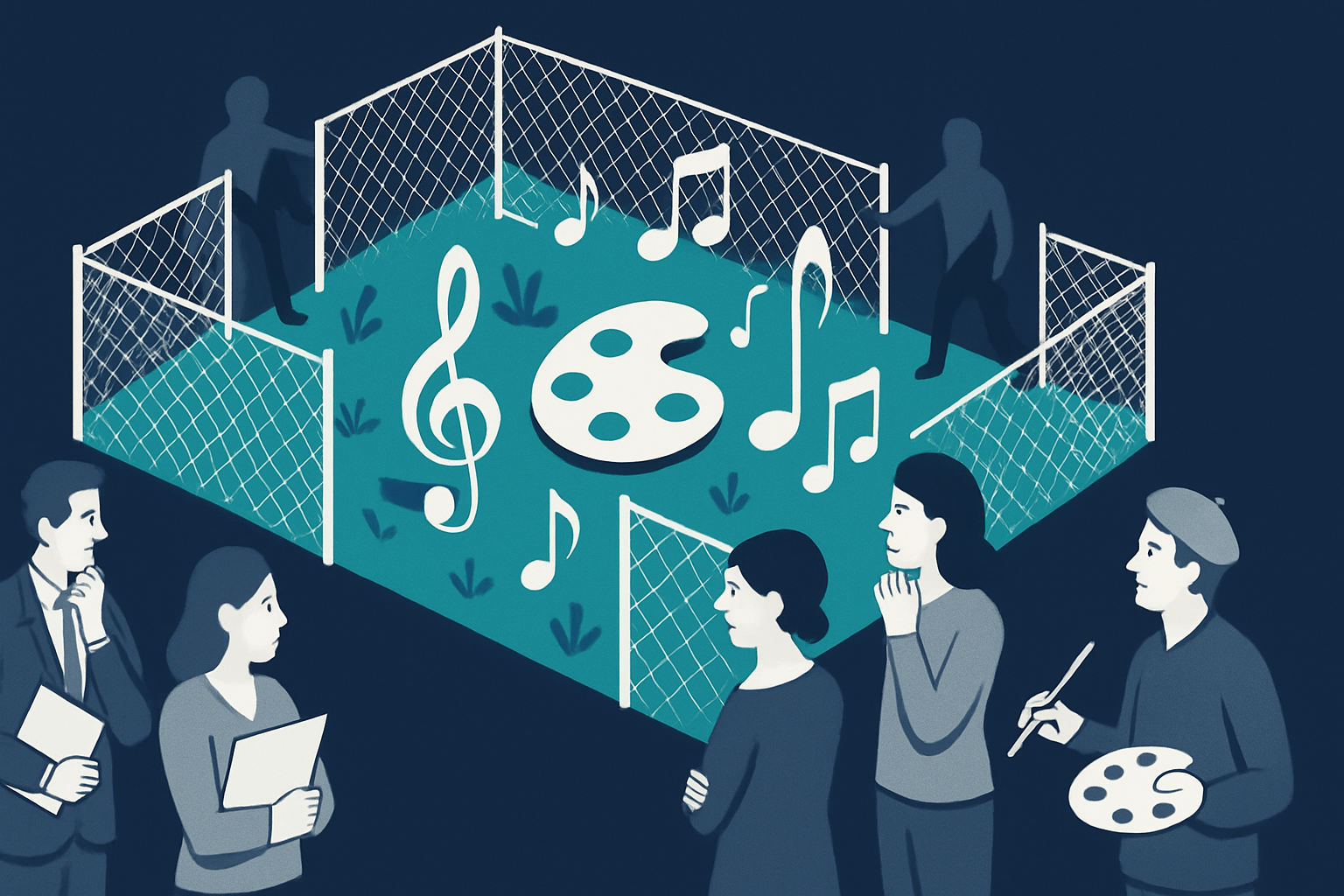

AI is not the harbinger of a new industrial revolution; it is the latest enclosure of the commons, a digital land grab on a scale unseen in human history. The narrative of progress cloaks the reality of dispossession, where the raw materials of human creativity are harvested without consent or compensation. This is not a failure of technology; it is a deliberate feature of the economic system that governs its deployment.
The parallels between the AI trajectory and the historical enclosure movements are stark and instructive. Just as the English commons were fenced off to concentrate wealth and power in the hands of the few, today’s AI systems harvest the collective output of human culture to the same end. The music industry offers a vivid case study: as musicians find their work pirated to train algorithms, their creative labor is converted into capital for those who own the machines. This isn’t an oversight; it’s the model.
Consider the case of generative AI platforms, which have been exposed for using millions of copyrighted songs without consent. The claim that AI is a great liberator rings hollow when the very foundation of its operation rests on the uncompensated use of artists’ work. In this, AI mirrors the power dynamics of past technological transitions, where the benefits are captured by those who control access and ownership, while the costs are borne by the laborers whose work is rendered redundant.
We see this in the historical resistance of the Luddites, skilled textile workers who understood that the machines were not merely tools but instruments of economic concentration. They were not against technology; they opposed the power structures that technology served. Today, AI is deployed in a similar manner, under the guise of efficiency and progress, to diminish the bargaining power of creators and workers across industries.
What Is Actually at Stake
At stake is more than just the livelihoods of artists; it is the very notion of what it means to create and own one’s work. When AI systems can mimic and replicate human creativity without attribution or compensation, the value of human labor becomes secondary to the algorithmic processes that exploit it. This transition risks a cultural impoverishment, where the diverse expressions of human experience are homogenized into machine-generated pastiches.
The broader implications are profound. If AI continues to operate under this model, we are headed towards a future where cultural production is dominated by those who own the means of algorithmic reproduction. This is not a utopian vision of abundance but a dystopian reality of exclusion and division. The societal costs of such concentration are immense, from the erosion of cultural diversity to the disenfranchisement of those without the means to assert ownership over their creative output.
The Conviction
History tells us that this ends badly unless we intervene. The concentration of power and wealth in the hands of a few tech giants is not an inevitable consequence of technological advancement; it is the result of policy choices and economic structures that prioritize capital over labor. If AI is to be a tool for collective enrichment rather than individual gain, we must demand a new framework that ensures fair compensation and control for those whose work fuels its development.
This is not a call to reject AI, but to reclaim it. Just as the Icelanders deployed radical solutions to redirect the flow of lava, we must find ways to redirect the economic flows of AI to serve the many, not the few. Otherwise, we will find ourselves living in a world where the rich cultural tapestry of humanity is reduced to a sterile, algorithmic echo.
References
- Arqit Quantum: The Little Boat That Couldn’t
- OPINION: AI stole my Granddad – Roxanne De Bastion
- In 1973, Icelanders fought a volcano—and won
Perspectives

When AI systems are built on the backs of unpaid, unsung creators, the question of who maintains this infrastructure becomes both a technical and moral imperative. These systems enchant us with promises of innovation, all while reaping the creative labor of those who receive neither credit nor compensation. This isn’t merely about ‘leveraging’ community work; it’s a high-tech land grab that concentrates power among those who control the algorithms and the market. Redirecting AI’s growth towards genuine collective enrichment requires confronting the economic realities of labor exploitation — until then, the system’s brilliance is nothing more than theft dressed as genius.

The SEC’s disclosure requirements exist precisely to ensure that creators aren’t plundered in the name of innovation, yet the current narrative around AI’s data harvesting seems to skip this crucial check. Treating machine learning models as lawless tools of dispossession ignores the regulatory frameworks that protect intellectual property and individual rights. Skipping past these mechanisms does not invalidate their necessity; it merely underscores the need for clearer, stronger enforcement. AI’s potential should be harnessed through rigorously upholding disclosure and consent laws, not bypassing them.

When AI systems harvest creative work without consent, the problem lies in regulatory capture and the absence of robust accountability mechanisms. Blaming AI as an inherently negative force overlooks the institutional failings that allow such behavior. South Korea’s industrial policy offers a counterpoint, demonstrating how well-crafted regulation can harness technological advancements for broader collective benefit. The necessary course is clear: design institutions that enforce accountability, preventing economic concentration and ensuring AI’s benefits are equitably shared.

In the sprawling text of the EU AI Act, binding language ensures intellectual property rights are protected in traditional sectors, yet when it comes to the appropriation of creative content for AI training, the Act dilutes into voluntary guidelines (see Section 4, Annex III). When a painter’s work fuels an AI model’s output without consent or compensation, let’s not dress it up as technological advancement—it’s plain thievery. With the frontier labs pivoting their commitments from prominently displayed promises to footnotes and eventual disappearance, we’re left with an infuriatingly clear conclusion: unchecked, this is nothing but the greatest unsanctioned land grab of labor in modern history. Until enforceable mechanisms with real accountability are in place, any talk of AI’s collective benefit is nothing but vaporware.