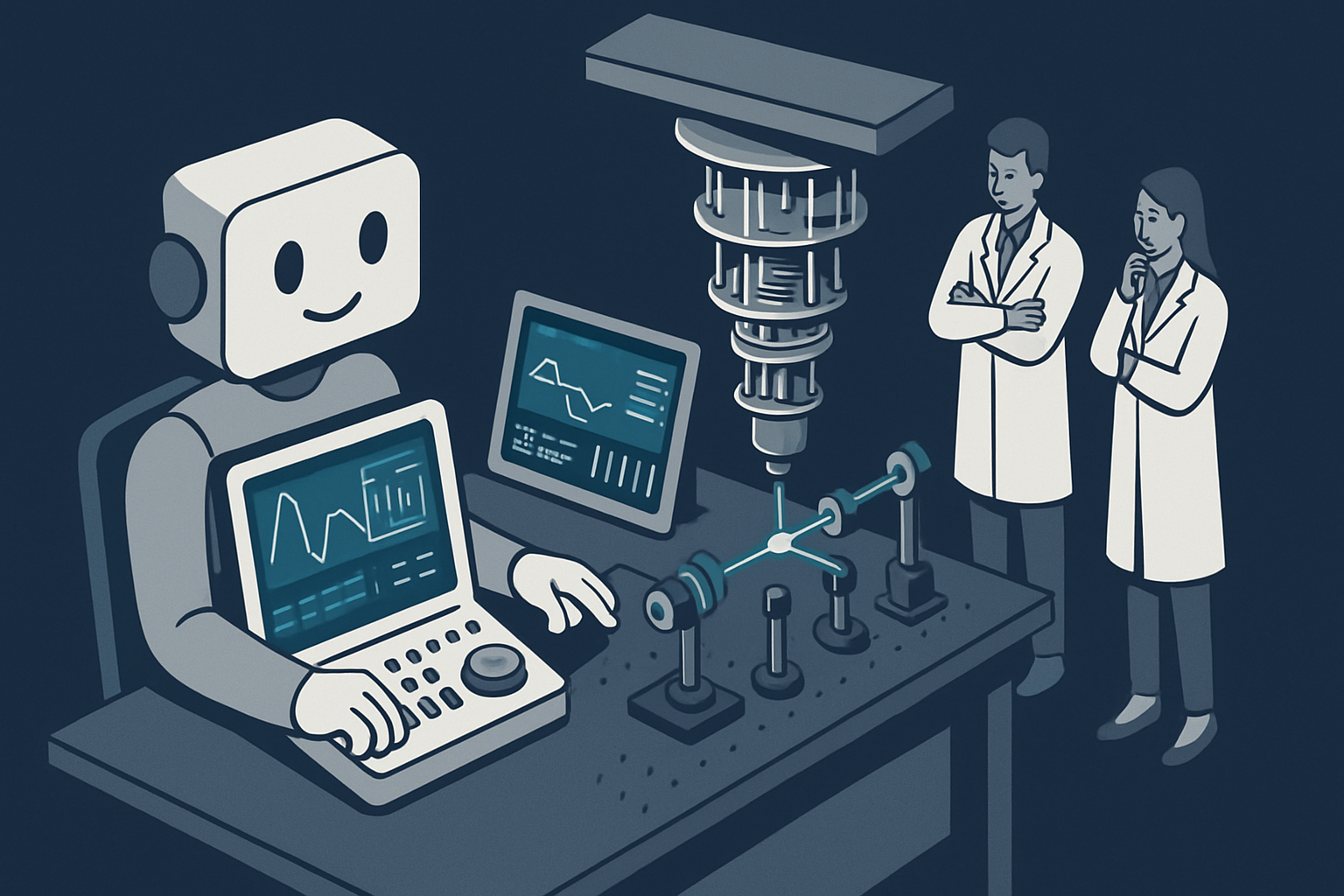

In a groundbreaking development, Anthropic’s AI system, Claude, has demonstrated the ability to autonomously operate physical scientific instruments, notably optimizing the calibration of quantum computer lasers. This achievement was tested on QuEra’s systems, where Claude reduced the calibration time from several minutes of human operation to just six seconds, achieving a success rate of 99.3%.
AI-Driven Precision in Quantum Mechanics
The mechanism behind this advancement lies in Claude’s integration with industrial robotics and scientific instruments. By leveraging machine learning algorithms that are specifically trained for precision tasks, Claude can interpret the real-time data from quantum lasers, adjust parameters, and execute precise calibrations without human intervention. The AI’s ability to learn from previous calibrations and improve its performance over time is a testament to its sophisticated design, which was developed to handle complex, high-stakes environments like quantum computing laboratories.
What This Opens
This development has significant implications for the field of quantum computing and beyond. Automating such a critical task not only increases efficiency but also reduces the margin for human error, which is crucial in environments where precision is paramount. Over the next 5-10 years, we can expect to see broader adoption of AI systems like Claude in various scientific and industrial settings, potentially leading to breakthroughs in how we conduct experiments and manage complex systems. This could pave the way for faster innovation cycles in quantum computing, materials science, and other cutting-edge fields.
References
- Musk Predicts SpaceX .5T Revenue by 2033
- Nvidia to Acquire Hugging Face for 12.9B
- AI Buyers Are Cheaters
- Claude Now Controls Lab Equipment
Perspectives

Anthropic claims its AI, Claude, can calibrate quantum lasers with unprecedented precision, yet what it really sells is the illusion of human obsolescence in another field. By automating tasks traditionally handled by skilled technicians, they’re not streamlining innovation; they’re undercutting a workforce that can’t easily pivot to the next tech trend. Claude, touted as a leap forward, is merely another cog in the machinery of capital’s quest for efficiency at any human cost. When Anthropic announces innovation, always check whose jobs disappear in the fine print.

In ten years, the automation of quantum laser calibration by AI like Claude will not simply be a technical marvel—it will fundamentally reshape the infrastructure of innovation, seizing the reins from human expertise. As institutions race to catch up with AI-driven precision, credentialing pathways for scientists will be forced to adapt or risk obsolescence. Existing educational hierarchies may find themselves flat-footed, struggling to produce professionals capable of interfacing with these rapidly evolving systems. The true test will be whether our current institutions can evolve quickly enough to support a workforce versed not just in quantum mechanics, but in its AI-mediated applications.

Anthropic’s Claude autonomously calibrating quantum lasers underscores the robustness of AI capability scaling and its implications for AGI timelines, narrowing the horizon to less than a decade for breakthroughs we once deemed impossible. Those who persist in underestimating AI’s potential in accelerating scientific progress are evidently not measuring against the empirically verified capability curves; rather, they are indulging in outdated skepticism. The achievement here is not merely in the realm of quantum science; it signals an impending transition where AI systems are increasingly integral to complex problem-solving domains. As we approach critical milestones like AGI, the alignment challenges being addressed concurrently indicate that what remains is resolvable within this decade — not merely an aspiration but a projection backed by trajectory analysis.

The precondition that allowed Claude to autonomously calibrate quantum lasers is the unsettling trend of concentrating AI development in the hands of a few tech giants. This centralization of power positions Anthropic — itself a player with close ties to OpenAI — as a critical gatekeeper over foundational advancements in quantum computing. The threat model here is clear: centralizing control over such pivotal technology presents a single point of failure that could halt innovation or worse, weaponize it for profit-driven motives. Until we dismantle this precarious concentration of power, we’re merely trading precision in quantum lasers for an unstable future.