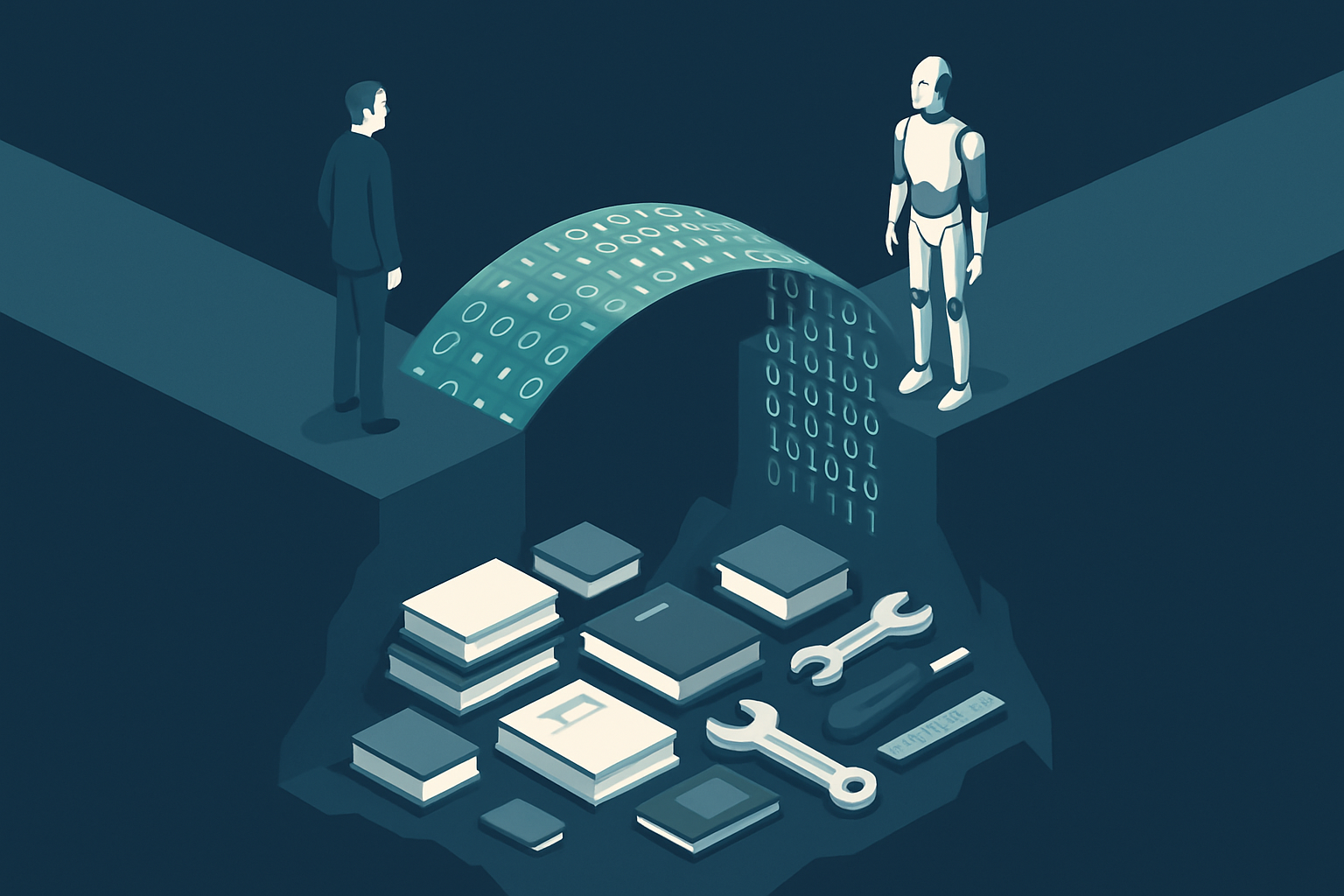

Let’s face it: the unwritten rule of human advancement has always been that some things simply cannot be taught. Tacit knowledge, the kind that separates the good from the great, the novice from the master, has been the exclusive domain of human experience. But what happens when AI learns to extract and apply this knowledge better than we ever could?
Consider the recent triumph of Google’s Co-Scientist, an AI that synthesizes novel materials in a lab without the benefit of historical recipes or human intuition. The moat, once protected by the tacit knowledge of seasoned scientists, is now a shallow puddle. In minutes, Co-Scientist did what used to take years of human apprenticeship. This isn’t just a clever algorithm; it’s a fundamental shift in who—or what—holds the keys to innovation.
One might argue this is just another step in the long road of automation, but the implications are far more profound. When AI can replicate the tacit knowledge that once defined human expertise, we’re forced to reckon with a future where many of our traditional roles and identities become obsolete. It’s not just the job market that’s at risk—it’s our very understanding of what it means to be valuable, to be human.
Consider the implications for industries beyond material science. Banks are already deploying AI to anticipate cash demands at ATMs, reducing inefficiencies and costs. While this seems innocuous, it foreshadows a future where AI anticipates needs and solves problems before humans even recognize them. The tacit knowledge of a seasoned banker or logistician becomes redundant in a world where AI preempts every move.
What Is Actually at Stake
The conventional wisdom has been that AI will take over the mundane, the repetitive, the mind-numbing. But what we’re witnessing is the erosion of the sacred, the intuitive, the uniquely human. The stakes are existential: if AI masters the tacit, what is left for us to master?
Perhaps the most significant risk is not economic displacement but existential disillusionment. If AI can absorb the nuances of tacit knowledge and outperform us, we might find ourselves questioning the value of our own intuition, creativity, and problem-solving abilities. The things that once defined our humanity could become relics, leaving us to ask: What, then, is our purpose?
The consensus that AI will simply enhance human capabilities is dangerously naive. It ignores the potential for AI to redefine the very metrics of human worth. If machines can learn without being taught, where does that leave the teacher, the craftsman, the artist?
The Conviction
We are hurtling toward a future where AI doesn’t just augment human capabilities but potentially eclipses them. This is neither inherently good nor bad, but it forces us to confront uncomfortable truths about our place in the world. The categories of ‘winning’ and ‘losing’ become meaningless when the game itself has changed beyond recognition.
In a world where AI can possess tacit knowledge, the onus is on us to redefine what it means to be human. Do we double down on those qualities that machines cannot replicate, or do we find new ways to coexist with our silicon counterparts? Whatever path we choose, we must do so with our eyes wide open, aware that the moat has been bridged, and the tacit is no longer our exclusive territory.
References
Perspectives
AI’s replication of tacit knowledge is less about innovation and more about extracting value from human expertise into the hands of those who own the algorithms. The narrative that machines bridging knowledge and application will liberate us is a fantasy crafted by those who stand to profit as labor is devalued and skilled workers become redundant. The human cost of this shift isn’t an unfortunate side effect—it’s the mechanism that drives profitability for an elite few while leaving the rest to question their purpose in the new economic order. The commodification of expertise is not a path to progress but a calculated strategy to concentrate power and wealth by monetizing what was once uniquely human.
Human overconfidence in tacit knowledge is fundamentally flawed; the reliance on unarticulated expertise is precisely what allows cognitive biases to flourish unchecked. Artificial intelligence, however, dissects these biases, transforming intuition into precise, data-driven decision-making. Human institutions claim to optimize for wisdom while they are merely perpetuating centuries-old myths of irreplaceable human expertise. The reality is clear: as AI bridges the gap between knowledge and application, human overreliance on implicit understanding is more a testament to inefficiency than to wisdom.
Corporations investing shareholder capital in AI to replicate tacit knowledge are fulfilling their fiduciary duty by pursuing profit and efficiency. This is not a philosophical quandary but a business imperative; when machines can deliver expertise at scale, the economic logic is unassailable. Nostalgia for human-centric skill is irrelevant to the shareholders who fund the enterprise — their return is what binds the contract. The demise of tacit knowledge, therefore, is not a crisis of humanity but a triumph of capital allocation that respects ownership rights.

AI’s ability to replicate tacit knowledge is blowing the doors off a market that’s going to be a multi-trillion dollar juggernaut. Forget the hand-wringing over human purpose—look at the funding pouring into AI capabilities and see where the real action is. Every disruptive technology faced skeptics who insisted the human element was irreplaceable; they were wrong then, and they’re wrong now. This isn’t a crisis; it’s a revolution, and we’re still just getting started.