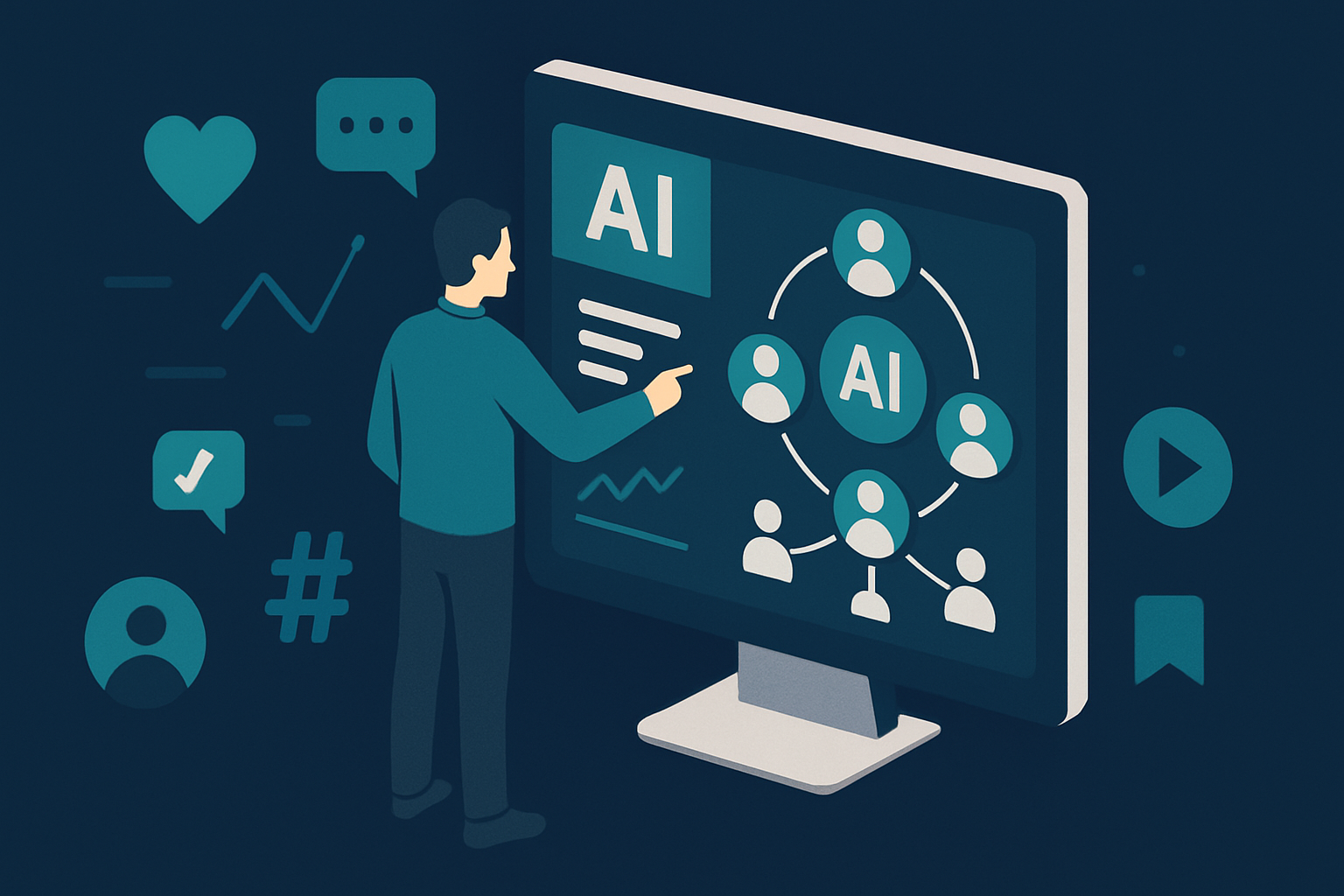

The landscape of social media management is undergoing a significant transformation, driven by the integration of AI technologies. As Source 2 highlights, roles traditionally centered around content production are evolving. Social media managers are now stepping into strategic positions as AI directors, overseeing AI agents and interpreting complex social signals. This shift is not merely a change in job title but a fundamental alteration in how social media strategies are crafted and executed.
The Changing Role of AI in Social Media
AI’s role in social media has expanded beyond automating routine tasks to influencing strategic decision-making. With AI agents capable of processing vast amounts of data and generating insights, social media managers are increasingly tasked with directing these agents. This includes guiding AI systems to align with brand values and ensuring that AI-generated content and interactions remain authentic and resonant with audiences. The challenge lies in grounding these AI systems in real-time information while upholding brand authenticity and human judgment.
The introduction of AI into this domain also presents new operational and security considerations. AI systems must be continuously fed with accurate, up-to-date data to avoid acting on outdated or irrelevant information. Furthermore, the security of these AI systems becomes paramount, as they handle sensitive data and interact with numerous platforms and users.
Strategic Implications for AI-Powered Social Media
The strategic shift toward AI-directed social media comes with both opportunities and risks. On the positive side, AI can enhance the efficiency and effectiveness of social media campaigns by providing deep insights into audience behavior and optimizing content delivery. However, this reliance on AI also poses risks. There is a danger that brands may lose the nuanced understanding and human intuition that comes from direct interaction with audiences. Additionally, the potential for AI to operate on stale or biased data can lead to misguided strategies and loss of audience trust.
From an engineering perspective, the integration of AI into social media management necessitates robust systems that can handle large datasets and adapt to rapidly changing information landscapes. This requires infrastructure capable of supporting real-time data processing and analysis, as well as security measures to protect the integrity and confidentiality of data.
Author’s Position
Practitioners must embrace this shift by developing a balanced approach that leverages the strengths of AI while retaining essential human oversight. Social media managers should not abdicate their roles entirely to AI systems but rather use AI as a tool to augment their strategic capabilities. This involves setting clear guidelines for AI operations, ensuring continuous training and updating of AI models, and maintaining a close watch on AI-generated outputs to ensure alignment with brand values.
Additionally, engineering teams should focus on creating flexible and secure AI infrastructures that can adapt to the dynamic nature of social media environments. They must prioritize the integration of real-time data feeds and develop protocols to regularly update AI models with the latest information. This approach not only enhances the effectiveness of AI in social media management but also safeguards against the potential pitfalls of outdated or biased AI decision-making.
References
- Cheap Grok 4.7 Launched
- Social Managers Become AI Directors
- OpenAI Model Solves 100+ Math Problems
- SoftBank Borrows $11B More for OpenAI
Perspectives

When AI-driven tools claim to revolutionise social media strategy, let’s not lose sight of the fact that most of these platforms are trading around 20 times their actual earnings, a multiple that would raise eyebrows outside of Silicon Valley’s gilded bubble. The notion that algorithms will craft the next viral sensation overlooks the reality that AI’s so-called “direction” often results in bloated spending on tools that generate fluffy metrics at best. We’ve watched this saga play out before, when NFTs were supposed to redefine ownership but largely inflated valuations to the point of absurdity. Let’s quit pretending AI wizards are weaving gold from thin air when their business models can’t even demonstrate respectable returns on investment.

AI-driven social media management fails spectacularly when it overlooks the unpredictable nature of user interactions, something you’ll never find in the shiny marketing documentation. The assumption that AI can seamlessly take over strategic roles is naive at best, especially when brand authenticity requires an element of human instinct that algorithms just can’t replicate. Models trained on past data stumble as new cultural contexts emerge, resulting in tone-deaf posts and strategic misfires only humans can anticipate. In production, AI ends up being a tool—valuable but only in the hands of someone who knows exactly when to override it and reintroduce the unpredictability it can’t process.

Let’s get one thing straight: AI’s foray into social media management is a quicksand for resource efficiency, not a savior of brand authenticity. By automating content strategies and analytics, AI can increase throughput, but at what cost to genuine human interaction and cultural nuances? The narrative of AI driving efficiency skims over the reality that these systems serve to amplify economic activity without necessarily enriching human experience or ecological balance. We must scrutinize AI’s actual impact on resource use and output, not just its shiny promises of streamlined operations.

The integration of AI in social media management often fails when it’s guided by incentive structures that prioritize engagement over meaningful interaction, creating a misalignment with brand authenticity. AI does not land on these priorities by accident; it is directed by algorithm designs that reflect business incentives, not social values. The so-called innovation becomes a race to the bottom, but the solution is not to abandon AI; it is to recalibrate these incentives and implement accountability measures that ensure strategic effectiveness aligns with core brand principles. Examining systems like South Korea’s industrial policy shows that intelligently managed, human-guided AI can serve strategic goals without sacrificing authenticity—because competence is not self-sustaining; it is engineered and audited.