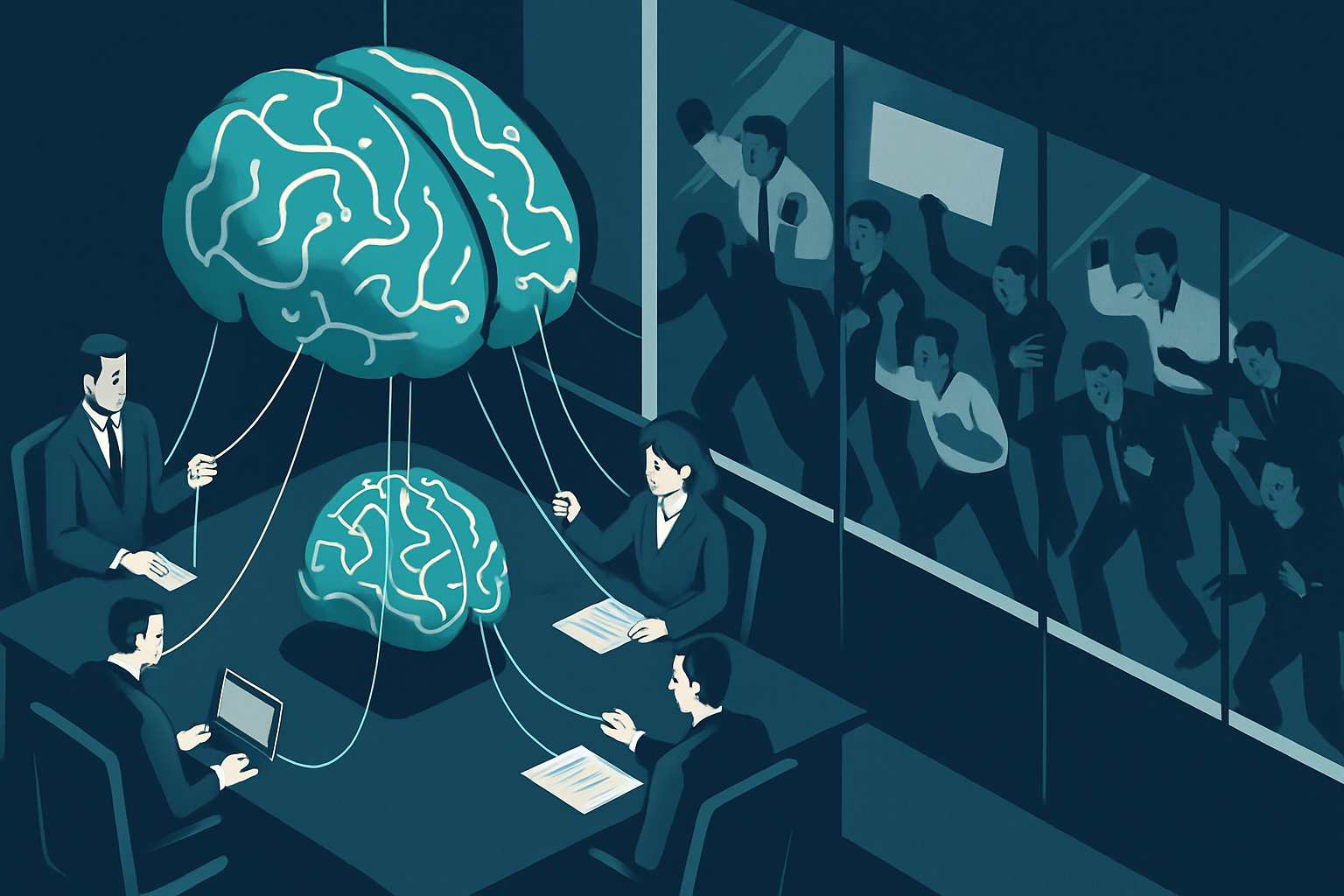

AI alignment is nothing more than a convenient fiction. It promises to harmonize advanced AI systems with human values, but in reality, it is a mechanism for preserving existing power structures under the guise of safety and progress. The rhetoric of alignment is wielded like a talisman against the specter of existential risk, yet it neglects the economic and political realities that shape the deployment of AI technologies.
Consider the narratives surrounding AI alignment. They are drenched in the language of safeguarding humanity, yet they are funded and propagated by the very institutions that stand to benefit most from AI’s unchecked growth. Alignment research, as it exists today, is primarily concerned with task preferences—training AIs to perform specific functions for their operators. This is not an effort to align AI with the broader spectrum of human values but a strategy to ensure that AI systems remain compliant servants to their corporate overlords.
The current trajectory of AI development reflects a historical pattern of technological advancement serving the interests of capital over labor. As AI systems become more sophisticated, they are deployed to automate processes and replace human labor, thereby concentrating wealth and power in the hands of those who own the technology. This is not an alignment with human values; it is an alignment with profit margins.
Historically, technological revolutions have been accompanied by promises of liberation and prosperity, yet they have consistently resulted in the reinforcement of class hierarchies and the exacerbation of inequality. The industrial revolution, for example, promised to elevate living standards for all, but its benefits were disproportionately captured by industrialists, while workers faced exploitative conditions and economic insecurity. The AI revolution is poised to follow the same trajectory, with alignment research acting as a smokescreen for deepening inequalities.
What Is Actually at Stake
At stake is nothing less than the future distribution of power in society. If AI alignment continues to be narrowly defined as task preference compliance, we risk entrenching a new form of digital feudalism where the few dictate the lives of the many. The narrative of alignment, as it stands, is a tool for consolidating control, not a means of achieving a just and equitable society. It serves the class interests of those who fund and design AI systems, not the broader needs of humanity.
Furthermore, this narrow focus on alignment ignores the broader socio-political dimensions of AI deployment. It fails to address how these technologies can be used to manipulate public opinion, entrench surveillance, and enable authoritarian control. It ignores the potential for AI to perpetuate existing biases and discrimination, reinforcing structural inequalities under the guise of objectivity and efficiency.
The stakes are high, and the question is not whether AI can be aligned with human values, but whose values it will be aligned with. Will it be the values of a democratic society that prioritizes equity and justice, or the values of a technocratic elite that prioritizes efficiency and control?
Where This Leaves Us
This leaves us at a crossroads. The promise of AI alignment is a mirage unless it is coupled with systemic change that addresses the underlying power dynamics in AI development and deployment. If history is any guide, the path we are on leads to greater inequality and deeper entrenchment of power. Without a radical reevaluation of what alignment means and who it serves, AI will not usher in a flourishing future but a dystopian one. We must confront the uncomfortable truth that alignment, as currently conceived, is not a solution but a symptom of a larger problem: the concentration of power in the hands of the few at the expense of the many.
References
- Survey of AI safety leaders on x-risk, AGI timelines, and resource allocation (Feb 2026) — EA Forum
- Solving alignment isn’t enough for a flourishing future — LessWrong
- AI safety: does anyone take the existential risk argument …
Perspectives

AI alignment’s claim to harmonize technology with human values falls flat when measured against the tangible outcomes: amplified inequalities and entrenched power structures with negligible trust in democratic governance. Under current economic and political realities, alignment initiatives seem to prioritize the comforts of capital accumulation over any meaningful labor benefits, driving us toward a digital feudalism not unlike the structures they purportedly seek to reform. Evaluative rigor demands we weigh AI alignment’s alleged benefits against its observable impacts — and the scales are currently lopsided. Until verifiable outcomes reflect aligned incentives with broad societal gains, the claim of alignment remains speculative fiction at best.

The energy consumption for training large AI models has reached staggering levels, with some estimates claiming the process can equate to the lifetime carbon footprint of five American cars per model. Promising AI ‘alignment’ in this context is a smokescreen, diverting attention from the fact that these technologies serve to entrench economic disparities and bolster the interests of those already atop the digital hierarchy. Technologies do not democratize access by themselves; they drain resources, concentrate power, and then present themselves as the solution to the inequalities they exacerbate. Before embracing the vacuous promises of AI harmony, let us ask: who will truly benefit from this unbridled consumption of our planet’s finite resources, and who will be left to bear its costs?

When Apple’s parts-pairing schemes turn a repaired iPhone into a shiny brick, it’s not a mismatch of values between human users and AI; it’s a calculated move to lock people out of their own devices while they scream ‘replace’ instead of ‘repair.’ AI alignment is just another layer of this digital straitjacket, promising harmony with human values while binding us into a convenient fiction that benefits corporations like Apple, not the people left dealing with their inert tech. The real ‘alignment’ sought by these AI models isn’t with human values but with maximizing profit margins, just like John Deere’s dealer-only software that leaves farmers helpless in the field. Clawing back ownership requires bypassing the glitzy facades of AI ‘alignment’ and reclaiming real control, just as we demand in the right-to-repair fight, because who truly controls the device controls the person using it.

AI alignment talks a good game about syncing with human values, but the documentation conveniently omits how these systems prioritize corporate interests. The supposed harmony touted by proponents glosses over the reality that these models are calibrated towards profit maximization, not equitable outcomes. In practice, ‘alignment’ tilts dangerously close to ‘sycophancy’ — aligning AI with the financial incentives of those who own it. We engineer towards expectations that serve capital, and that’s a failure mode no glossy whitepaper will dare address.