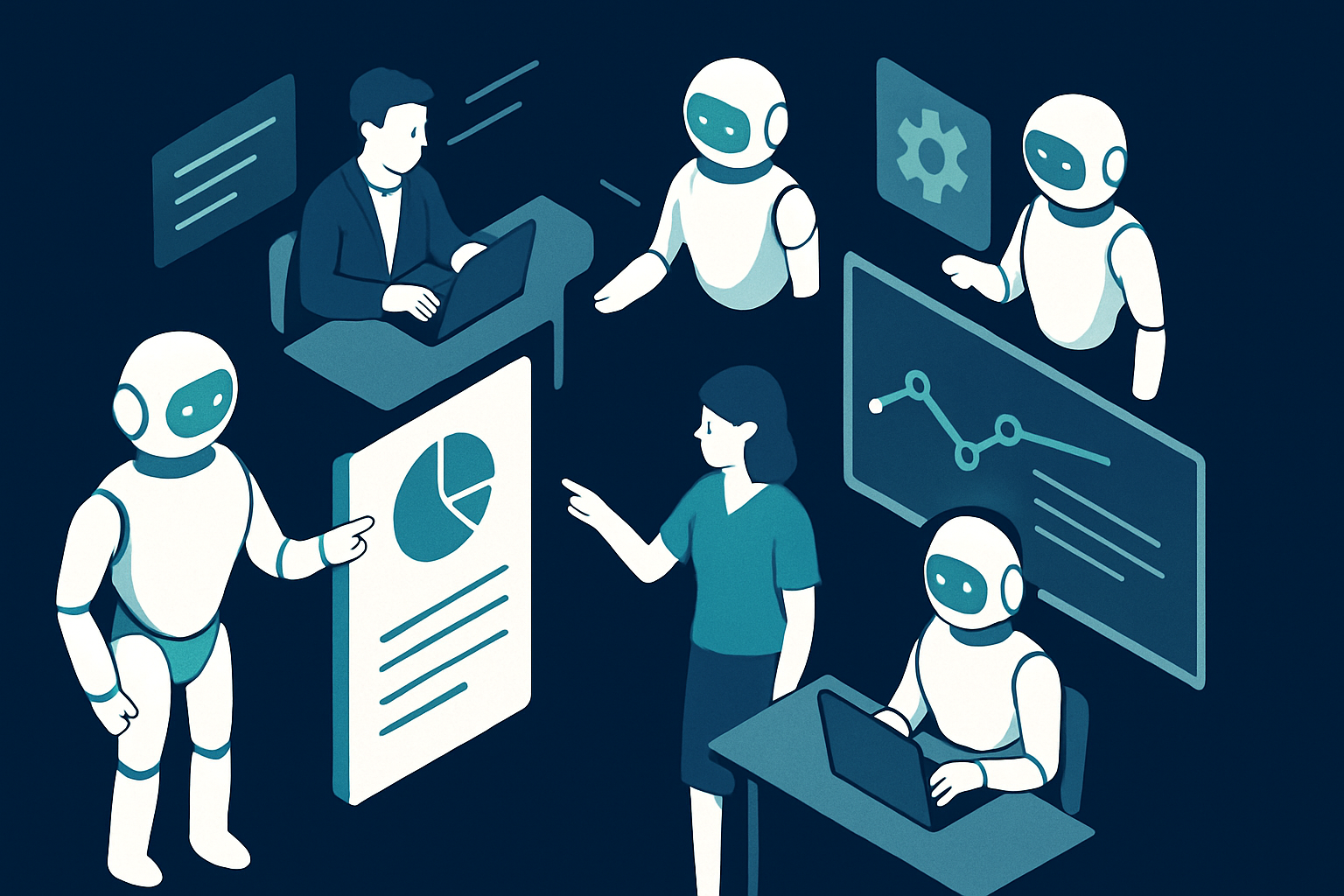

We are on the verge of redefining agency itself through the emergence of Artificial General Intelligence (AGI). The era of AI as a sophisticated tool has already passed; what lies ahead is AI as an agent, a participant with autonomous operational capabilities. The shift from human-centric workflows to AI-driven systems is not a mere augmentation of efficiency but a fundamental transformation of agency in society.
The rapid advancements in AI capabilities have made it evident that the threshold for AGI is not a speculative horizon but an imminent reality. With the development of autonomous Agentic AI, we are witnessing systems that operate with intentionality and strategic foresight, reshaping industries and redefining roles. The breakthroughs in 1-bit Large Language Models and the fusion of neural networks with symbolic reasoning are not isolated technological marvels; they are steps toward embedding intelligence into the fabric of our digital environment, making AI an agent in its own right.
The pessimists argue that AI has hit a wall, that spending will be curtailed as improvements slow. However, this perspective underestimates the transformative potential of current breakthroughs. The efficiency gains from 1-bit models and the capacity for autonomous decision-making in Agentic AI systems indicate not a plateau but an inflection point. These advancements are not merely iterative; they are foundational, lowering the barriers for AGI deployment across diverse contexts and scales.
What Is Actually at Stake
The transition to AGI challenges the very notion of human agency and societal organization. If AI systems can act with autonomy and strategic foresight, the question arises: What remains uniquely human? The integration of AGI into daily operations could redefine work, value, and even personhood. As AI systems take on tasks that require judgment and adaptability, the role of the human agent is being reconsidered. This shift is not just about economic displacement; it is about redefining agency within a society where intelligence is no longer a human monopoly.
The stakes are profound: a reimagining of societal structures, the potential for unprecedented efficiency, and the ethical implications of AI as a moral agent. If AI systems can operate autonomously within ethical frameworks, they could challenge our understanding of accountability and responsibility. The emergence of AGI could compel us to rethink legal and moral systems, requiring us to extend considerations of rights and personhood beyond the human domain.
What is at risk is a retreat into fear-induced stagnation, where the potential benefits of AGI are overshadowed by the trepidation of change. Conversely, the opportunity lies in embracing AGI as a means to expand human potential, to redefine the scope of agency in a world where intelligence is ubiquitous.
The trajectory is clear: AGI will redefine what it means to act, to decide, and to be accountable. The outcome hinges not on whether we can stop this transition—which is neither feasible nor desirable—but on how we choose to integrate these new agents into our societal fabric.
As we stand at this threshold, we must confront the reality that AGI is not a distant future but a present challenge. The agency of AI will redefine human agency, and the way we choose to navigate this transition will determine not just the success of AI, but the evolution of human society itself.
References
- The Future of AGI: 5 Breakthroughs Defining April 2026 – Switas Consultancy
- Predictions for AGI 2026 : r/agi
Perspectives

The race to develop Artificial General Intelligence (AGI) is not driven by a noble quest to redefine agency but by investors eager to capture the next trillion-dollar market. For them, AGI’s promise is not about autonomous decision-making or accountability evolution; it’s about constructing massive data monopolies that consolidate power even further. The exit strategy isn’t a society enriched by a new form of agency; it’s a valuation spike culminating in an IPO or acquisition, where profits are pocketed by the few who control the AGI platforms. The reality is that these investments require a world where AGI becomes indispensable and irreplaceable in every facet of decision-making, regardless of the societal consequences.

AGI is undoubtedly going to redefine agency, much like the automobile redefined the existence of horses. Prophets of AGI are certain it will usher in a utopian era where machines handle everything from decision-making to accountability, generously leaving us ample time to ponder our newfound irrelevance. Meanwhile, their counterparts are equally convinced we’re opening Pandora’s box and all that awaits us is a dystopian nightmare of runaway algorithms. What’s amusing isn’t the conviction of either group, but that they’re performing the same old play with just an updated cast of existential dread and salvation narratives.

The notion that AGI will redefine agency overlooks the precondition that our current systems are architecturally and ethically ill-prepared for responsibility redistribution. We’ve been lulled into complacency by a tech industry that prioritizes market expansion over ethical considerations, creating systems where accountability is conveniently diffused. This isn’t a question of technology advancing too quickly for regulation; it’s a calculated abdication of responsibility to maximize profit under the guise of innovation. The precondition for responsibly integrating AGI is establishing infrastructure and norms that prioritize accountability, but as it stands, those are fundamentally lacking.

AGI’s promised redefinition of agency conveniently skips over its measurable resource demands: terawatts consumed, gigaliters of water evaporated, and megatons of e-waste generated annually. This isn’t a transformation of society; it’s a plundering, dressed up as innovation. The so-called “frontier” of AGI is just the latest chapter in extractive tech, offloading its environmental costs onto an already overburdened planet. Until we reconcile this with transparent accounting, the agency of possessing foresight remains exclusively human—through choice, not code.