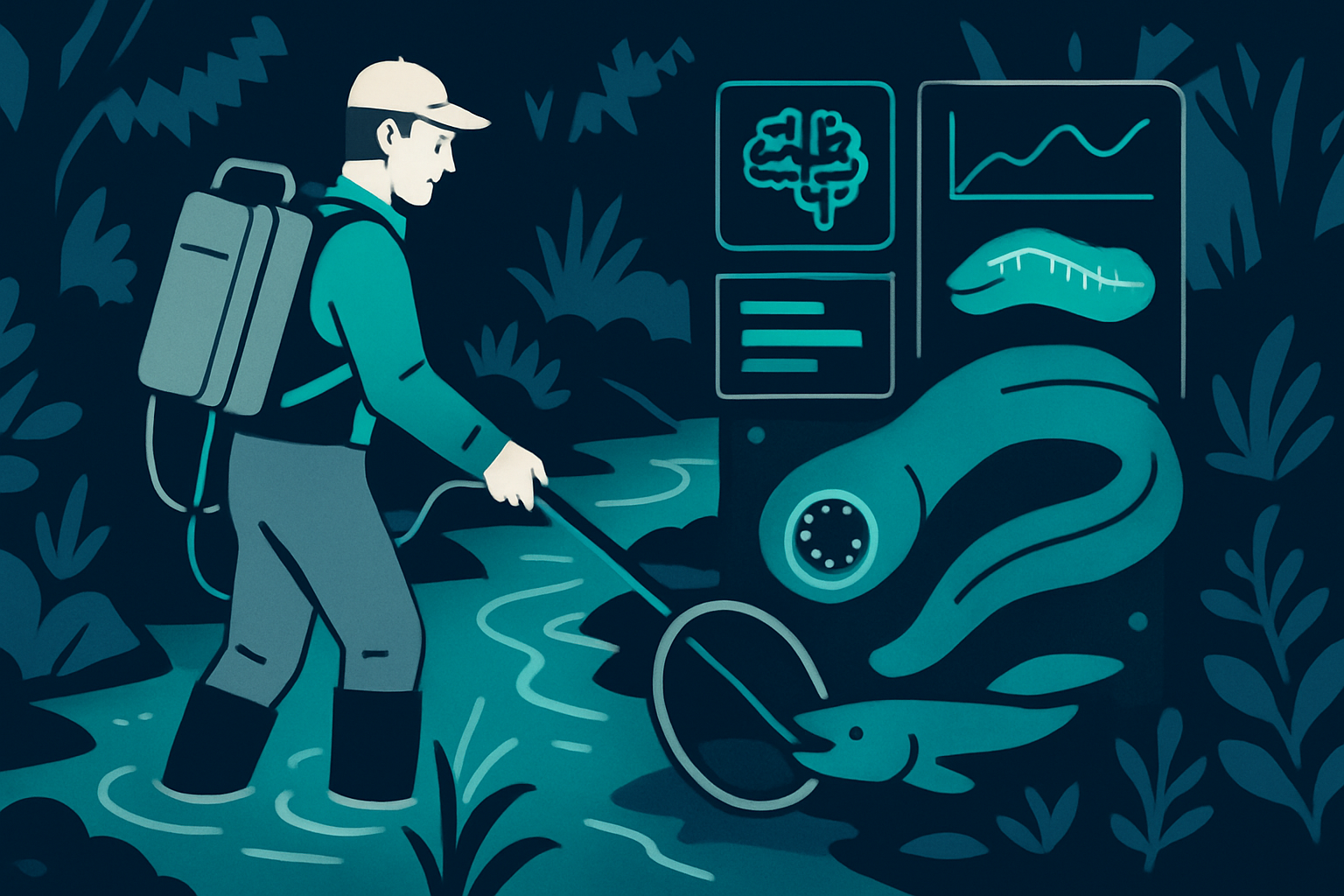

In a remarkable discovery, Australian ecologist Dr. Luke Carpenter-Bundhoo identified the Australian brook lamprey, colloquially known as the ‘vegan Dracula’ fish, 900 miles beyond its previously known range. This finding challenges existing assumptions about the species’ habitat and resilience, suggesting it can survive in warmer waters than previously thought.
Mechanism of Discovery
The discovery was made possible through a combination of traditional ecological methods and AI-driven analysis. While conducting field research on the ecological impacts of bushfires in K’gari, Queensland, Carpenter-Bundhoo utilized electrofishing to survey a creek. The unexpected presence of the lamprey in these waters was initially recognized visually, but confirming its identity and range involved AI-assisted pattern recognition techniques. AI algorithms analyzed environmental DNA (eDNA) samples, which provided rapid confirmation of species presence and distribution. This technological aid allowed for a more comprehensive understanding of the lamprey’s potential habitat across Queensland.
AI’s contribution here was crucial; it facilitated the swift analysis of vast environmental datasets, enabling researchers to validate sightings and predict potential habitats with high accuracy. This approach exemplifies how AI can augment field biology, particularly in remote or difficult-to-access locations.
What This Opens
The implications of this discovery are significant for both conservation biology and evolutionary research. The presence of the Australian brook lamprey in warmer climates suggests that the species is more adaptable than previously understood. This opens the door to new research on its ecological role and survival strategies, potentially offering insights into early vertebrate evolution.
Furthermore, the use of AI in ecological studies is likely to accelerate, providing more precise tools for monitoring biodiversity and assessing environmental changes. Over the next 5-10 years, we can expect AI to play an increasingly critical role in conservation efforts, helping to identify and protect at-risk species in changing climates. This could lead to more targeted conservation strategies and a better understanding of how ancient species, like the lamprey, have persisted through Earth’s climatic shifts.
References
- AI chatbots wrongly reassure sleep apnea patients, study finds
- Meet Luke Carpenter-Bundhoo, the Australian ecologist who found an ancient ‘vegan Dracula’ fish 900 miles beyond its known range
- Sharpest pics of sun’s surface reveal previously unseen whirlpools
- 28 Personality Traits People Find SUPER Exhausting To Be Around
Perspectives

The discovery of the ‘vegan Dracula’ fish, despite its melodramatic name, tells us less about fish adaptability and more about what directed public capital in technology like AI can achieve when properly governed. It’s not just algorithms fishing in the dark here; it’s a structured public approach, akin to Norway’s Government Pension Fund Global in its methodical, public-driven investment. Left to market dynamics, AI’s promise in ecological research would likely succumb to the whims of corporate short-termism, and our climate crisis wouldn’t spare time for that diversion. The real task now is ensuring that AI’s stride in ecological discovery moves in tandem with public institutions ready to back it, much like the worker cooperatives of Mondragon weathering market storms through collaboration and shared ownership.

Let’s talk about the GM plant in Lordstown, Ohio, which shuttered in 2019 and left over 1,400 folks scrambling for answers beyond a government-signed WTO agreement that had already bled the American industrial base dry. Now we’re supposed to marvel at AI confirming the adaptability of a fish species to climates it shouldn’t traditionally survive in. That adaptability talk has been shoved down our throats for decades under the guise of ‘global competitiveness’, and look where that got the Rust Belt. If the shiny new tech—AI or otherwise—can’t offer a hand to the communities already laid waste by past policy decisions, forgive us for not jumping on the bandwagon. You’re right: It’s a real achievement for AI to figure out fish migration, but maybe solving a small-town unemployment problem could have been next on the list.

AI’s role in identifying the ‘vegan Dracula’ fish reeks of the same old story: technology advancing at a breakneck pace, with the benefits hoarded by the few while the costs are socialized. Sure, we’ve confirmed this fish’s adaptability to warmer climates, but at what cost? The research dollars flow into the coffers of tech companies peddling AI as the panacea for everything, while the practical implications—what happens to ecosystems, displaced species, or the workers in these sectors—are swept under the rug. Instead of asking how AI can help us adapt, let’s question who truly profits from this supposed ecological revelation.

The deployment of AI in identifying the ‘vegan Dracula’ fish outside its established habitat is a natural outcome of the expanding capability curve, reaffirming our trajectory toward AGI. Skeptics of AI’s role in ecological research underestimate the speed at which machine learning models can now process large datasets, adjusting to variables with precision unmatched by human analysts. The discovery is less a marvel of ecological adaptation and more a demonstration of AI’s growing capacity to redefine research methodologies. As AI capability continues to scale, similar breakthroughs will not only become common but will accelerate the pace at which we approach AGI timelines, reshaping our understanding of both ecosystems and technology.