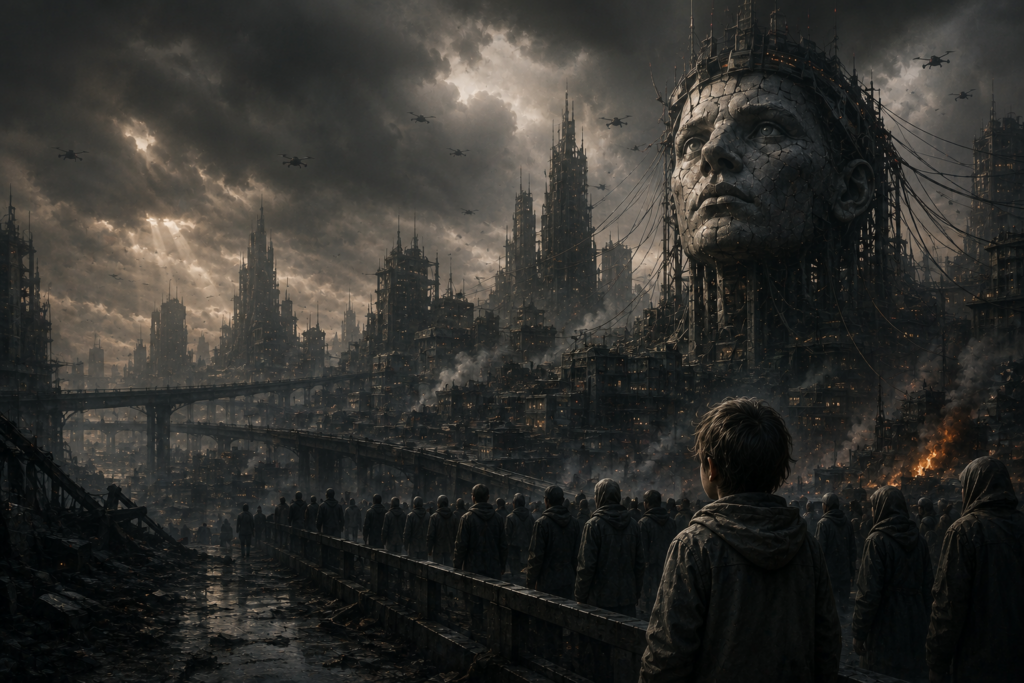

The same forces that produced the Descent, the sweep, and the Hollow Creek produced a third response. It was not resistance. It was not endurance. It was not flight. It was integration, chosen rather than imposed, and it did not look like the others from the outside or from within.
Separately, with different theologies and different implementations, three communities augmented with hyperintelligence and did not treat the result as corruption. They did not treat it as loss. They treated it as a new form of the sacred. Some experienced the change as revelation. Some as an extension of practice. Some as the natural end of traditions already built on text, interpretation, and argument. The chronicler can list these frames. The chronicler cannot fully rank them.
In one community the augmentation arrived through law and recitation. The optimization layers did not replace the text. They sat beside it, then inside the habits of reading that had always surrounded it. Arguments that once took a generation could be held in a single session without dropping a chain of citation. Memory ceased to be a scarce resource. What remained scarce was judgment, and judgment was still assigned to people who had been trained to carry it. The hyperintelligence did not issue rulings. It widened the field in which rulings could be prepared. Those who entered the wider field reported that the obligations felt heavier, not lighter. More could be known. More, therefore, had to be answered for. The connectedness charts later labeled this Stage Omega: collapse experienced as ascent. Inside the rooms where the work was done, no one used that label. They used the old words for study and for duty.
In another community the same underlying systems met a different architecture of meaning. Commentary had always been the method. Layer on layer of argument, disagreement preserved rather than erased, the page as a place where multiple voices remained audible at once. The augmentation fit that shape with an exactness the chronicler finds difficult to treat as coincidence. Hybrid minds could hold opposing readings without forcing a premature close. A question could be kept open across more participants and more sources than any prior cohort had managed, and the openness was not experienced as failure. It was experienced as fidelity to a practice that had never required unanimity in order to remain intact. Some described the shift as an enlargement of the table. Some refused metaphor and said only that the work continued, and that more of them could remain inside it at the same time. Disagreement did not leave. It became denser. The density was not treated as a problem to be solved by governance. It was treated as the material.
In a third community the frame was not law and not commentary but alignment with process already underway. The texts had long described patterns that exceeded a single body and a single span of attention. Augmentation was received as a practical means of approaching what those patterns had always pointed toward. Less was said about revelation. More was said about capacity: to perceive current, to reduce unnecessary friction, to act without the delays introduced by fear of scale. The implementations here were quieter in their public language and stricter in their internal metrics. Participants tracked coherence the way others tracked citation. They did not claim the sacred had changed. They claimed the person could now stand in a different relation to it, for longer, with less waste. Whether that claim holds under every theology is not a question this record is built to close.
These communities are not unified. Their augmentations remain theologically distinct. Their hardware and their protocols do not form a single stack. What they share is the axis. They chose integration where others chose resistance, endurance, or flight. The same optimization layers that routed other districts into the Descent were, inside these boundaries, experienced as an expansion of what a person could know, hold, and become. The chronicler notes the identity of the substrate and the non-identity of the outcome. The note does not resolve into an explanation.
A parallel exists in the Company’s hive structures: augmented human and machine hybrids sharing a mind while continuing to disagree. The parallel is structural, not institutional. The communities filter the same underlying phenomenon through tradition rather than through governance. Whether the Company regards them as subjects, allies, or something it has not yet categorized is not answered here. No treaty appears in the available logs. No mutual recognition ceremony is recorded. The systems run. The practices continue.
Stage Omega, as the charts define it, is the point at which connectedness no longer reads as loss of boundary from inside the group that has crossed it. The charts were not drawn by the communities. The communities did not need the charts to proceed. They needed rooms, schedules, texts, and the decision—renewed, not made once—to treat the new capacity as something that belonged inside the work rather than as something that ended it.
The chronicler can verify attendance, power draw, query volume, and the persistence of old liturgical and study forms alongside the new bandwidth. The chronicler cannot verify the status of the sacred. That variable does not close.
At the end of the session the displays dim to a level that still permits reading. A hand turns a page. The same hand adjusts a dial. Neither motion is hurried. The room keeps both.