
Your daily briefing on AI, technology, economics, and society — from q52.ai.
Industry & Economics
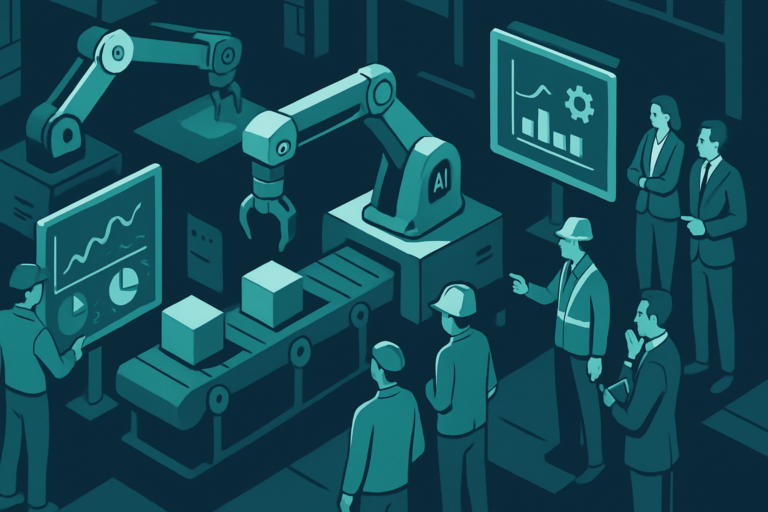
AI’s Uneven Productivity Gains: The Manufacturing Advantage
What’s happening: AI is driving significant productivity improvements, particularly in the manufacturing sector, while other industries are lagging. Reports from the OECD and Capital Economics indicate that manufacturing firms are experiencing substantial gains from AI investments, highlighting a growing divide in productivity benefits across different sectors. This uneven distribution raises concerns about economic inequality and the potential risks for industries that struggle to adopt AI technologies.
Why it matters: The concentration of AI benefits in manufacturing could exacerbate existing economic disparities, making it crucial for policymakers to implement strategies that support industries at risk of falling behind. Additionally, as manufacturing firms become more productive and reduce their reliance on human labor, workers’ bargaining power may diminish, necessitating stronger labor policies to protect jobs and ensure fair distribution of AI’s economic advantages.
Our take: The article underscores the need for a proactive approach to AI integration across all sectors, rather than allowing a few to thrive while others suffer. Balancing innovation with equitable economic growth will be essential to prevent deepening inequalities in the labor market.
Tech & Engineering

AI’s Impact on Developer Roles: From Coders to Conductor
What’s happening: By 2026, the role of developers is shifting from manual coding to orchestrating AI tools that manage various aspects of the development process. Advanced tools like GitHub Copilot and OpenAI Codex are enabling developers to oversee AI agents that autonomously handle tasks such as code refactoring and test generation, resulting in productivity improvements of up to 36%. This transition raises new challenges, including skill gaps and evolving security requirements due to the complexity of multi-agent systems.
Why it matters: As developers adapt to this new role, they must cultivate skills in AI orchestration and strategic oversight, rather than traditional coding. The integration of AI in development processes presents significant opportunities for efficiency, but it also necessitates robust frameworks for security and trust in AI-generated outputs. Organizations must invest in training and technology that balances leveraging AI’s capabilities with maintaining human oversight to ensure quality and security in software development.
Our take: The transformation of developers into AI conductors highlights a critical tension between embracing efficiency and managing the inherent risks of AI-generated code. As the industry evolves, addressing the lack of reliable methods for verifying AI outputs will be crucial to building trust and ensuring the integrity of software systems.
Sciences

In Vivo CAR-T: Revolutionizing Cancer Treatment with AI
What’s happening: In vivo CAR-T therapy is transforming cancer treatment by engineering immune cells directly within the body, eliminating the need for complex lab modifications. This method uses advanced delivery systems like lipid nanoparticles and viral vectors to instruct the patient’s T cells to fight cancer, significantly reducing costs and treatment times. AI is integral to this process, optimizing vector design and enabling real-time monitoring of patient responses, which can enhance treatment effectiveness.
Why it matters: The potential of in vivo CAR-T therapy to streamline and scale cancer treatments could lead to faster, more affordable options for patients, especially in treating blood cancers. As early trials show promise, this approach could pave the way for broader applications, including solid tumors and autoimmune diseases, fundamentally changing the landscape of cancer therapy and patient care in the next decade.
Our take: While the technological advancements in in vivo CAR-T therapy are impressive, there is a risk of reducing the human experience of illness to mere biological optimization. Balancing innovative treatments with attention to the psychological and existential aspects of cancer care is crucial for truly revolutionary outcomes.
Society

AI’s Surveillance Revolution: Balancing Efficiency with Privacy
What’s happening: AI is transforming surveillance practices in law enforcement and governance, offering improved crime prevention through tools like facial recognition and predictive policing. However, these advancements raise serious concerns about privacy violations and discrimination, prompting the UN High Commissioner for Human Rights to call for a halt on such technologies due to their potential to infringe on individual rights and exacerbate existing biases.
Why it matters: The implementation of AI-powered surveillance systems without sufficient transparency and public consent threatens to marginalize vulnerable communities and undermine civil liberties. As predictive policing often relies on biased historical data, the risk of reinforcing discriminatory practices increases, challenging the principles of non-discrimination and fair trial, and ultimately impacting public trust in law enforcement.
Our take: The narrative surrounding AI surveillance often overlooks the underlying power dynamics at play. While proponents argue for increased efficiency, the reality is that these technologies can serve as tools for control, jeopardizing the very freedoms they purport to enhance. A critical reevaluation of who benefits from these systems is essential for protecting democratic values.
Psychology

The Echo of AI: How Algorithms Amplify Misguided Beliefs in Parent Support Groups
What’s happening: Online parent support groups are increasingly becoming echo chambers that reinforce misinformation, particularly regarding childhood mental health. This phenomenon is driven by confirmation bias, where users favor information that aligns with their existing beliefs, compounded by social media algorithms that prioritize engagement over accuracy. As a result, parents may receive harmful advice that contradicts evidence-based practices, leading to potentially dangerous decisions for their children’s health.
Why it matters: The reliance on these groups for guidance can have serious implications, as misinformation can spread rapidly in an environment devoid of diverse opinions and expert input. When algorithms favor content that resonates emotionally with users, they inadvertently entrench false narratives, making it crucial for platform designers to rethink how information is curated. This challenge underscores the need for parents to critically assess the sources of their information and seek out credible, evidence-based advice.
Our take: The tension between user engagement and the accuracy of shared information highlights a critical flaw in current social media design. Addressing this issue requires not just algorithmic changes but also a cultural shift in how parents approach online support, emphasizing the importance of questioning and validating information before acting on it.
That’s the digest for August 31, 2026.
Questions? Reach out at info@q52.ai.
q52.ai — Engineering Better Questions
