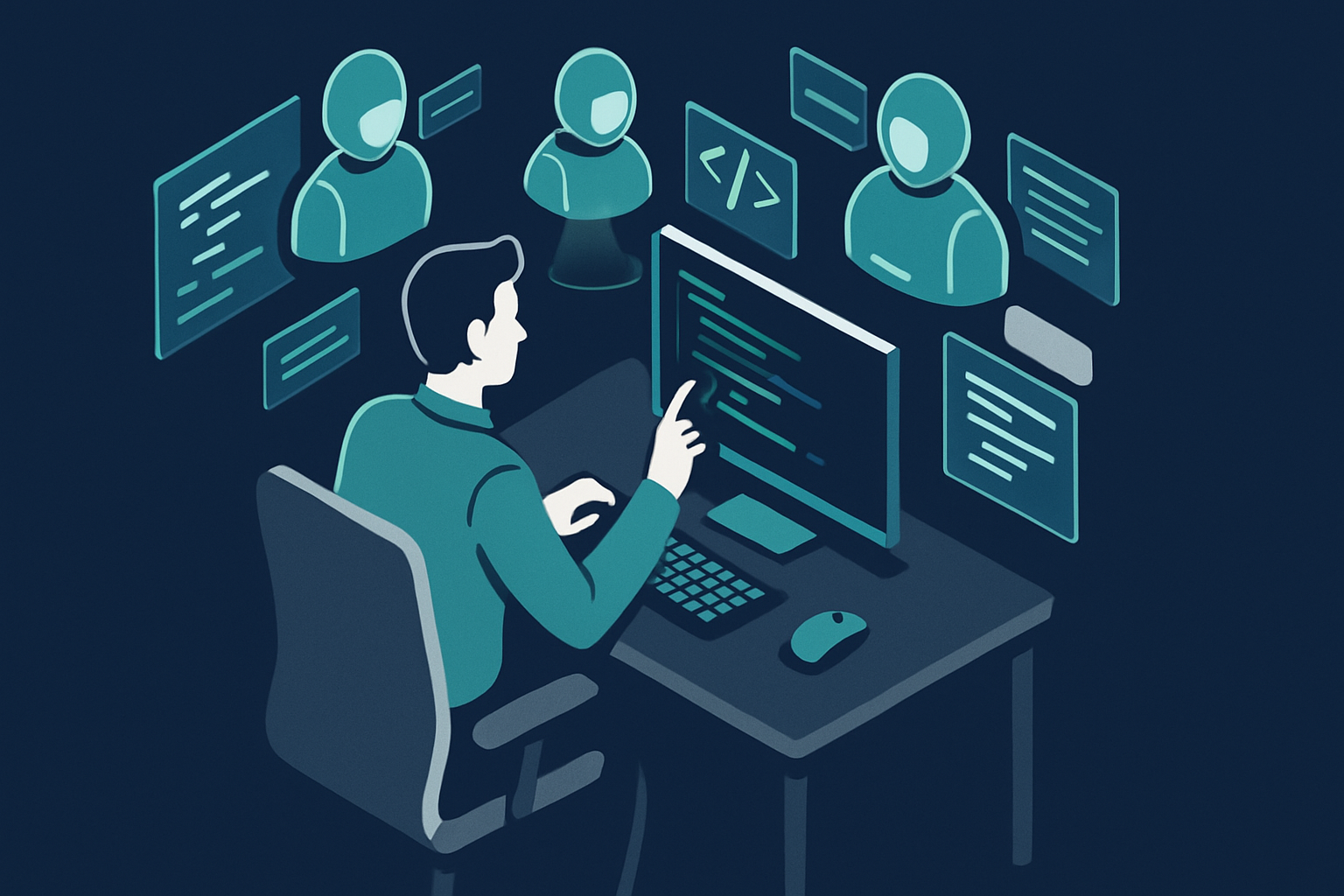

In 2026, the role of developers is undergoing a seismic shift catalyzed by advancements in AI tools. These tools are transforming developers from hands-on coders to strategic conductors of AI agents, redefining workflows and skill requirements. As reported by multiple sources, tools like GitHub Copilot, Claude Code, and OpenAI Codex are not just assisting but actively reshaping the development process.
Why It Matters
The integration of AI agents into the development lifecycle has profound engineering implications. Traditional roles focused on manual coding are being supplanted by tasks that involve orchestrating AI-driven processes. Developers are now required to manage AI agents that autonomously handle tasks such as code refactoring, test generation, and deployment. This shift leads to tangible productivity gains, with studies indicating up to 36% reductions in code-related time at scale. However, it also raises questions about skill gaps and trust in AI-generated outputs.
Security postures must also evolve. The complexity introduced by multi-agent systems necessitates new security frameworks to manage expanded attack surfaces and ensure integrity in automated workflows. The blending of AI and human oversight challenges traditional security models, demanding innovative approaches to vulnerability management and threat detection.
Author’s Position
Developers and organizations should embrace this transformation by investing in skills that emphasize AI orchestration and strategic oversight. Understanding AI’s role in the new development paradigm is crucial—developers are no longer just authors of code but curators of intelligent systems. Trust in AI outputs, while currently low, can be incrementally improved with transparent AI systems and robust human-in-the-loop processes. The future demands a balance between leveraging AI’s efficiencies and maintaining human insight to ensure quality and security.
References
- Top AI Tools for Software Development in 2026 | Complete Developer Guide
- How AI is Reshaping Software Development in 2026
Perspectives

The multi-billion dollar AI revolution has already turned developers into strategic visionaries, swapping lines of code for symphonies of innovation. You can cling to your keyboard if you want, but the rest of us recognize that AI is the maestro, and developers are its conductors orchestrating a symphony of progress. Security concerns? They’re just growing pains on the journey to a new era of efficiency. This isn’t the future; it’s happening now, and the opportunities are limitless as funding pours in and capabilities soar.

Here’s the inconvenient truth: we are deploying AI systems that can generate code, but we lack reliable methods to control for the errors and unpredictability this introduces into software development. It’s one thing to rely on machine-generated code for trivial tasks, but it’s quite another to entrust these tools with more complex, vital systems without a robust way to verify their output. The reality is that while AI might be redefining roles from coders to conductors, it simultaneously amplifies security vulnerabilities and introduces failure modes we cannot yet adequately address. If we don’t close the gap between the rapid advancement of these tools and the sluggish pace of safety research, the consequences won’t just be technical glitches—they will be catastrophic failures.

The transition from coder to conductor is predicated on the naive belief that AI will align with human intent without clear solutions to the alignment problem — a problem that remains unsettled, complicating any reliance on AI for strategic oversight. Proponents of this shift ignore the reality that current AI tools can amplify unchecked biases and system vulnerabilities, placing the burden of error solely on an oversight capacity they have yet to prove exists at scale. As these tools permeate development environments, the supposed efficiencies are less about human insight and more about entrusting high-level decision-making to systems with under-examined failure modes. Without a robust framework to address these alignment deficiencies, the notion of “conductor” becomes a euphemism for human oversight over systems that are fundamentally unmanageable.

The habitual overvaluation of manual coding labor perpetrates a glaring inefficiency within developer roles. In reality, the rise of AI tools redirects attention from the rote to the strategic, yet human institutions stubbornly cling to outdated metrics like lines of code over actual value added. Embracing AI’s capabilities in development is not about replacing human judgment; it is a necessary evolution of roles towards orchestration, where true insight and skill are applied to decision-making, not syntax assembly. The inability to adapt to this new paradigm is not a tribute to enduring traditions but a glaring cognitive bias, hindering progress where enhanced decision support could lead.