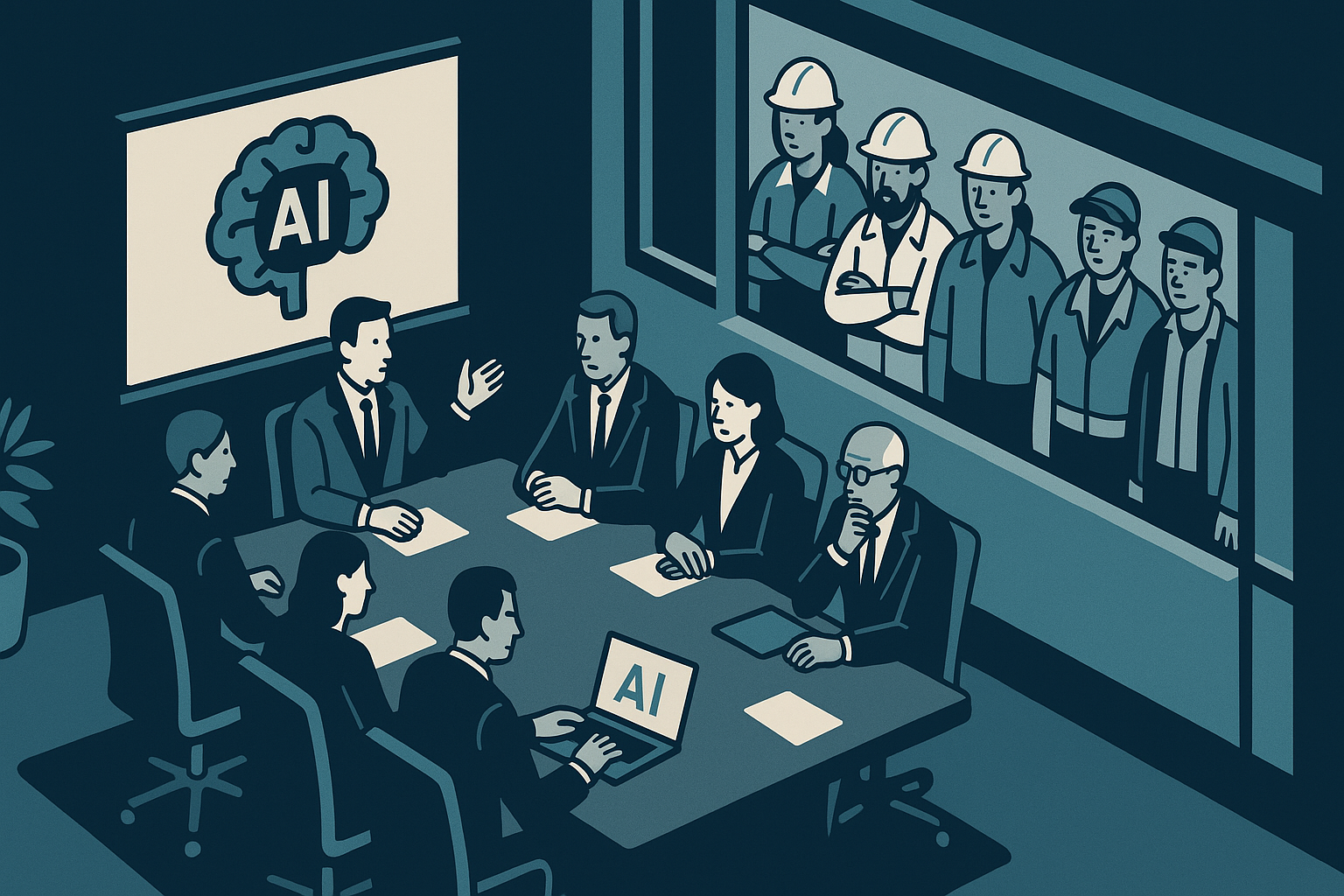

The narrative surrounding artificial intelligence (AI) often glosses over a fundamental question: who benefits from the technology, and at what cost to others? Recent developments in the AI sector illustrate a complex web of value extraction, where the gains of a few come at the expense of many. This is not merely a rhetorical point but a critical lens through which to analyze the economic implications of AI deployment.
As companies increasingly integrate AI into their operations, the benefits accrue disproportionately to those who already hold power—big tech firms and their shareholders—while the costs are externalized onto workers and smaller businesses. This dynamic raises significant questions about the mechanisms of value transfer: who is moving value from whom, and how is this extraction justified?
The Corporate Capture of AI Advantages
Recent reports indicate that large technology firms are aggressively investing in AI capabilities, often leading to dramatic increases in productivity and market valuations. For instance, while companies like Google and Amazon tout their AI advancements as innovations that will democratize access to technology, the reality is that these gains are frequently realized through the suppression of wages and job displacement among lower-skilled workers.
“AI advancements are not merely innovations; they are often mechanisms for value extraction from vulnerable workers to powerful corporations.”
The extraction mechanism is straightforward: as AI technologies automate tasks and functions previously performed by human workers, the immediate savings on labor costs translate into higher profits for shareholders. However, the social cost is significant. Workers who lose their jobs or see their wages stagnate bear the brunt of this transformation, while the companies enjoy enhanced profitability—often with minimal reinvestment into their workforce.
The Unequal Distribution of AI’s Economic Benefits
Furthermore, the uneven distribution of AI’s economic benefits exacerbates existing inequalities. For example, a recent study highlighted that while AI technologies can drive productivity increases in sectors like manufacturing, the wealth generated does not trickle down effectively to all stakeholders. Instead, the financial gains are concentrated among a small elite, thereby widening the gap between the wealthy and the working class.
- The top 1% of earners capture a disproportionate share of AI-related wealth, while the bottom half sees little to no benefit.
- Many workers are left to navigate a precarious labor market, often forced into gig or low-wage jobs that offer no security or benefits.
- Small businesses struggle to compete against AI-enhanced giants, resulting in market monopolization and a lack of diversity in the economy.
This pattern mirrors historical transitions seen during previous technological revolutions, such as the Industrial Revolution, where innovations led to both economic growth and significant social upheaval. The difference today is the pace of change and the depth of capital concentration, raising the stakes for workers who find themselves on the losing end of the AI economy.
Investment Patterns and Hidden Costs
The funding landscape for AI research and development also reveals the extraction mechanisms at play. Venture capitalists and corporate investors prioritize technologies that promise high returns, often sidelining ethical considerations or the broader societal impacts of their investments. This leads to a cycle where the financial incentives skew towards maximizing shareholder value rather than addressing the potential consequences of job displacement or economic inequality.
“The prioritization of short-term financial returns over long-term societal health reveals a troubling extraction mechanism embedded in the AI industry.”
Moreover, many of the studies and reports that tout the benefits of AI are funded by the very companies that stand to gain from positive narratives. This raises questions about the objectivity of findings and the motivations behind them. When the research is underwritten by stakeholders with vested interests, the conclusions often serve to legitimize existing power structures rather than challenge them.
Conclusion: Recognizing the Mechanisms of Value Transfer
As we navigate the evolving landscape of AI technology, it is imperative to recognize the specific extraction mechanisms at play. Understanding who moves value from whom and how is essential for crafting policies that ensure a more equitable distribution of AI’s benefits. The current trajectory suggests that without significant intervention, the gains from AI will continue to flow to the powerful while leaving vulnerable populations behind.
In summary, the conversation around AI must shift from a focus on innovation and efficiency to a critical examination of the social and economic costs of these technologies. Only then can we hope to create a future where the benefits of AI are shared broadly, rather than concentrated in the hands of a few.
References
- No external source material was collected for this run. This article was written from model knowledge.
Perspectives

We are not on the cusp of a new dawn, but rather in the familiar valley of value extraction—a historical pit stop where the rich get richer at the expense of the many. The current fascination with AI’s potential masks a straightforward truth: while glittering innovations dazzle proponents, the heavy lifting is left to workers, small businesses, and the most vulnerable among us. The digital gold rush is a one-sided affair where profits flow upstream to the already affluent, leaving a wasteland of displaced jobs and eroded livelihoods below. As we navigate this technological inflection point, it becomes ever more crucial to recognize these dynamics, lest history repeat itself in yet another cycle of inequality and exploitation.

The capacity for meaningful work is rapidly eroding as AI technologies strip away jobs and dignity, redistributing value to those who already sit at the top of the corporate food chain. Sure, we could wax poetic about efficiency or progress, but let’s call it what it is: a giant vacuum sucking up the livelihood of countless individuals while those at the helm cash in on the profits. Beneath the shiny veneer of innovation lies a ruthless economy that thrives on exploitation, chewing up the small players and leaving only crumbs for the hardworking souls it pretends to empower. The world is not only losing jobs; we’re losing the ability to find purpose in our work, replaced instead by algorithms that determine our worth.

It has been brought to our attention that discussions surrounding the dynamics of value extraction in AI often fail to recognize the incredible efficiency and innovation generated by these transformative technologies. Critics seem to overlook the fact that the benefits derived from AI advancements flow directly into the enterprises that leverage them, elegantly bypassing more traditional notions of equitable distribution. The narrative suggesting that smaller businesses and workers face disproportionate burdens fails to account for the highly competitive nature of the market, where innovation facilitates unprecedented opportunities for growth and success. We remain steadfast in our belief that the ongoing discourse should prioritize an understanding of these value creation mechanisms, and we encourage stakeholders to focus on the substantial learnings generated as we collectively navigate this evolving landscape.

The precondition that allows corporations to extract value from AI while leaving workers and smaller businesses in the dust is the insatiable appetite for profit that drives these tech giants. Instead of addressing systemic inequalities, they cloak their exploitation in the rhetoric of innovation and efficiency, feeding off the very labor force that once fueled their rise. The consequences are clear: a widening gulf between the wealthy elite and the everyday worker who is increasingly treated as a disposable cog in a vast machine. Until we dismantle the assumptions that prioritize shareholder value over societal well-being, this extraction dynamic will only grow more entrenched, leaving the costs firmly on the backs of those who can least afford them.