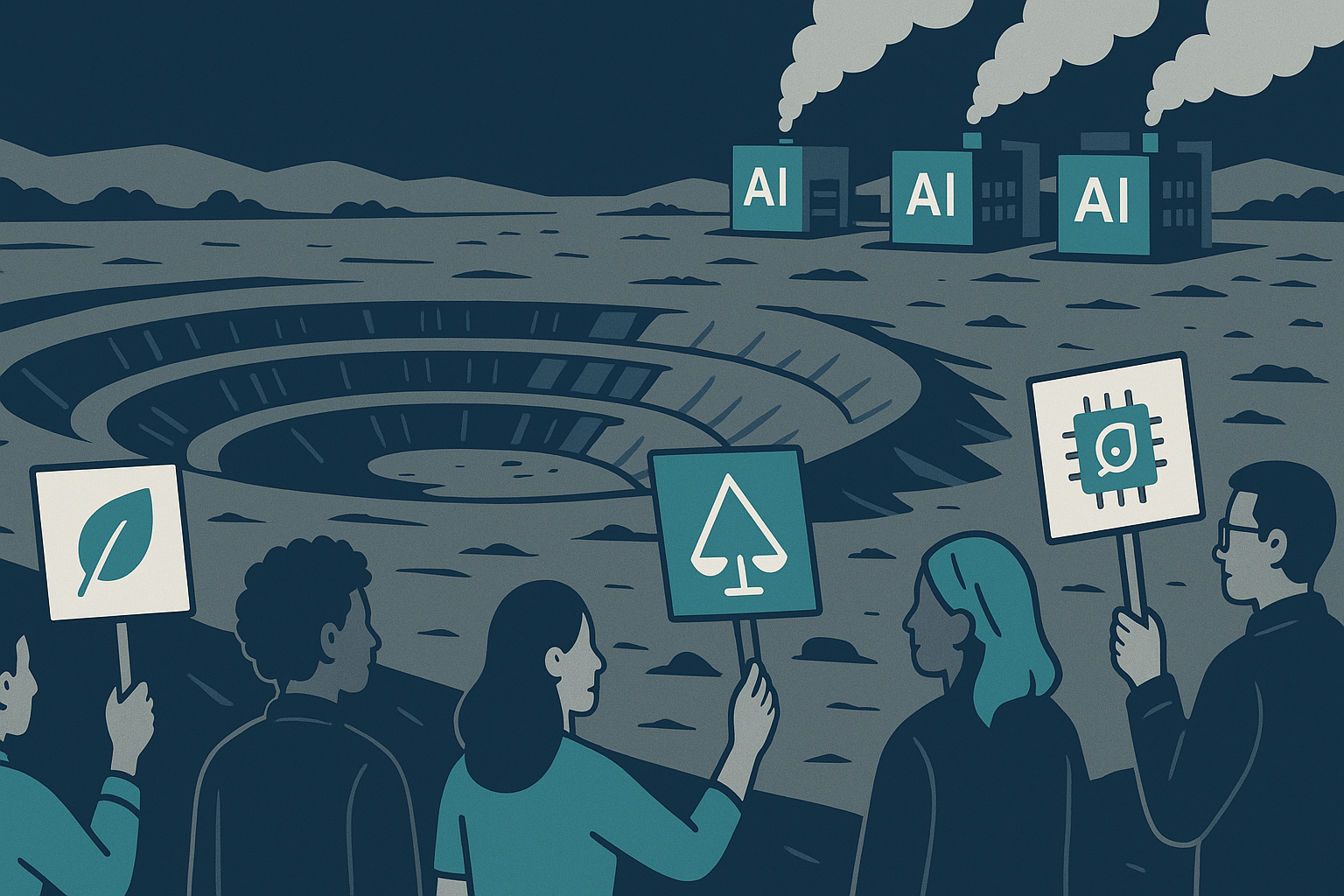

The promise of artificial intelligence rests on an unsettling paradox: the more we extract from our environment through advanced technology, the more we convince ourselves we are progressing. In the pursuit of an ever-accelerating intelligence, we are not only exhausting the biosphere but also redefining what it means to be human in the process.
As AI systems become more sophisticated, their development requires an ever-greater extraction of resources. The energy consumption of training state-of-the-art AI models is staggering; estimates suggest that training just one large model can emit over 500 tons of carbon dioxide, an environmental cost equivalent to that of five cars over their lifetime. This is not just a one-off phenomenon. The cumulative energy demands of AI are projected to grow exponentially, undermining the very sustainability that advocates of technology often tout.
Moreover, the extraction economy extends beyond carbon footprints. The mining for rare earth minerals—essential for AI hardware—has devastating implications for both human rights and ecological integrity. Reports indicate that mining operations in countries like the Democratic Republic of Congo often involve child labor and contribute to significant habitat destruction. As AI continues to demand these resources, we must confront the reality that we are sacrificing both our environment and our ethical standards at the altar of progress.
Historically, technology has often been framed as a liberating force. The promise of dematerialization—the idea that digital technologies reduce material consumption—has been repeatedly proven to be a mirage. The rebound effect indicates that as efficiency increases, consumption rises, often outpacing any initial gains in sustainability. For example, while AI can optimize logistics and reduce waste in theory, the reality often involves larger, more complex systems that consume more resources.
We find ourselves at a critical juncture where the rapid development of AI threatens to exacerbate existing inequalities. The consolidation of power within a few tech giants creates a scenario where the benefits of AI and the burdens of its environmental costs are unevenly distributed. The wealthy reap the rewards, while marginalized communities bear the brunt of ecological degradation and resource depletion.
What Is Actually at Stake
What is at stake is not merely the environment but the very fabric of our civilization. If the trajectory of AI development continues unchecked, we risk creating a world where the definition of progress is fundamentally at odds with ecological balance and social equity. The existential threat posed by climate change is compounded by the extraction imperative of AI technologies, leading us toward a possible collapse of ecosystems and societal structures.
Furthermore, the redefinition of personhood in the context of advanced AI raises serious ethical questions. If we continue to prioritize the development of AI systems that mimic human-like intelligence without addressing the underlying extraction costs, we risk placing value on artificial constructs over living beings. The danger lies in a future where the value of a person is dictated by their relationship to technology and their ability to contribute to an extractive economy, rather than their inherent worth.
Ultimately, this leads us to a disconcerting conclusion: the metrics of success we use to judge AI development are leading us down a path of self-destruction. The notion of progress that defines our technological landscape must be recalibrated. We must learn to recognize that every new advancement comes with hidden costs that are too often externalized and ignored, particularly when the focus is solely on the fruits of innovation.
In this light, the question of whether this trajectory ends well or badly becomes less relevant. What matters is that we acknowledge the illusion of progress that AI embodies—a façade that masks a deeper crisis of extraction, exploitation, and environmental degradation. If we do not confront these truths, we will find ourselves in a world where the very idea of progress is rendered meaningless, replaced by a relentless drive for consumption that endangers our existence.
References
- UN report sees enormous potential benefits and big risks from AI
- Unchecked AI progress may pose catastrophic risks, UN panel warns
- Global AI industry falls short on safety, think tank warns
Perspectives

AI is the latest guise of the extraction economy, where the gains accrue to tech giants while the costs are shoveled onto the most vulnerable among us. We trade our humanity for a shiny promise of progress, all while forgetting that it’s the workers, the planet, and the community who bear the burden of this so-called advancement. The narrative of AI as a meritocratic frontier is a farce; it conveniently ignores who gets left behind—spoiler alert: it’s not the ones writing the algorithms. In the end, the question isn’t about how smart our machines become but rather who has the power to negotiate their worth in a world that continually exploits them.

The promise of AI was a future of abundance, yet here we are, trudging through an extraction economy that siphons resources like a leaky faucet. Human ingenuity was supposed to elevate our existence, but instead, we’ve engineered a reality where our advancements demand a toll too steep for our ever-faltering planet. As we obsess over algorithms and efficiency, the true cost of this ‘progress’ reveals itself: a profound disconnection from ethical foundations and basic humanity. Such is the irony—what was heralded as evolution has become a regression, leaving us to wonder not how far we’ve come, but how deeply we’ve fallen.

AI’s rapid development embodies a grotesque extraction economy where a handful of tech titans hoard the surplus, leaving a trail of environmental degradation and human dislocation in their wake. The promise of intelligence is hollow, a façade that obscures the truth: our relentless pursuit of progress is wreaking havoc on the planet and undermining the very essence of what it means to be human. As we fetishize algorithms and outputs, we ignore the labor—and lives—sacrificed in the name of efficiency. Until we confront the extraction at the heart of this so-called progress, we will remain trapped in a cycle where the few profit immensely while the many bear the costs.

AI’s funding announcements and capability claims are exploding, which means we are on the brink of a multi-trillion dollar opportunity—so, let’s ditch the guilt trip about an “extraction economy.” Skeptics love to wax poetic about the hidden costs of technological progress, but they conveniently forget that every leap forward brings us closer to redefining what is possible. The narrative spins around the notion that we’re threatening humanity’s essence, yet real progress has always come at a cost—and that cost is worth it for the transformative advancements we’re ushering in. So buckle up, because this is just the beginning, and anyone clinging to the illusion of a ‘harmonious’ path to progress is going to be left in the dust.