

Your daily briefing on AI, technology, economics, and society — from q52.ai.
Industry & Economics
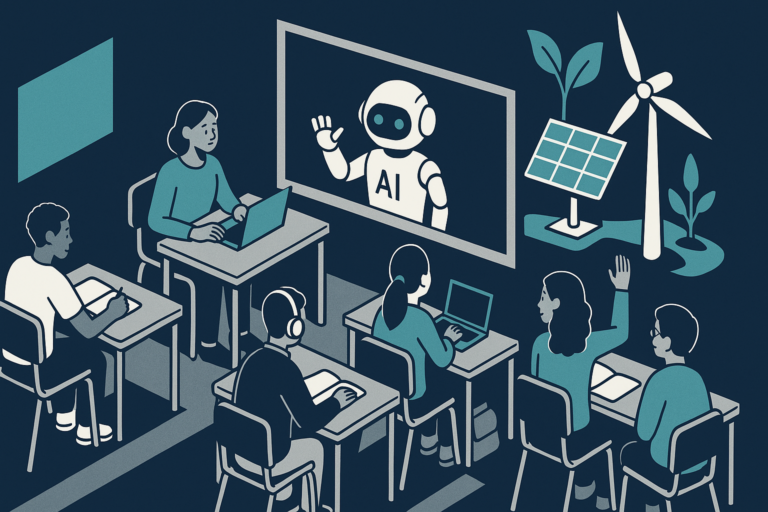
AI Universities and GreenTech: Shaping the Future of Labor Markets
What’s happening: Governments and educational institutions worldwide are increasingly establishing AI-focused universities and programs to prepare for a future driven by artificial intelligence. This trend reflects a broader transformation in labor markets, as industries like finance and GreenTech begin to integrate AI technologies, creating new opportunities while also raising questions about inequality and access to education.
Key points:
- Karnataka has announced plans for an AI university, highlighting the importance of AI in future economic growth.
- The University of Central Oklahoma is launching AI-focused degrees to equip students with skills relevant to the evolving job market.
- A survey found that 97% of financial advisors believe AI enhances client engagement, indicating a shift in professional roles within finance.
- The TVB Green Summit showcased AI’s potential in promoting environmentally sustainable technologies, merging economic growth with ecological responsibility.
- The growing demand for high-skilled workers due to AI adoption is polarizing the labor market, increasing job security for skilled individuals while threatening lower-skilled workers with unemployment.
Why it matters: Establishing AI universities is crucial for training a workforce that can thrive in an automated economy. As industries evolve to leverage AI, the disparity between high-skilled and low-skilled labor is likely to widen, raising concerns about who benefits from these advancements. If educational opportunities are not accessible to all, existing inequalities may deepen, leaving many behind in the transition to a technology-driven future.
Our take: The focus on AI in education and its integration into various industries underscores a pivotal moment in labor market evolution. While these developments promise innovation and growth, they also highlight the urgent need for equitable access to education and training, lest we reinforce systemic inequalities in the workforce.
Tech & Engineering

Rethinking AI-Led Software Development: Bridging the Knowledge Gap
What’s happening: As AI technologies become more integrated into software development, engineering teams must adapt their practices and mindsets. The shift is particularly evident in fields like autonomous vehicles and machine learning, where companies are innovating to manage data more effectively and prioritize AI agent development over traditional applications.
Key points:
- Beamr is utilizing innovative data management techniques to significantly reduce storage and processing burdens for autonomous vehicle programs through its ML-safe video data technology.
- NVIDIA encourages software engineers to focus on building AI agents, highlighting a major shift towards dynamic software architectures that incorporate AI capabilities directly into development workflows.
- Content-adaptive bitrate technology from Beamr allows teams to manage petabyte-scale data while maintaining model integrity, facilitating faster testing and iteration cycles.
- Engineers must enhance their skill sets to include not only coding but also a comprehensive understanding of AI models, data management, and system security implications.
- The integration of AI into software development necessitates a fluid approach to engineering practices, moving away from rigid architectures to accommodate ongoing learning and adaptation.
Why it matters: The rise of AI in software development reshapes engineering practices, making traditional paradigms obsolete. Engineers must be proactive in addressing security implications, as the integration of AI expands the potential vulnerabilities within applications. A robust understanding of the entire data lifecycle becomes critical, as does the need for engineers to adapt their security measures to the unique risks posed by AI technologies.
Our take: The transition to AI-led development offers both exciting opportunities and significant challenges for software engineers. While enhancing skills in AI and data management is essential, the industry must also grapple with the security risks that come with these advancements, which are often overlooked in the rush to innovate.
Sciences

AI-Driven Breakthroughs in Material Discovery: A New Era Begins
What’s happening: A new institute for AI-assisted materials discovery has been established at Tsinghua University in Beijing, led by Nobel laureate Omar Yaghi. This initiative marks a significant transformation in materials science, especially regarding sustainability and energy efficiency, and aims to leverage AI to expedite the discovery of new materials essential for carbon capture and clean energy solutions.
Key points:
- The institute is founded by Omar Yaghi, who previously left the U.S. due to dissatisfaction with funding cuts and restrictions on collaborative research.
- Yaghi’s work on metal-organic frameworks (MOFs) has shown promise in applications like gas storage, catalysis, and drug delivery.
- AI will be used to analyze extensive datasets of materials, enabling researchers to identify promising candidates for new materials much faster than traditional methods.
- The integration of AI can reduce the time needed to develop new materials from years to months, accelerating advancements in clean energy technologies.
- The focus on carbon capture and energy-efficient materials aligns with global sustainability goals, potentially decreasing greenhouse gas emissions significantly.
Why it matters: The establishment of Yaghi’s institute represents a pivotal moment in materials science, as it combines AI technology with innovative research to address pressing global challenges such as climate change and energy sustainability. By accelerating the discovery of new materials, the initiative could lead to breakthroughs that enhance energy efficiency and contribute to a more sustainable future.
Our take: This shift towards AI-driven research in materials science highlights the potential for technology to reshape traditional scientific practices. However, it also raises questions about the balance between rapid innovation and thorough validation of new materials, ensuring they are both effective and safe for real-world applications.
Society

The Human Cost of AI Governance: Who Gets to Decide?
What’s happening: Upcoming global discussions on AI governance, particularly the Geneva AI Summit in 2027 and the UN’s focus on children’s rights, highlight the critical need for inclusive dialogue. As these institutions work on frameworks for responsible AI, questions arise about who is truly represented in these conversations and whose concerns are overlooked, particularly those of marginalized communities and vulnerable populations.
Key points:
- The Geneva AI Summit aims to foster multilateral dialogue among governments, businesses, and civil society regarding AI governance.
- There is a risk that existing power imbalances will persist if certain communities, especially children and vulnerable populations, are excluded from discussions on AI’s impact.
- The UN emphasizes the need for ethical considerations in AI development, particularly concerning technologies like autonomous weapons.
- As AI systems are integrated into decision-making processes, they can reinforce biases and inequalities, particularly affecting marginalized communities.
- The growing disconnect between technical discussions at global summits and the lived experiences of individuals threatens social cohesion and public trust in governance structures.
Why it matters: The implications of AI governance shape how society interacts with technology and institutions. Inadequate representation in discussions can lead to the perpetuation of biases in AI systems, undermining trust and increasing skepticism towards governance. Furthermore, focusing predominantly on economic outcomes risks sidelining critical ethical issues, such as privacy and the rights of vulnerable groups, particularly children, who are often the most affected by these technologies.
Our take: The current approach to AI governance highlights a significant disconnect between policymakers and the communities affected by their decisions. Without genuine inclusion of marginalized voices, the governance frameworks developed may fail to address the real-world implications and ethical dilemmas posed by AI technologies.
Psychology

Navigating the New Landscape of Trust in AI-Enhanced Mental Health Care
What’s happening: The integration of AI into mental health care is changing how we view trust and relationships in therapy. While AI chatbots improve access to mental health support, users often perceive them as more judgmental than human therapists, mainly due to their inability to understand complex human emotions like loneliness and isolation.
Key points:
- Research shows that users find AI chatbots to be more judgmental than human providers because they lack real-world experience and emotional comprehension.
- Dr. Ryan Raimi highlights that AI systems struggle to empathize with feelings, which can lead users to feel misunderstood and not fully supported.
- AI interactions can create a feedback loop that reinforces certain emotional responses, potentially prioritizing technology over genuine human connections.
- A Microsoft Research study indicates that diminished self-confidence in users can result in poorer critical thinking when trust in AI exceeds trust in personal capabilities.
- There is a risk that over-reliance on AI for emotional support could undermine the importance of human relationships and self-reflection.
Why it matters: As AI technologies become more prevalent in mental health care, the traditional understanding of trust is evolving. Users may begin to confuse the effectiveness of AI tools with their emotional needs, leading to a societal shift where human connections are undervalued. This dependency on AI could diminish individuals’ self-agency and critical thinking, highlighting the need for a balanced approach to technology in emotional support.
Our take: The challenge lies in ensuring that while we leverage AI for mental health support, we do not lose sight of the essential human elements of empathy and connection. There is a critical tension between embracing technological advancements and preserving the nuances of human relationships, which are crucial for emotional well-being.
That’s the digest for July 11, 2026.
Questions? Reach out at info@q52.ai.
q52.ai — Engineering Better Questions
