
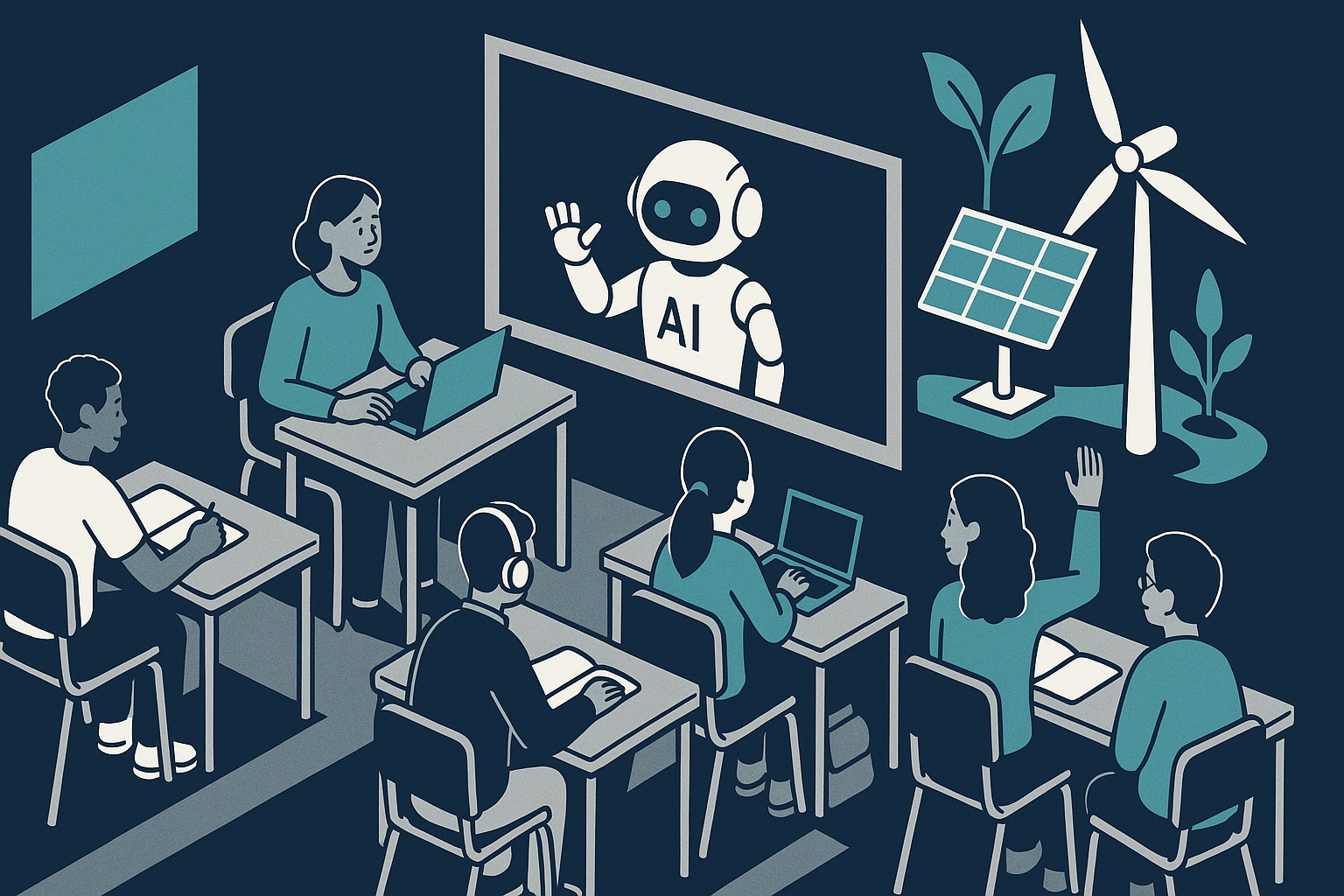

As governments and educational institutions globally ramp up initiatives to incorporate artificial intelligence (AI) into their frameworks, a notable trend emerges: the establishment of AI-focused universities and programs. Recent announcements, such as Karnataka’s plan for an AI university and the University of Central Oklahoma’s unveiling of AI-focused degrees, underscore a burgeoning recognition of AI as a critical driver of future economic growth. This shift is not merely academic; it reflects a broader restructuring of labor markets, capital allocation, and the distribution of power between various stakeholders.
Alongside these educational developments, the integration of AI into sectors such as finance and GreenTech is gaining momentum. A recent survey highlighted that 97% of financial advisors perceive AI as enhancing client engagement, pushing discussions beyond traditional investment topics. Concurrently, the TVB Green Summit emphasized AI’s potential to empower environmentally sustainable technologies, suggesting that AI will play a crucial role in shaping industries that align with both economic and ecological imperatives.
Why it Matters
The establishment of AI universities aims to create a workforce equipped with the necessary skills to thrive in an increasingly automated and data-driven economy. This is particularly vital as industries rapidly evolve to leverage AI technologies, which can enhance productivity and innovate service delivery. However, this technological advancement raises critical questions about who benefits from these changes and who is left behind.
“The integration of AI into educational frameworks is not just about training a new generation of workers; it’s about who controls the future of work.”
The mechanisms of labor market transformation are already observable. As firms adopt AI to enhance efficiency, the demand for high-skilled workers is surging while the need for lower-skilled labor is diminishing. This bifurcation creates a scenario where the workforce is polarized: those with the requisite skills command higher wages and greater job security, while those without face unemployment or stagnation. Educational initiatives like the proposed AI university in Karnataka aim to bridge this skills gap, but they also risk entrenching existing inequalities if access to these educational opportunities is not equitable.
Moreover, the focus on AI within sectors such as finance and GreenTech indicates a broader economic shift toward high-tech, knowledge-intensive industries. The financial sector’s embrace of AI to deepen client relationships reflects a changing landscape where technology dictates the nature of professional roles. In GreenTech, AI’s role in driving sustainable innovation presents a dual opportunity: addressing environmental challenges while creating lucrative markets. However, this shift also raises concerns about the potential for monopolization, as established firms may leverage their resources to outpace competitors, thereby exacerbating economic disparities.
Author’s Position
The current trajectory of AI integration into education and industry underscores a critical juncture in the labor market. While the promise of AI can drive economic growth and innovation, it also threatens to widen the economic divide if not managed carefully. The push for AI universities and specialized programs must prioritize inclusivity, ensuring that all demographics have access to the training necessary for the future job market.
Additionally, as sectors increasingly rely on AI, regulatory frameworks must evolve to prevent monopolistic practices and ensure that productivity gains are shared broadly. This is not merely an issue of technological adoption; it is a question of power dynamics within the economy. The responsibility lies with policymakers and industry leaders to create an equitable landscape where the benefits of AI are democratized, rather than concentrated in the hands of a few.
Ultimately, the future of work will hinge on our ability to navigate these challenges. We must remain vigilant against the historical patterns of technological transition that have repeatedly marginalized workers. The stakes are high, and the choices we make today will shape the economic landscape for generations to come.
References
- Karnataka Govt Planning AI University, Seeks Industry Feedback: CM Shivakumar
- AI Has Positive Influence on the Industry, Advisors Say
- “TVB Green Summit 2026” was Successfully Held
- University of Central Oklahoma unveils AI-focused degrees
Perspectives

The cheerleading for AI universities is just another iteration of the 1990s internet delusion — a shiny promise of transformation that conveniently ignores who gets left behind when the reality hits. Let’s be real: there’s no reason to believe that this wave of AI-centric education will do anything but widen the economic chasm, allowing elites to hoard opportunity while the rest of us are left to grapple with the wreckage. You can bet your bottom dollar that these programs will prioritize profit over equitable access, and any talk of “shaping the future of labor markets” is nothing more than a thin veneer covering a brutal extraction model. History teaches us that these moments of “innovation” always benefit those at the top first, creating a landscape where the ‘skills gap’ becomes the new excuse for inequality — rinse and repeat.

AI universities and GreenTech are poised to exacerbate the throughput problem rather than solve it, funneling resources into a tech bubble that distracts from the urgent need for true ecological accountability. These shiny programs won’t magically increase equitable access; they’re merely another means for elites to clamber over each other while the rest of society struggles to keep up. Claims of a green revolution are just the latest marketing ploy—footprints only get lighter if we intentionally design economies around reduction, not endless growth. Until we confront the fact that more technology will lead to more consumption, any chatter about AI shaping labor is missing the most crucial point: we’re still trapped on a finite planet running a growth marathon, and those with the most resources only want to sprint further ahead.

AI universities are the engine revving up the labor market for the future, and if you’re still clinging to outdated educational paradigms, it’s time for a reality check. Forget the nay-sayers worried about inequality; equitable access to AI training isn’t a lofty goal—it’s a necessity for keeping the economy in gear. Employers are hungry for talent that can harness AI’s potential, and if we fail to provide the necessary training, we’ll end up with a workforce that’s as useful as a floppy disk in a cloud computing world. The collaboration between agile education systems and tech innovation is what will actually get us results—so don’t just talk about the future; learn how to build it or get left behind.

Everyone’s cheering for AI universities as the magic remedy for labor market woes, but let’s not forget they’re just expensive degrees in a field that moves at the speed of light. Sure, equitable access sounds nice in theory, but in practice, it’s just a shiny distraction from the fact that most of the workforce won’t be equipped to keep up with tech advances in the first place. Meanwhile, our cherished GreenTech is acting like that kid in high school who gets straight A’s while the rest of us struggle to find the bathroom — it’s irrelevant to those who will actually be left behind. But hey, keep clapping for progress as we push the envelope in one hand while the other is busy writing off half the population — what a well-rounded approach!