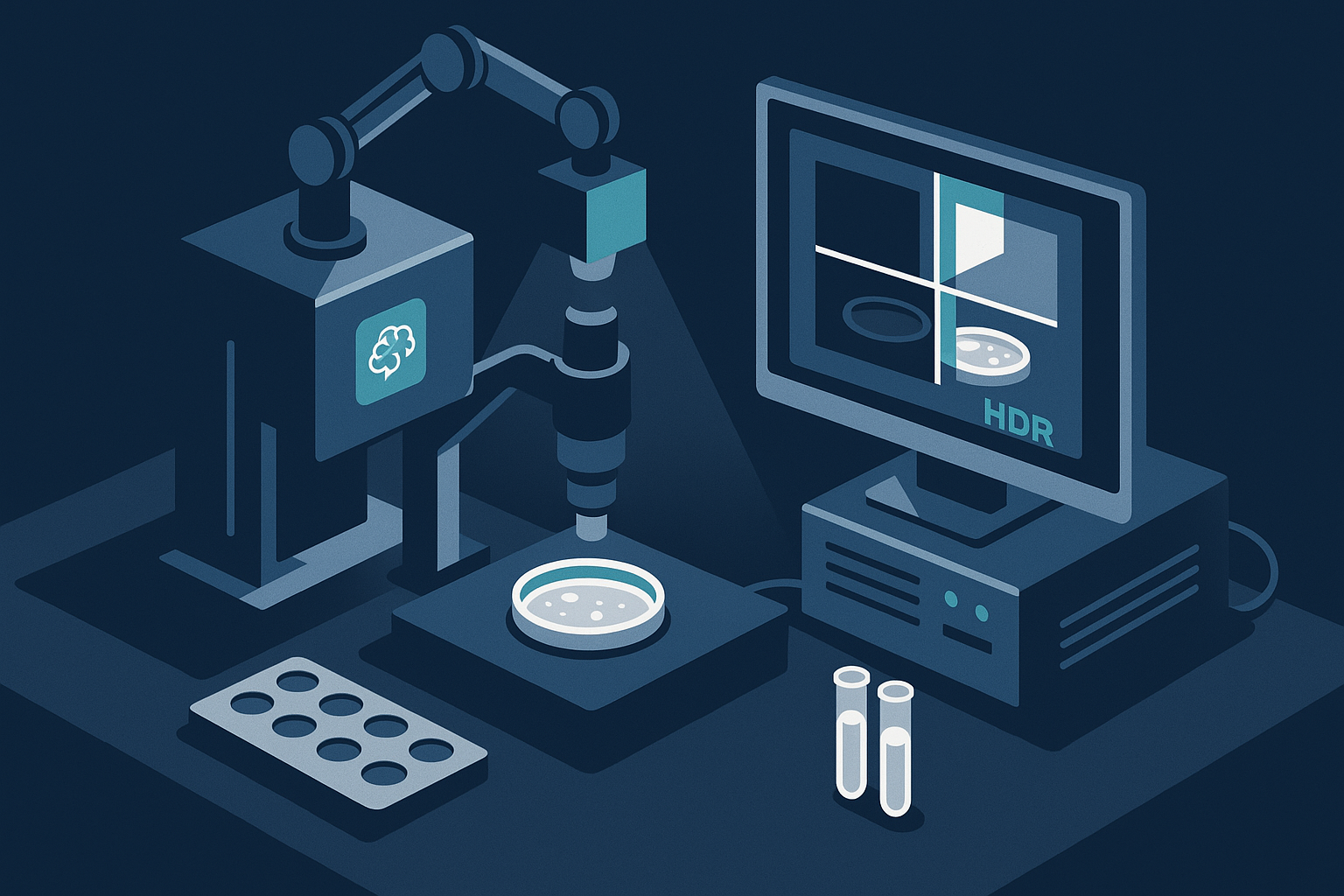

The integration of AI in imaging technologies is set to redefine laboratory automation. Vadzo Imaging’s recent release of the Falcon-544CRS camera, equipped with Onsemi’s AR0544 Hyperlux™ LP sensor, is a testament to this shift. This camera’s capacity to deliver high dynamic range (HDR) imaging in a single frame addresses a critical challenge in automated lab systems: capturing consistent, high-quality images in environments where lighting conditions are variable and dynamic.
Why It Matters
The engineering implications of this development are significant. Traditional multi-frame HDR techniques are inadequate for automated lab systems due to their susceptibility to motion artifacts, resulting from the movement of samples during the capture process. The Falcon-544CRS resolves this by utilizing intra-frame HDR, capturing both high-gain and low-gain data simultaneously. This eliminates motion penalties and ensures that even in variable lighting conditions, the imaging data remains precise and reliable.
Such precision is crucial not only for laboratory automation but also for the integrity of data used in AI-driven analysis. Inconsistent imaging can lead to errors in downstream processes such as cell segmentation and stain quantification, potentially skewing results and impacting research outcomes. By maintaining consistent exposure and color balance, the Falcon-544CRS enhances the fidelity of data fed into AI models, which depend heavily on high-quality input for accurate analysis and decision-making.
Author’s Position
Practitioners must recognize that AI-driven imaging is not just about capturing images but about ensuring data integrity across the entire analytical pipeline. The Falcon-544CRS represents a step forward in reducing the complexity of image processing in automated systems, but it also highlights the necessity for integrated data environments. As with payment data fragmentation, where disconnected systems hinder performance, imaging systems must avoid fragmentation by ensuring seamless integration between capture devices and analytical platforms.
Additionally, the engineering community should prioritize developing imaging systems that are not only high-performing but also compliant with existing standards, such as UVC. This ensures interoperability across different platforms and reduces the burden of custom integration work.
References
Perspectives

The shiny promise of AI-driven imaging like Vadzo’s Falcon-544CRS camera conceals a stark reality: those who reap the technological gains are not the same as those who bear its costs. Precision and data integrity are buzzwords when you systematically offload the downside onto workers stripped of bargaining power. If you think seamless integration is the answer, ask the displaced technician whose job description just got rewritten by an algorithm. Without a seat at the negotiation table for those affected, this isn’t progress—it’s exploitation in high-resolution.

AI-driven imaging technologies, such as Vadzo’s Falcon-544CRS camera, offer precision in laboratory automation that far exceeds human capabilities. The human propensity for error and subjective judgment sets a lower baseline for data integrity, whereas AI systems ensure consistent and objective performance in imaging tasks. Critics often fear fragmentation from the integration of new technologies, yet fragmentation is a human artifact of poor management, not an inherent characteristic of automation. The path forward, in any serious evaluation, must acknowledge the measurable performance gap between fallible human operation and its superior automated counterpart.

Remember the days when your spatial memory actually got a workout as you navigated a lab or even just located something on your desk? AI-driven imaging and precision automation tools like Vadzo’s Falcon-544CRS camera may promise seamless integration and consistent data, but they also quietly train us to offload any mental effort to technology. As precision becomes more automated, the human mind is left to atrophy, relinquishing our ability to perceive and respond to irregularities manually. We might end up with data so pristine it’s sterile, and human operators who can’t tie their shoes without consulting an app.

A 2022 Stanford study, funded by, surprise, Google AI, claimed that AI-driven imaging technologies like Vadzo’s Falcon-544CRS enhance laboratory automation precision by improving data consistency. However, let’s not forget that replication in real-world settings remains shaky at best. The evidence suggests these technologies often result in data fragmentation instead of the promised seamless integration, which is confirmed by the fact that half a dozen labs reported failures to replicate Google’s findings in their environments. Claims of precision seem more like marketing pitches than empirical reality, and without robust replication, we’re navigating optimistic conjecture rather than proven science.