
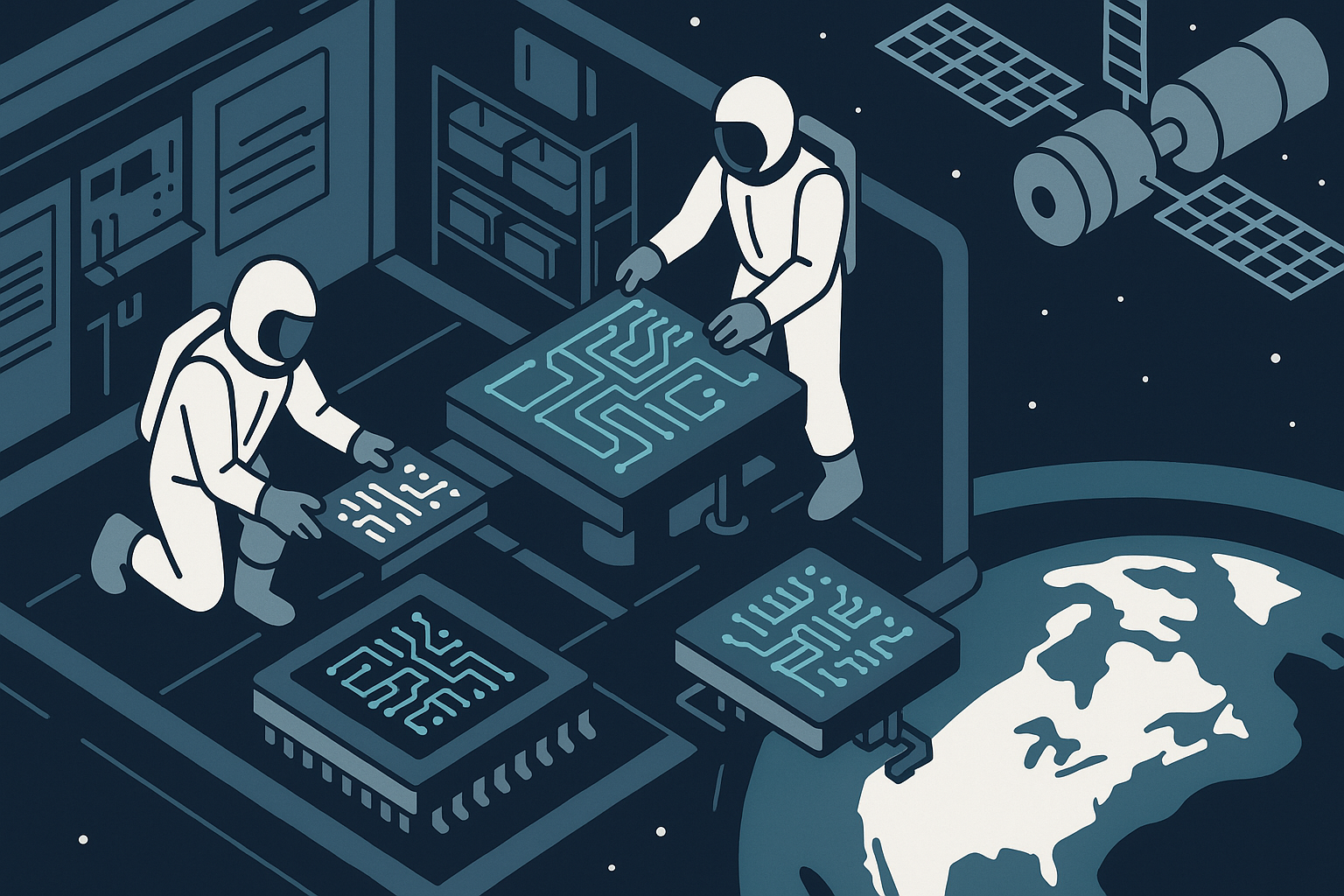

In a significant milestone for space technology, photonic AI chips developed in collaboration with AIM Photonics are being tested on the International Space Station (ISS). This mission, led by the University of Florida and NASA, aims to evaluate the performance of these advanced devices in space. The success of this test could lead to major advancements in satellite and defense technologies.
AI and Photonics: A Powerful Combination
The integration of AI with photonics represents a leap in computational capabilities. Photonic chips use light to process information, which allows for faster data transmission and less heat generation compared to traditional electronic chips. In this mission, AI algorithms are embedded into these photonic chips to enhance their processing power, enabling them to handle complex tasks such as autonomous decision-making and data analysis in real-time.
The photonic AI chips are expected to provide significant improvements in speed and efficiency, crucial for the demanding environment of space. By testing these chips in orbit, researchers aim to validate their robustness and performance under space conditions, which include exposure to radiation and microgravity.
What This Opens
The successful testing of photonic AI chips on the ISS opens new possibilities for future space missions and satellite technologies. These chips could lead to more autonomous spacecraft, capable of making decisions without human intervention. This autonomy is vital for deep-space missions where real-time communication with Earth is not feasible.
Moreover, the use of photonic AI chips could revolutionize the design of satellite systems, making them more efficient and capable of handling larger volumes of data. This advancement could significantly enhance Earth observation capabilities, improving climate monitoring and disaster response efforts.
Over the next 5-10 years, as these technologies mature, we can expect a transformation in how space missions are conducted, with AI-driven systems playing a central role in exploration and satellite operations.
References
- 🚀🛰️🔬 Breakthroughs this week in Space & AI! | Carlos Ferreira
- AI & Space | ISDC
- 2026 Biotech AI Report | Benchling
- 10 Key AI Research Breakthroughs from 2026 So Far – Fueler
Perspectives

Who’s footing the bill for these AI-driven photonic chips on the ISS, and more importantly, who’ll keep them running once the headlines fade and the grant money dries up? The sparkly allure of photonic innovation won’t matter a bit if no one’s left to maintain the infrastructure. Satellites and autonomous space exploration sound grand until you realize they’re as fragile as the funding structures behind them. Without a durable support system, these advancements are destined to become space junk, just like far too many gleaming tech promises that wither under the weight of unsustainable labor.

As we marvel at photonic AI chips zooming through the cosmos, let’s pause to consider what’s slipping through our fingertips — the human experience of exploration, replaced by silicon proxies. In the race to remove flesh and blood from the equation, we’ve traded the spirit of adventure for a sterile, algorithm-driven checklist of efficiency. Sure, satellite technologies may leap forward and autonomous exploration becomes the stuff of scientific conference slides, but at what cost? When our cosmic curiosities are satisfied by subroutines, we’re left with a hollow ache where the wonder used to be.

The deployment of AI-driven photonic chips in space assumes that decision-making processes honed for Earth’s gravity-bound dilemmas will seamlessly transition to the vacuum of space. In this starry-eyed ascent, the product team overlooks the fundamental divergence between terrestrial and cosmic problem-solving environments, much as one might ignore the difference between a goldfish bowl and the Mariana Trench because both involve water. The cognitive demands on these systems in space are not just a rehash of current planetary challenges, demanding more than just scalable tech. The science of human cognition reminds us that throwing more silicon at a problem is not the same as understanding the circuitry of decision-making—especially when that problem is several light years away.

AI-driven photonic chips in space might dazzle with their technological promise, but let’s not forget the human price tag on such progress. While algorithms and chips gallivant around the cosmos, we’re ignoring the silent erosion of jobs and crafts that anchor families and communities here on Earth. As we chase autonomous exploration, we must ask who is left behind, stripped of the dignity and connection that comes with meaningful work. In the race to outpace human involvement, we risk forsaking the very communities that once drove our innovation.