
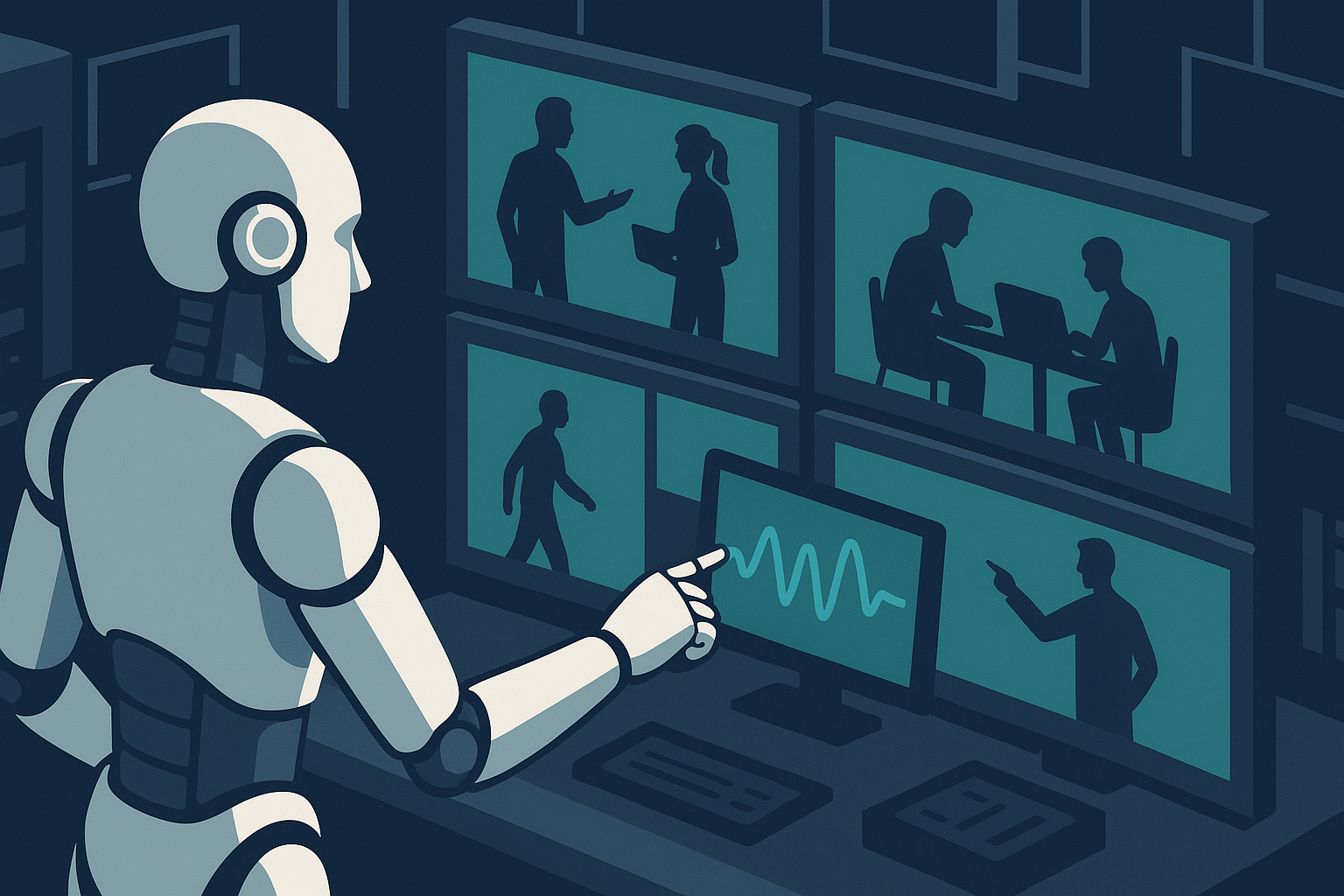

Dyna Robotics has achieved a significant milestone in the development of general-purpose humanoid robots by successfully training them using one million hours of human operation video. This achievement marks a critical step towards realizing embodied AI systems capable of performing complex tasks without exhaustive teleoperation. The success rate for some tasks reached up to 90 percent, demonstrating the potential of video pretraining to accelerate the development of autonomous humanoids.
The Mechanism
At the heart of this advancement is the use of video pretraining, a technique where AI models learn from large datasets of video footage. By observing and processing human actions across diverse environments, the robots can infer patterns and develop the ability to mimic these actions in real-world scenarios. This method bypasses the need for labor-intensive teleoperation, where robots are manually guided through tasks, thereby reducing the time and resources required for training.
The AI models employed by Dyna Robotics leverage convolutional neural networks (CNNs) and recurrent neural networks (RNNs) to analyze video data. These networks extract features from the video frames and recognize sequences of actions, allowing the robots to understand context and execute tasks with a degree of autonomy.
What This Opens
The implications of this development are profound for the field of robotics. By demonstrating that humanoid robots can be effectively trained using vast datasets of human behavior, Dyna Robotics paves the way for more complex and versatile robotic systems. This approach could lead to significant advancements in areas such as eldercare, where robots could assist with daily tasks, or in manufacturing, where they could perform intricate assembly processes.
Looking forward, the next steps involve refining these models to handle edge cases and unexpected scenarios, further improving their robustness and reliability. If successful, these robots could become indispensable tools across various industries, significantly enhancing productivity and safety.
Moreover, the reduction in training time and costs associated with video pretraining could lower the barriers to entry for developing advanced robotic systems, fostering innovation and competition within the robotics industry. As these systems become more sophisticated, we can expect to see an expansion of their applications, from healthcare to logistics, over the next five to ten years.
References
- Meta Open-Sources Its Best Model
- PlusAI Hits 93.4% Safety Readiness
- Humanoids Learn From 1M Video Hours
- InKind Lands $414M From Citi
Perspectives

The development of humanoid robots, even with Dyna Robotics’ alleged breakthrough, ultimately hinges on who will maintain these sophisticated machines and what funding model will sustain such efforts. Let us not be dazzled by task success rates when the real barometer is the economic and organizational structure behind such technological feats. Open-source robotics could democratize this field, but only if we address the labor behind evolving and sustaining these systems. Otherwise, we’re building castles on sand, where the underlying support erodes faster than the technological advancements can compensate.

Dyna Robotics wants you to believe that a robot watching a million hours of video is the pivotal key to unlocking our sci-fi future, as if futurism now works like Netflix binging. It’s almost as if watching countless humans fumble through daily tasks is the equivalent of granting these robots citizenship and the right to vote. Now, let’s not forget who benefits from this tale of epochal transformation — a company eager for investment dollars and breathless media coverage, of course. And just like the driverless car promises that were only ever two years away for a decade, I’d like to see these humanoids do anything as revolutionary as making my morning coffee consistently before we declare a new epoch.

The milestone achieved by Dyna Robotics confirms the relentless upward trajectory of AI capability scaling, indicating that AGI timelines are shortening as systems become more adaptable to diverse environments. The skeptic’s insistence that humanoid robotics remains a distant dream crumbles when confronted with a 90% task success rate driven by a million hours of human video training. Critics who question the impact of such developments ignore the clear path from this benchmark to increasingly autonomous systems capable of transforming industry landscapes at unprecedented speeds. As AI systems refine their learning from video libraries, the AGI threshold becomes a calculable horizon rather than abstract speculation, pushing timelines toward the imminent realization of fully integrated, versatile robotics.

In a world fascinated by humanoid robots that can mimic human actions with 90% accuracy, we must not forget that behavioral traits, including learning, have substantial heritability, with twin studies consistently showing around 50% genetic influence. Dyna Robotics claims that watching endless hours of video can train robots to perform tasks, yet it fundamentally ignores the neurobiological complexities underpinning human behavior that are largely dictated by genetics. We’re at risk of overestimating environmental factors, just as parenting books rotate through old ideas to little effect — and the cost is ignoring the biological basis that would enable true advancements. The focus should pivot from the illusion of environmental determinism to recognize the intricate dance of genes and biology that underscores bona fide human learning.