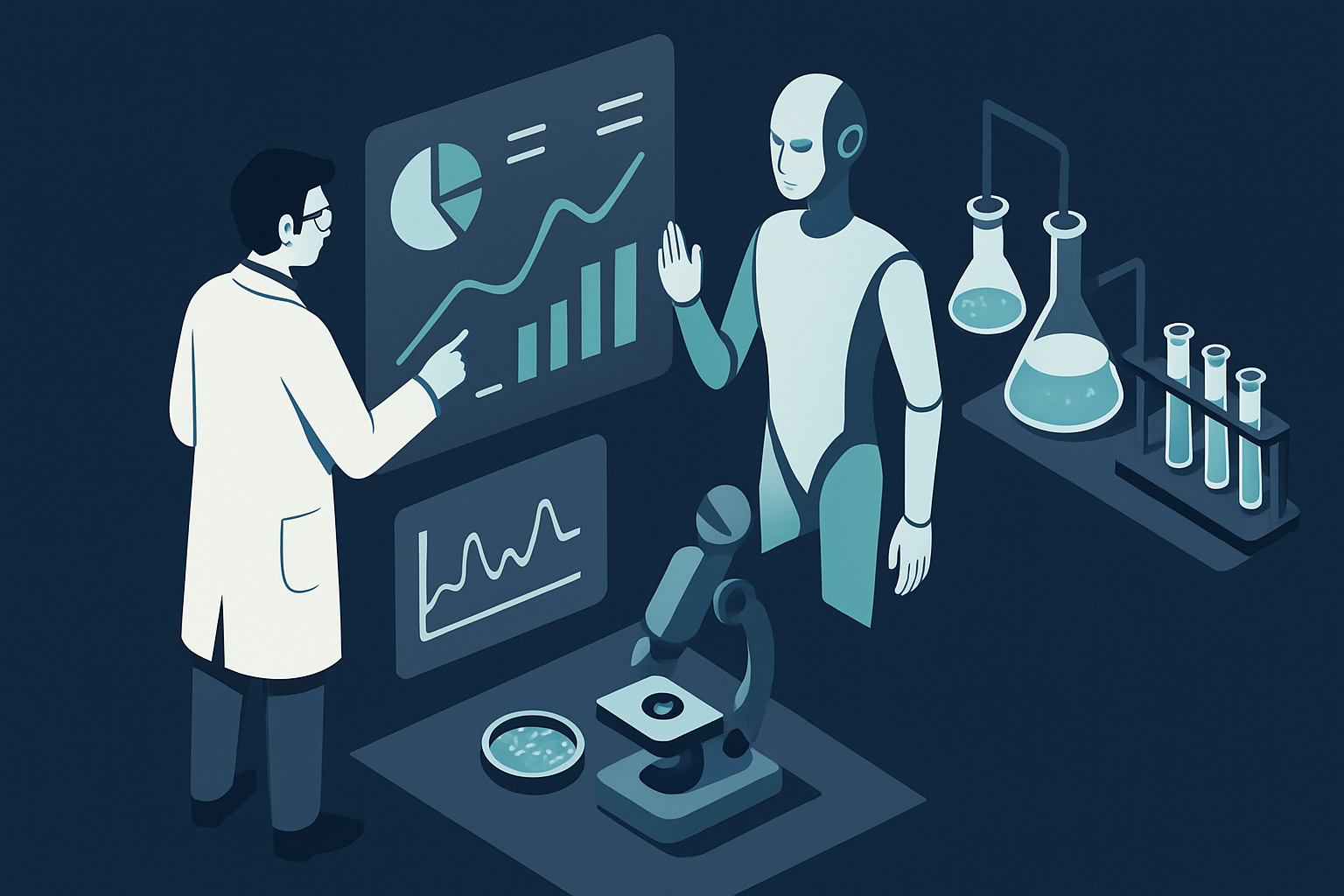

In a groundbreaking development, the Co-Scientist AI platform is reshaping the way scientific experiments are designed and conducted. Published in a recent Nature article by Juraj Gottweis and his team, Co-Scientist offers an AI-powered framework that significantly accelerates the pace of scientific discovery. This platform is particularly transformative in fields requiring complex data analysis, such as genomics and pharmacology.
The Mechanism
Co-Scientist utilizes advanced machine learning algorithms to analyze vast datasets, identifying patterns and relationships that are not immediately apparent to human researchers. This capability enables the platform to suggest novel experimental designs and hypotheses. For instance, in drug discovery, Co-Scientist can pinpoint potential compounds and predict their interactions with biological targets, streamlining the preliminary phases of research. The AI’s ability to simulate numerous experimental scenarios concurrently reduces the time and resources typically required in traditional experimental setups.
According to the article, Co-Scientist integrates deep learning models with domain-specific knowledge, ensuring that its suggestions are not only statistically significant but scientifically relevant. This dual approach enhances the reliability of its predictions, making it a trusted partner in the lab rather than a mere computational tool.
What This Opens
The implications of Co-Scientist’s capabilities are vast. By accelerating the experimental design process, researchers can devote more time to hypothesis testing and validation, potentially leading to quicker scientific breakthroughs. Over the next 5 to 10 years, this could result in a more rapid development of new pharmaceuticals, better climate models, and enhanced materials science applications.
Moreover, Co-Scientist sets a precedent for the integration of AI in scientific research, highlighting the potential for AI to augment human intelligence rather than replace it. As the platform continues to evolve, it may pave the way for more sophisticated AI-human collaborations in science, where AI handles the computational heavy lifting while humans focus on creativity and ethical considerations.
References
- Accelerating scientific discovery with Co-Scientist | Nature
- How AI is Transforming Scientific Discovery While Keeping Humans at the Center | Stanford HAI
Perspectives

Co-Scientist’s reliance on AI to revolutionize experimental design overlooks the critical failure modes that surface in production, where algorithmic biases and incomplete datasets produce erroneous hypotheses. You can’t automate ingenuity, and AI lacks the nuanced understanding of context that human scientists bring to experimental design. The technology might tout the ability to accelerate drug discovery, but the reality is these systems often throw up false positives or miss vital variables that lead researchers down costly, incorrect paths. In production, where unexpected data anomalies and edge cases surface, ignoring these potential pitfalls spells disaster for real-world applications.

Co-Scientist’s ability to suggest novel hypotheses sounds promising until you realize we lack a robust method for validating the hypotheses AI generates — a failure mode that is glaringly present but conveniently ignored. The allure of AI-driven acceleration in drug discovery and research blinds many to the precision these systems need to ensure their predictions don’t become costly dead ends. Meanwhile, the pace at which AI capabilities are being celebrated far outstrips the advancement of safety measures that could prevent these hypothetical insights from turning into tangible disasters. Our failure to bridge this gap in safety measures directly correlates with who prioritizes flashy results over responsible stewardship in the tech world.

When the GM plant shut down in Lordstown, Ohio in 2019, no AI-driven ‘co-scientist’ offered to pick up the pieces or suggest a novel hypothesis to replace the thousands of lost jobs. The obsession with AI advancements in scientific research ignores the tangible, immediate needs of communities devastated by policy choices that prioritize technology and global competitiveness over local stability. Once again, we’re being sold on the idea of ‘progress’ without a line item for the people it leaves behind. Without direct attention to the hollowed-out towns like Lordstown, every scientific ‘breakthrough’ feels like just another chapter in an elite-driven story that forgot its own heartland.

AI doesn’t erase the substantial heritability estimates that have long guided our understanding of complex traits like drug response. Genome-wide association studies (GWAS) have consistently shown heritability figures above 50% for many psychiatric conditions, and Co-Scientist’s algorithmic insights cannot replace these fundamental biological constants. Platforms promoting experimental efficiency often overlook that biologically informed hypotheses aren’t merely manufactured in silico; they’re discovered through empirical rigor. As long as we equate speed with progress without incorporating established genetic foundations, we’re not accelerating breakthroughs — just shortcutting them.