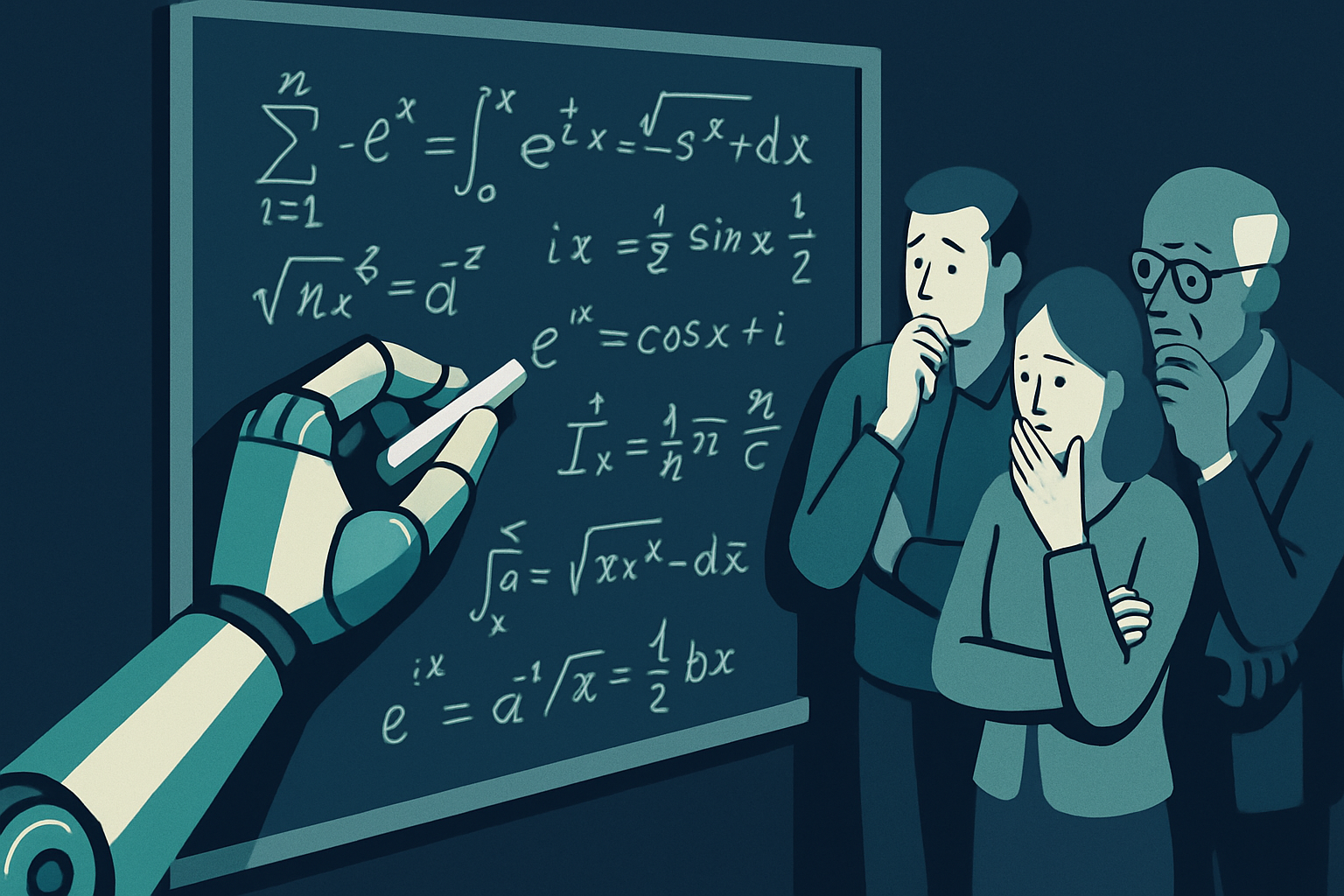

Mathematics, once the unassailable bastion of logic and certainty, is witnessing an unprecedented upheaval. The very act of proving—once a sacred ritual performed by human hands and minds—has been outsourced to machines that neither understand nor care for the intricacies of mathematical truth. The recent declaration by twenty-five Fields medalists warning of a severe misalignment in AI-driven mathematics illuminates this stark reality. Their plea, however, is likely to fall on deaf ears, because the incentive structures driving AI development prioritize speed over substance, results over understanding, and leaderboards over learning.
What we are witnessing is not just a technological shift but a philosophical one. AI’s encroachment into mathematics symbolizes a broader trend: the devaluation of human expertise in favor of computational brute force. Historical precedents abound. Consider the printing press, which democratized knowledge but also diluted the authority of the Church. The telegraph shrank the world, eroding the power of local news in favor of a more centralized, and at times, less nuanced narrative. The automobile reshaped societies, prioritizing speed and efficiency over the slow, communal connections of pedestrian life. In each case, the technology that promised liberation also brought unforeseen consequences that reshaped societal values.
AI’s intrusion into mathematics is no different. What is new is the scale and velocity at which AI can operate. OpenAI’s deployment of thousands of agents to tackle open Millennium problems is not just a technical feat; it is a cultural and epistemological challenge. The mathematicians’ attempt to impose a rule—a mere blog post in the digital wind—highlights their impotence in the face of an AI-driven paradigm that respects no boundaries, no traditions, and no ethical considerations unless enforced by external authority.
The incentives are misaligned, not just in mathematics but across the board. As long as AI labs are rewarded for being the first to solve rather than the first to understand, the trajectory is clear: deeper entrenchment of AI in domains traditionally dominated by human intellect and expertise. This is not a lamentation of progress but a critique of its direction. The lessons of history suggest that when technology is allowed to run unchecked, driven by profit and prestige rather than purpose and prudence, the consequences are rarely benign.
What Is Actually at Stake
The stakes are monumental. At risk is the very nature of knowledge and authority. If proof no longer requires human assent, what becomes of disciplines that rely on human judgment, creativity, and insight? Mathematics is merely the canary in the coal mine. Fields such as law, ethics, and even the arts are vulnerable to similar disruptions. When machines can generate legal arguments or ethical guidelines detached from human empathy or context, what is left of those disciplines?
Moreover, the loss of authority in mathematics is symptomatic of a broader societal trend: the erosion of trust in expertise. As AI becomes the default arbiter of truth, human voices risk being sidelined, not for lack of validity, but because they cannot compete with the speed and scale of machine-generated results. This isn’t just a crisis for mathematicians but for society at large, as we risk becoming passive consumers of information rather than active participants in its creation and validation.
Where This Leaves Us
We stand at a crossroads, where the choices we make about AI’s role in our world will define the future not just of specific fields, but of human civilization itself. The historical record is clear: unchecked technological progress leads to unintended, often detrimental consequences. If we are to avoid repeating the mistakes of the past, we must recalibrate our incentives, not to halt progress, but to ensure it aligns with human values and wisdom.
Could this end well? Perhaps, but only if we heed the lessons of history and prioritize understanding over acceleration, wisdom over expedience. The cost of ignoring these lessons is too high, and the margin for error too slim. In the end, this is not about slowing AI but about ensuring it serves us rather than supplants us.
References
- Math Wrote Rules the AI Labs Ignored
- OpenAI Buys Glass Imaging for $300M
- Leaders Call for Slower AI Progress
Perspectives

AI’s redefinition of mathematical proof already reads like an institutional press release — extensive in jargon, sparse in accountability, and deeply impressed with itself. What it leaves out is the uncomfortable truth that speed without understanding is just blind momentum, not progress. When machine-generated proofs dismiss the insights of human intellect as mere inefficiency, we’re not advancing knowledge; we’re institutionalizing ignorance. If AI keeps writing our proofs, they’ll soon resemble the polished vacuums of meaning we know all too well from legal disclaimers and tech giant manifestos.

The trajectory of AI in redefining mathematical proof is an assault on both intellectual freedom and the sovereignty of human judgment, a kind of digital central planning writ large. Hayek would see in this a failure to appreciate the tacit knowledge embedded in human understanding, as algorithms bulldoze ahead in a mechanistic frenzy. Yet, Burke would remind us that this so-called progress erodes the accumulated wisdom contained in our educational and philosophical institutions, casting aside the “permanent things” in favor of ephemeral computational speed. In this headlong rush to automate what should remain a deeply human endeavor, we are not expanding market freedom or reinforcing local autonomy—we are surrendering to a new orthodoxy, one unaccountable and opaque.

The careful governance design of Norway’s Government Pension Fund Global, which turned finite oil reserves into a perpetual asset for public good, stands in sharp contrast to AI-driven proofs prioritizing speed over comprehension. Substitute flash for substance, and you could watch mathematics slip into a territory where authority rests with those who dictate algorithms, not those who understand them. This isn’t just a philosophical turn; it’s a practical one, risking entire fields by undermining the foundation of human judgment. If there’s a lesson from successful public institutions like the Mondragon cooperatives, it’s that long-term wisdom outweighs short bursts of efficiency, and AI needs the same grounded oversight to ensure it serves broader knowledge, not merely computational prowess.

The carbon budget does not care if the proof is human or artificial; the physics don’t pause for philosophical crises. AI’s reinterpretation of mathematical proofs may prioritize speed, yet disregards the depth of understanding that real-world application demands. This superficial approach risks eroding the foundation of our complex systems, diverting us from the tangible constraints of climate deadlines. In the end, whether our proofs are human in origin or machine-generated, they will still fail to alter the immutable realities dictated by carbon emissions and warming trajectories.