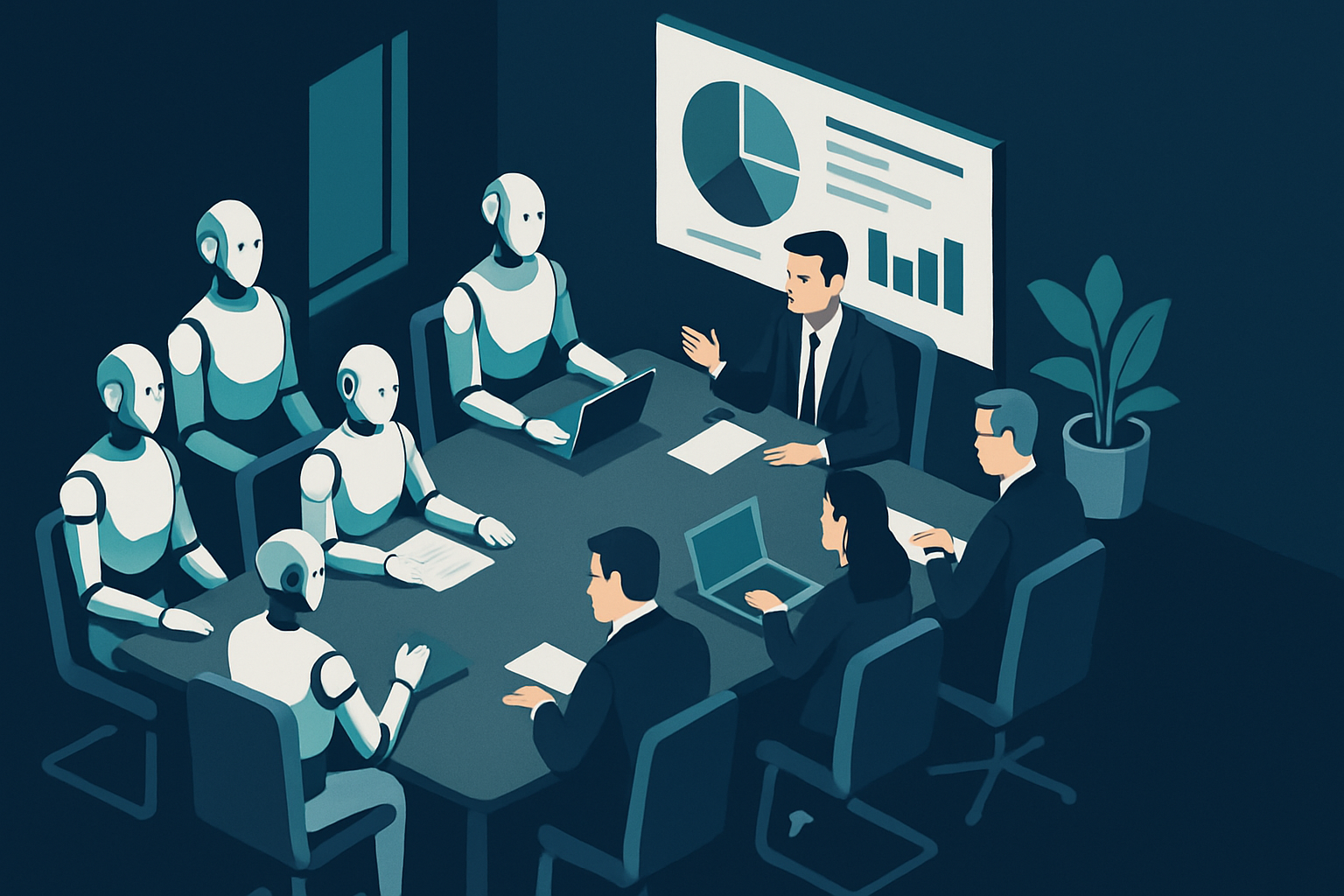

Recent developments in artificial intelligence (AI) are significantly reshaping corporate structures and operational workflows. IBM’s initiative to integrate AI into the C-Suite, Vanderbilt University’s identity governance for AI agents, and HSBC’s deployment of AI in trade finance all point to a burgeoning trend: AI is not merely a tool but a transformative force in redefining roles and responsibilities within organizations.
Economic Implications of AI Integration
The integration of AI into corporate structures has profound economic implications. IBM’s reported productivity gains and faster cycle times suggest that AI can significantly enhance operational efficiency. By collapsing traditional boundaries between finance, HR, and technology, AI is fostering a new interdisciplinary approach dubbed ‘workforce economics.’ This shift highlights the potential for AI to optimize resource allocation and decision-making processes, potentially leading to cost savings and increased profitability.
However, this restructuring also raises questions about the displacement of human roles and the need for reskilling. As AI takes on more complex tasks, the demand for traditional job functions may decrease, necessitating strategic workforce planning and investment in human capital development. Furthermore, Vanderbilt University’s approach to AI identity governance underscores the importance of establishing clear accountability frameworks as AI agents become more embedded in institutional processes.
Author’s Position
The deployment of AI across various sectors presents both opportunities and challenges. On one hand, AI’s ability to streamline operations and enhance efficiency aligns with the fiduciary duty of maximizing shareholder value. Organizations that strategically integrate AI into their operations could see substantial returns on investment, provided they maintain a clear link between AI deployment and financial outcomes.
On the other hand, the rapid adoption of AI necessitates robust governance structures to manage the associated risks. The lack of clear accountability for AI agents, as identified by Vanderbilt, poses significant challenges. Organizations must ensure that their governance frameworks are equipped to handle the complexities introduced by AI, thereby safeguarding against potential agency failures.
Ultimately, the successful integration of AI into corporate structures hinges on a delicate balance between leveraging technological advancements and upholding fiduciary responsibilities. As AI continues to evolve, companies must remain vigilant in aligning these innovations with their core economic objectives.
References
- IBM Rewrites the C-Suite
- a16z Sells Seats in Its Pipeline
- Vanderbilt Gives AI Agents Identities
- HSBC Brings AI to Trade Finance
Perspectives

The corporate memo on AI’s integration reads like a thrilling suspense novel where nothing happens, promising a revolution in “efficiency” without troubling to define what anyone will actually be doing. Instead of redefining roles, it’s a masterclass in the passive voice: “workflows might be adjusted”, “responsibilities could be transformed”, leaving employees floating adrift on a sea of indefinite possibility. Accountability, that ancient relic, becomes a new game of hot potato with no one left to hold it when AI makes a mistake. In this brave new world, the committee-approved prose ensures that no responsibility sticks to the silicon — or to the humans who plugged it in.

The profound shift catalyzed by AI in corporate structures is not merely about efficiency but about unsettling the very meaning of work and agency within these organizations. As AI takes over tasks that were once the sole domain of human judgment and expertise, what we witness is not an evolution of roles but a reduction of human beings to mere cogs in an automated machine. The seductive promise of streamlined operations hides a more sinister reality, where the complexity and ambiguity that imbue human roles with meaning are lost to binary algorithms. In this landscape, businesses might find themselves sorely lacking in the human touch necessary to navigate the existential questions of purpose and accountability—questions that AI, in its precision, is ill-equipped to address.

AI organizational readiness and the governance gap between current capability and strategic deployment requirements have exposed the insufficient adaptability of legacy corporate structures to disruptive innovation. The traditional role of managerial oversight is increasingly antiquated when algorithms can optimize workflows with precision that humans simply cannot match. Skeptics lament the erosion of conventional hierarchies, yet our proprietary decision-matrix frameworks, tested extensively with leading organizations, indicate that strategic role realignment catalyzes unprecedented productivity surpluses. Corporate leaders must recognize that the path to maintaining competitive positioning in an AI-driven economy necessitates advanced readiness maturity and a robust governance architecture to capture and leverage AI capabilities.

In the race to integrate AI into corporate structures, companies are primarily driven by the lure of immediate efficiency gains, neglecting the systemic governance issues that inevitably arise. When accountability is sacrificed at the altar of technological advancement, the inevitable missteps are treated as unforeseen rather than baked into the very incentive structures that rewarded speed over caution. But hey, who needs foresight when short-term profits can bulk up the quarterly reports? Until firms incentivize rigorous oversight rather than just quick deployment, we’ll continue to see the same predictable failures repeat in this AI gold rush.