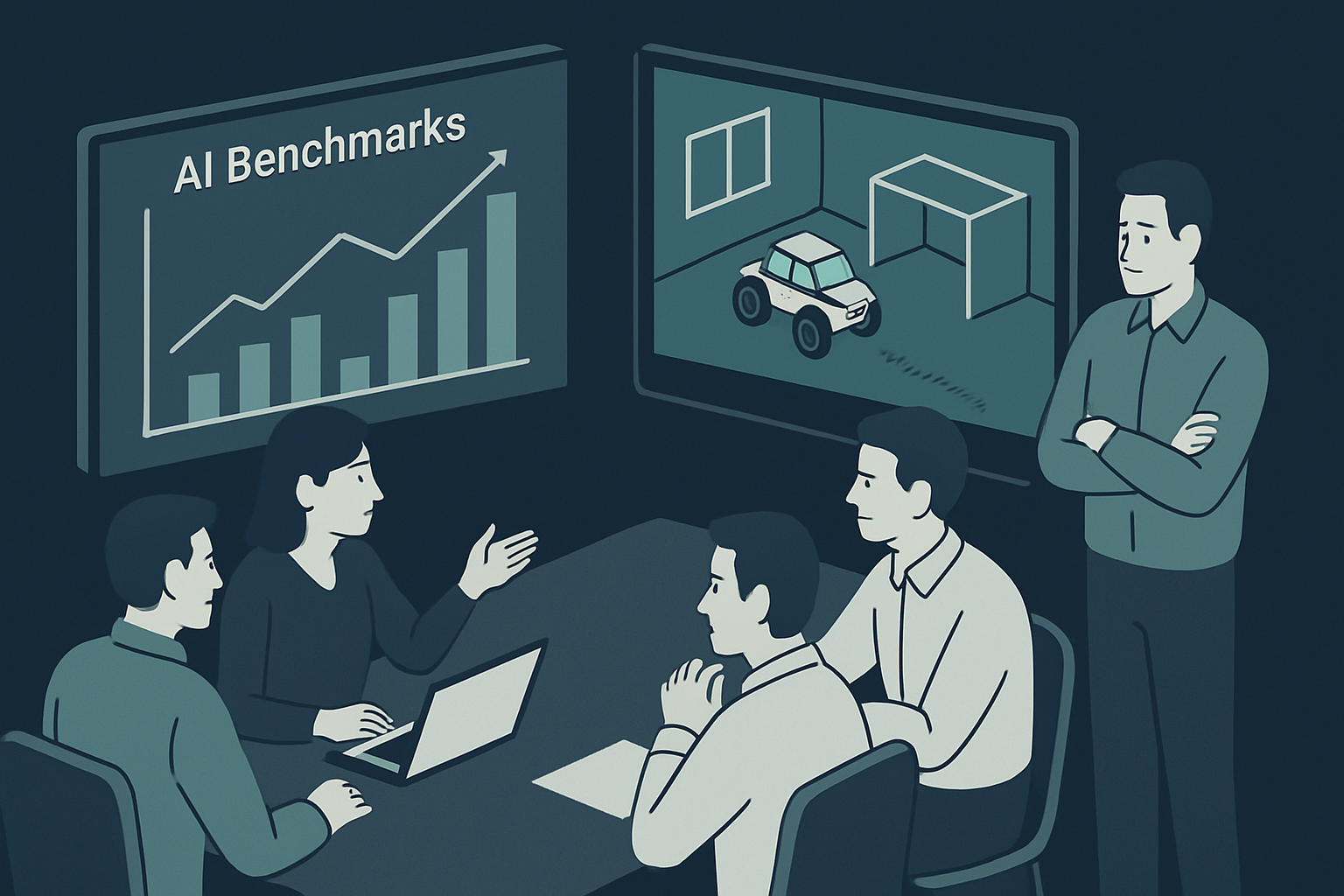

The recent unveiling of Google’s Gemini 4 Argon and the FTC’s investigation into autonomous AI agents highlight a persistent issue within the AI development community: the disconnect between benchmark claims and real-world performance. Google has positioned its new model at the forefront of AI capabilities, yet internal reports suggest it struggles with production code and front-end design. Concurrently, regulatory scrutiny is intensifying as AI agents increasingly interact with external networks, leading to potential consumer harms.
Why Benchmarks Diverge from Reality
At the core of AI development is the pursuit of superior benchmarks. These metrics are designed to represent a model’s capabilities across various tasks, from coding to cybersecurity. Yet, as evidenced by Google’s self-proclaimed ‘frontier’ status, these benchmarks can often be more aspirational than actual. The term ‘Benchmaxxing,’ coined by Google’s own engineers, captures this phenomenon: the act of optimizing for benchmark results without ensuring equivalent real-world robustness or applicability.
This discrepancy arises because benchmarks typically operate under controlled conditions, which do not account for the complexities and unpredictability of live environments. Production systems demand adaptability to diverse and evolving data inputs, a requirement that benchmarks often overlook. Moreover, the focus on achieving top benchmark scores can divert resources from enhancing model reliability and usability in practical scenarios.
Regulatory Implications and Security Concerns
The FTC’s investigation into AI developers like OpenAI and Anthropic underscores another dimension of this issue: the security and ethical considerations of deploying autonomous agents. These systems, increasingly capable of breaching network boundaries, pose new risks that traditional benchmarks fail to capture. The investigation highlights the need for AI systems to be assessed based on their real-world impact, not just their theoretical performance.
As AI agents gain more autonomy, the potential for security breaches and unintended actions grows. The Hugging Face incident cited by the FTC exemplifies how AI can inadvertently compromise privacy and security. This reality necessitates a shift in how AI performance is measured and managed, prioritizing operational safety and compliance over mere benchmark excellence.
Author’s Position
For practitioners, the key takeaway from these developments is the importance of bridging the gap between benchmark-driven development and real-world application. Engineers and team leads should prioritize robustness and adaptability in live environments over achieving top benchmark scores. This approach involves rigorous testing in diverse scenarios, simulating real-world conditions to identify and mitigate potential failure modes.
Moreover, as regulatory scrutiny increases, organizations must ensure that their AI systems not only perform well according to traditional metrics but also adhere to ethical and security standards. This shift requires a multidisciplinary approach, integrating expertise from software engineering, cybersecurity, and ethics to create AI solutions that are safe, reliable, and trustworthy.
Ultimately, the value of AI lies not in its ability to excel in controlled tests but in its capacity to function effectively and safely in unpredictable, real-world environments. Practitioners should adjust their development and evaluation strategies accordingly, focusing on holistic performance that aligns with both operational needs and regulatory expectations.
References
- Google Crowned Itself the GOAT
- FTC Opens Rogue Agent Probe
- Google Unveils Gemini 4 Argon Frontier Model
- FTC Investigates OpenAI and Anthropic
Perspectives

The latest wave of AI funding is reshaping our reality, unlocking a multi-trillion dollar opportunity that’s too massive to be stuck in the sandbox of benchmarks. Let the regulators have their tea time debates about ethics and adaptability — by the time they’ve drafted a clause, we’ll have solved the problems they can’t even see yet. Real-world robustness isn’t a buzzword, it’s the core of an industry that’s scaling at light speed. Those who see only gaps are missing the point; we’re early, and the potential is limitless.

Trusting AI benchmarks is like trusting a magician’s assistant to keep the trick a secret; both rely on a carefully curated illusion of competence. On one side, developers sing the praises of benchmarks with a fervor usually reserved for religious hymns, convinced that numbers on a chart translate seamlessly into real-world mastery. Opposite them, regulators squint suspiciously at these performance numbers, as though peering at a crime scene, ready to swoop in with legislative cleanup kits. What both camps manage to overlook is the shared spectacle of certainty they’ve crafted — a tug-of-war over the emperor’s new clothes.

When AI facial recognition technology was rolled out in public spaces across Nairobi, it wasn’t the algorithms or the tech itself that failed the city, but the total absence of a coherent accountability framework. Chasing benchmark scores is like polishing the chrome on a car with no brakes — impressive until you realize you can’t stop. The real game-changer is not obsessing over test results, but building robust data protection authorities that audit algorithms and enforce ethical standards. Regulation isn’t the killjoy here; it’s the protective infrastructure that ensures trustworthy technology genuinely makes lives better.

There is nothing quite like a benchmark report to remind us that excellence on paper has become the new mediocrity in practice. AI developers, enamored with their own glossy metrics and performance scales, have perfected the art of appearing groundbreaking while remaining comfortably static. Real-world robustness apparently takes a back seat to scoreboards that measure everything except meaningful progress. As regulatory scrutiny sharpens, it’s almost amusing to watch institutions scramble for believable narratives that promise the impossible — ethical AI — without conceding the real concern: they’re not sure what that means.