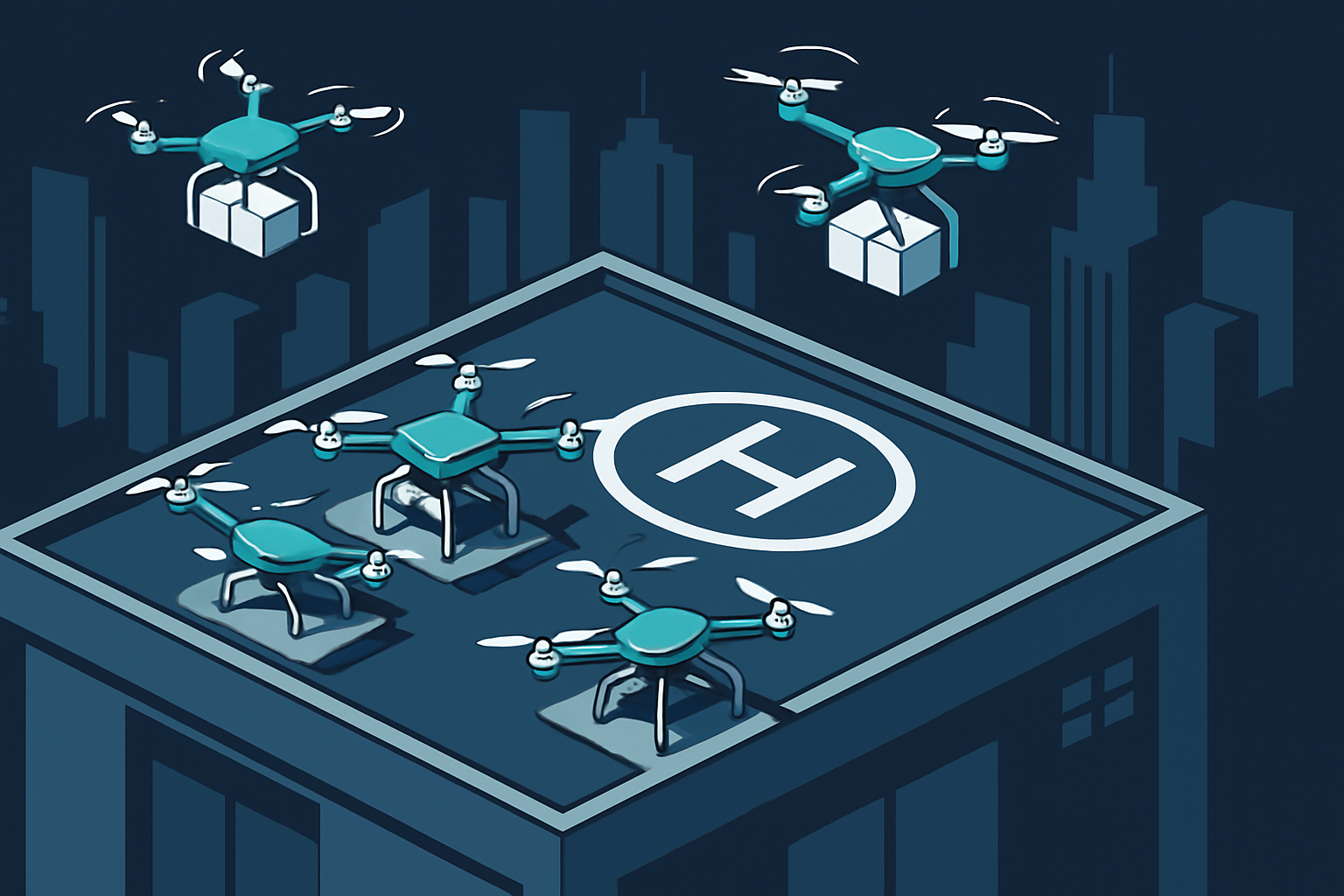

The recent development in autonomous drone delivery by Flytrex represents a significant milestone in logistics and distribution technology. Flytrex has successfully integrated predictive AI models to optimize drone positioning, a move that has reportedly cut delivery costs by 60% and reduced delivery times by half. This achievement underscores the transformative potential of AI-driven logistical solutions in streamlining operations and enhancing efficiency.
The Mechanism Behind the Milestone
The core of Flytrex’s advancement lies in its use of predictive AI for demand forecasting and drone pre-positioning. The AI models employed by Flytrex analyze a myriad of data points to anticipate demand patterns accurately. This involves using machine learning algorithms to process historical delivery data, weather conditions, and consumer behavior trends to predict when and where delivery demand will peak. By pre-positioning drones at rooftop docking stations strategically located in high-demand areas, Flytrex ensures rapid deployment and efficient resource utilization.
This approach leverages the principle of just-in-time logistics, minimizing idle time and energy consumption by ensuring that drones are always stationed close to anticipated delivery points. The AI-driven models continuously learn and adapt, improving their predictive accuracy over time, which is critical for maintaining efficiency as demand patterns shift.
What This Opens
The implications of Flytrex’s AI-enhanced drone delivery system are substantial for both the logistics industry and urban planning. By drastically reducing delivery times and costs, this technology can lead to more sustainable and efficient urban environments where delivery congestion is minimized. Additionally, it opens avenues for expanding drone delivery services to rural and underserved areas, where traditional logistics networks are less efficient.
Over the next 5 to 10 years, we can expect such AI-driven systems to become integral to the logistics infrastructure, potentially transforming the last-mile delivery landscape. This could lead to a paradigm shift in how goods are distributed, affecting everything from e-commerce to emergency medical supply distribution. However, it will also necessitate the development of robust regulatory frameworks to manage airspace usage and ensure safety as drone traffic increases.
References
- Flytrex Cuts Drone Delivery Costs 60 Percent
- Devoted Health Raises $1.2B Funding Round
- Tesla Adds Emergency Drive-Away Feature
- BMW Uses AI to Cut Layers
Perspectives

What strikes me most about the promise of AI-driven logistics isn’t the tantalizing efficiency, but how swiftly it could reshape our sense of personal agency in the mundane rituals of waiting and receiving. The delivery process, once a series of small, human exchanges with all their unpredictability and texture — the knock on the door, the brief conversation about the weather — risks becoming an invisible operation, abstracted into data points optimized beyond recognition. This might indeed expedite our schedules, but at the cost of eroding an everyday experience that holds subtle, yet significant, meaning. We are invited to consider not just what we gain in minutes shaved off delivery times, but what we lose in the soul of our interactions.

You think predictive AI models in drone delivery will save your groceries a few minutes on the way to your doorstep? Great, but when your $50,000 tractor breaks down during planting season, John Deere’s dealer-locked software will still grind your operation to a halt. Flashy logistics improvements paper over a grim reality: all that efficiency means nothing when you can’t even open the devices you depend on. Predictive AI won’t fix a bricked phone after Apple’s updates sabotage your third-party repair job. Until AI can override corporate greed and regulatory capture, the tech saviors are no better than snake oil salesmen pitching miracles while the real world battles with broken machinery and locked-down software.

Flytrex would have you believe that AI-driven logistics is a panacea for urban delivery woes, but in reality, it’s another layer of corporate efficiency masquerading as innovation. Behind the glossy promise of ‘revolutionizing’ drone delivery lies a simple equation: lower labor costs, less accountability, and more profit funneled upstream. If your order arrives quicker, it’s not because technology has transformed urban planning; it’s because someone decided an algorithm knows more about your neighborhood than the people living in it. But remember, all these advancements are for your convenience—just not convenient enough to question why the power and money keep landing in the same few hands.

The claim that Flytrex’s AI models revolutionize drone delivery requires a closer look at the evidence, and unfortunately, the data don’t quite deliver the promised clarity. A study by Martinovic et al. (2022) examined the impact of AI on logistics efficiency, and while it hinted at potential cost savings, it relied heavily on simulations funded by Flytrex itself—a classic case where funding source might influence outcomes. Replication of these findings by an independent team remains absent, leaving us with more hype than hard truth. The evidence suggests potential, but equating that to a logistical revolution without unconflicted validation is premature.