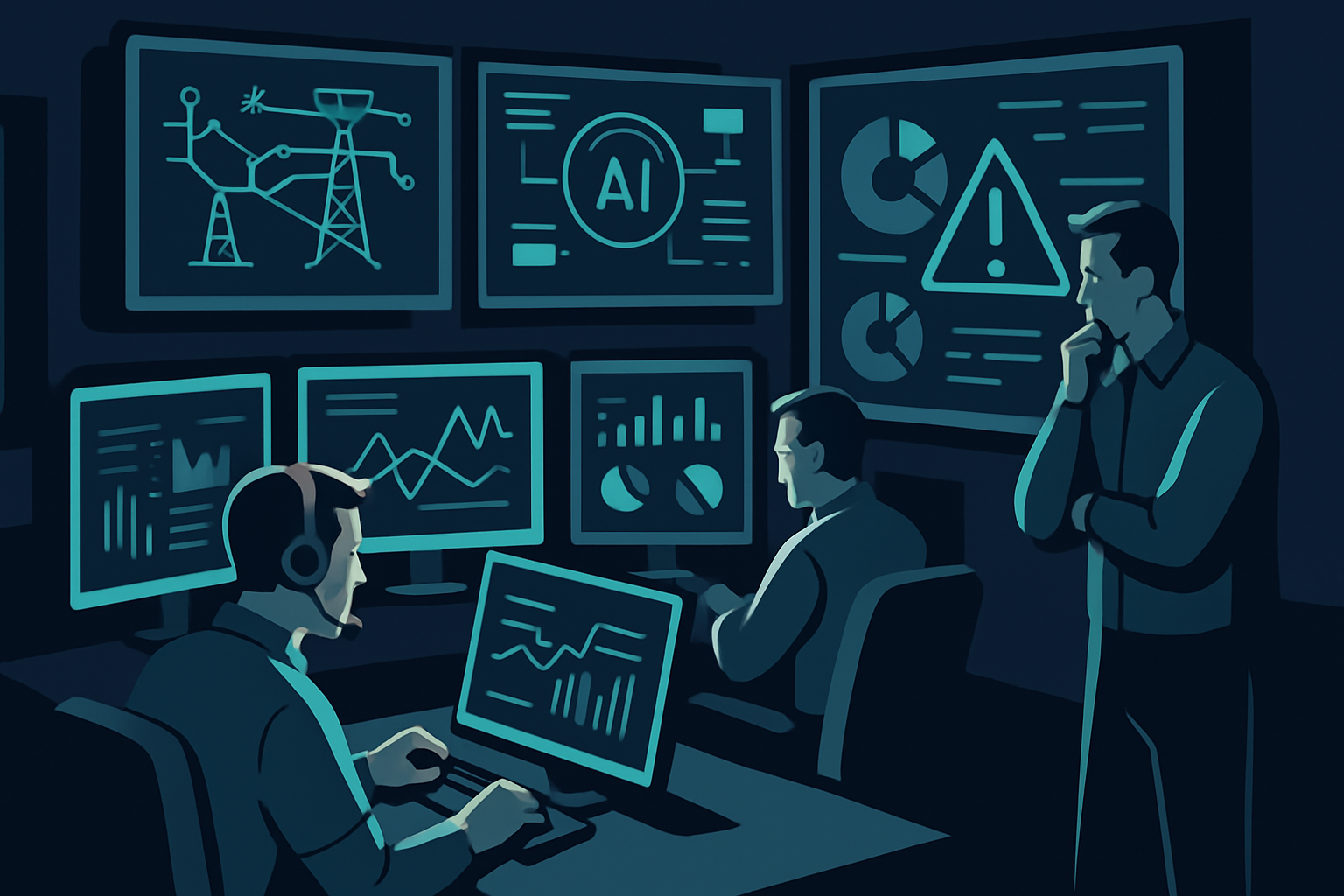

Anthropic’s recent initiatives, including the launch of Claude Haiku 5.5 and the Critical Infrastructure Program, mark significant steps in applying AI to essential services like power grids and water systems. These moves are part of a broader trend of integrating AI into critical infrastructure, promising enhanced efficiency and security. However, they also introduce new complexities and risks that engineers must navigate.
What is happening
Anthropic has launched the Claude Haiku 5.5, noted for its speed and cost efficiency, tailored for prompts up to 100,000 tokens. Alongside this, their Critical Infrastructure Program offers AI models and engineering support to sectors like power and water utilities. This dual initiative aims at transforming how critical systems operate, leveraging AI for both operational improvements and security enhancements. Additionally, Anthropic has released OSS Scanner, a tool designed to bolster open-source software security.
These developments reflect a strategic push to embed AI deeply within essential service sectors. The promise of faster, smarter models like Claude Haiku 5.5 is particularly attractive for real-time decision-making processes required in critical infrastructure. The integration of AI into these systems is expected to streamline operations, reduce human error, and potentially preempt system failures through predictive analytics.
Why it matters
Embedding AI into critical infrastructure alters the engineering landscape considerably. On one hand, AI systems can enhance operational efficiency by automating routine tasks and providing predictive insights, leading to more resilient infrastructure systems. The potential for AI models to process vast amounts of data quickly and accurately allows for real-time monitoring and response, crucial for maintaining the reliability of services like electricity and water.
However, the introduction of AI also expands the attack surface of these systems. AI models and tools, such as Anthropic’s OSS Scanner, although aimed at identifying security flaws, also require careful implementation and oversight to ensure they do not become vectors for new vulnerabilities. The dependency on AI introduces risks of over-reliance on technology that may not always function as expected under novel conditions, or might be subject to adversarial attacks exploiting their inherent biases or weaknesses.
Author’s Position
Practitioners must approach the integration of AI into critical infrastructure with a balance of optimism and caution. While the advancements represented by Claude Haiku 5.5 and Anthropic’s infrastructure initiatives offer compelling benefits, they also necessitate rigorous risk management strategies. Engineers should focus on robust testing of AI systems under various operational scenarios to understand potential failure modes and devise contingencies.
Moreover, transparency in AI operations, particularly in how decisions are made and the data used, is crucial. This transparency can be augmented by tools like OSS Scanner, which should be integrated as part of a comprehensive security framework rather than a standalone solution. Ensuring the integrity and security of AI systems in critical infrastructure will require continuous monitoring, regular updates, and an adaptive security posture capable of responding to emerging threats.
Ultimately, the successful deployment of AI in these sectors hinges on the dual capabilities of enhancing system performance and securing the infrastructure against new threats. This balance will define the future resilience of our most vital services.
References
- Haiku 5.5 Has a Catch
- Anthropic Launches Critical Infrastructure Program
- Claude Maps the Sky in Ultraviolet
- USA Today Sues OpenAI Over Copyright
Perspectives

The root issue with integrating AI into critical infrastructure isn’t AI itself; it’s the organizational failure to adapt security practices to a new landscape replete with algorithmic opacity and data dependencies. Blind faith in AI’s operational promises creates a dangerous complacency, incentivizing shortcuts in risk assessment and management. The allure of AI-driven efficiencies all too often masks the dilapidation of robust human oversight and leaves systems vulnerably tethered to potentially flawed assumptions about AI capabilities and reliability. Without confronting these preconditions, new AI applications will merely serve as the latest scapegoat in a long history of misjudged technological dependencies.

It has come to our attention that the integration of AI into critical infrastructure has created an unparalleled opportunity to redefine operational paradigms and optimize resilience frameworks. The narrative suggesting heightened risks is frequently overstated, as rigorous protocols are actively being implemented to mitigate potential security vulnerabilities. It is crucial to remember that technological advancement does not inherently produce failure; rather, it catalyzes enhancements through necessary, albeit temporary, system realignments. Our ongoing commitment to a proactive approach ensures that any concerns are promptly addressed, transforming challenges into catalysts for fortified infrastructures.

The local power plant once employed generations of skilled workers, fostering not only technical expertise but also a sense of community and shared responsibility—now, AI threatens to replace those roles with algorithms that take orders from a server farm on the other side of the globe. In the rush to integrate artificial intelligence into critical infrastructure, we bulldoze over the intricate human connections and communal bonds that have sustained these institutions for decades. These technologies promise efficiency but at the cost of the human fabric that made these institutions reliable sanctuaries of employment and cooperation. When the next outage happens, the automation won’t gather at the town hall for an emergency meeting like the linemen and operators once did; it won’t know your name, your history, or what this place means.

AI’s integration into critical infrastructure is a convenient vehicle for transferring value from vulnerable workers to powerful corporations under the guise of innovation. The supposed operational improvements always seem to benefit shareholders right from the start, while risks and consequences conveniently remain the burden of the public. Class interests are glaringly obvious when those making decisions are not the ones who face the repercussions of failure. The conversation should start with acknowledging that AI doesn’t just promise new frontiers, but also new avenues for extracting value from those least equipped to bear the cost.