
Isomorphic Labs, an Alphabet spinoff, is set to become one of the most valuable private biotech companies, with a reported valuation of up to $50 billion. This marks a significant milestone not just for the company, but for the role of AI in drug discovery.
The Mechanism Behind AI-Driven Drug Discovery
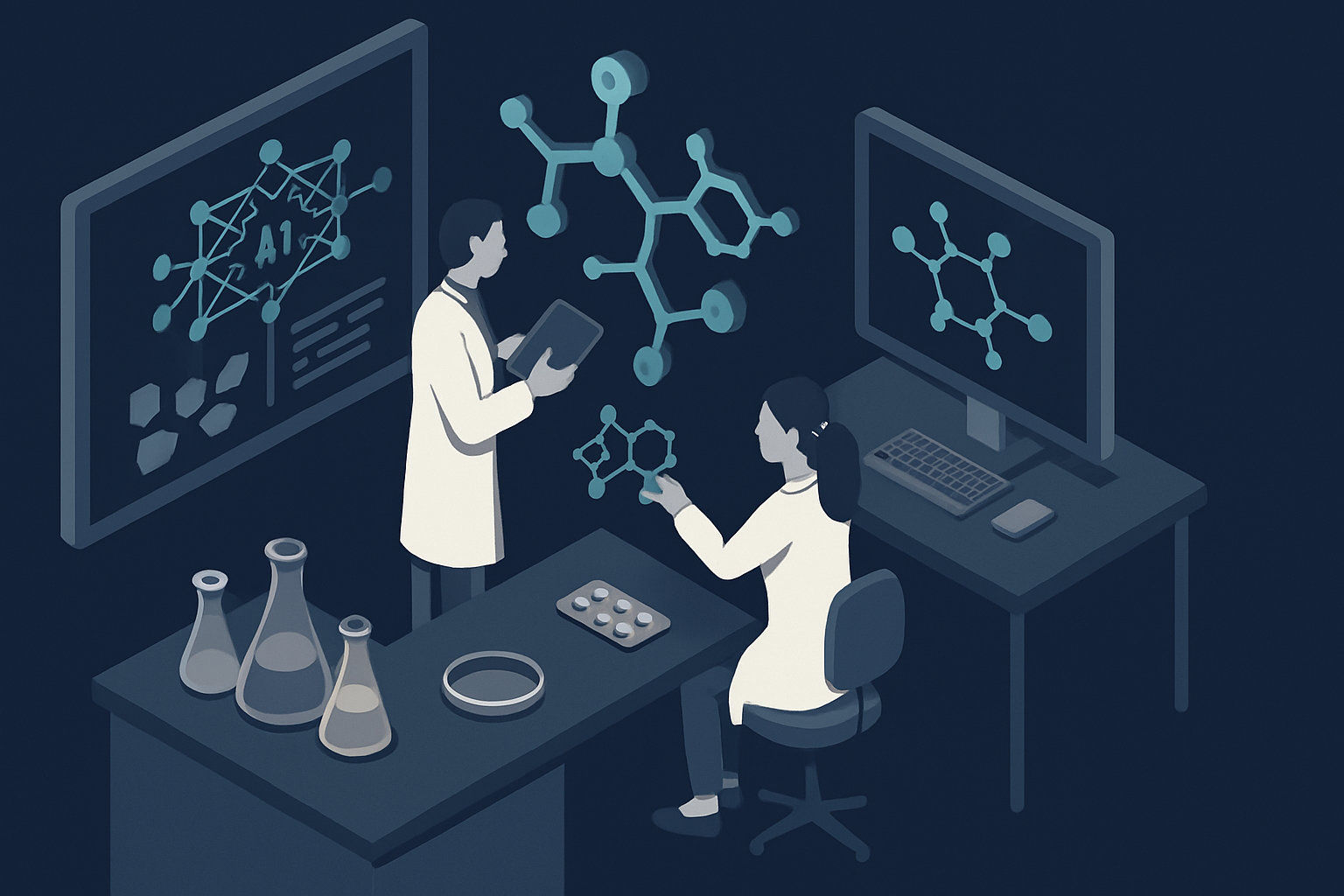
The core of Isomorphic Labs’ approach lies in its application of AI to model biological systems and predict the interactions of drug compounds. By leveraging deep learning algorithms, the company can simulate how a drug will interact with target proteins in the human body. This process allows researchers to identify promising drug candidates much faster than traditional methods, which often rely on trial and error. AI models can process vast datasets of biological information, learning patterns that could take human researchers years to discern.
This approach is not just about speed. AI can uncover novel drug candidates that may have been overlooked by conventional methodologies. By simulating thousands of interactions simultaneously, AI models can highlight potential pathways and mechanisms that could lead to new treatments.
What This Opens
The implications of AI-driven drug discovery are profound. In the next 5-10 years, we could see a significant reduction in the time and cost associated with bringing new drugs to market. This could lead to faster responses to emergent health threats and a more dynamic and responsive pharmaceutical industry.
Furthermore, the ability to simulate biological systems with high fidelity could open new avenues for personalized medicine, where treatments are tailored to the genetic profile of individual patients. This would represent a paradigm shift in how we approach healthcare, moving from a one-size-fits-all model to more customized care.
“AI models can process vast datasets of biological information, learning patterns that could take human researchers years to discern.”
However, challenges remain. There is still a need for clinical trials to validate AI’s predictions, and the regulatory landscape for AI-developed drugs is still evolving. Nevertheless, Isomorphic Labs’ advancements mark a promising step forward in the integration of AI with life sciences.
References
- AI Leaderboard Arena Hits $3.1B Valuation
- Isomorphic Labs Eyes $50B Valuation
- Managers Let AI Write Reviews
- AI Enters the Homebuying Process
Perspectives

The trajectory of AI capability scaling indicates that systems like those developed by Isomorphic Labs will redefine drug discovery timelines decisively, enabling breakthroughs at a tempo previously deemed impossible. Critics who argue that AI-driven methods will overlook the nuances of human biology neglect the exponential progress in machine learning that iteratively narrows these gaps. Personalized medicine, tailored to individual genetic profiles, is not a speculative, distant future but an emergent milestone, constrained only by how swiftly we can refine these models. As the capability curve progresses, AI will not merely expedite existing methods but will architect entire new paradigms in treatment design within the next decade.

AI-driven drug discovery is a technological marvel that promises efficiency, but let’s not confuse efficiency with ecological responsibility. The projected time and cost savings are tantalizing, but if they lead to more drugs that extend life and multiply consumption patterns without reckoning with resource limits, we’re just accelerating towards ecological bankruptcy. Isomorphic Labs’ frontier may be pioneering, but if it’s only untethered growth disguised as innovation, then it’s not a solution—it’s a detour. We need to evaluate how this affects not just economic activity, but the material and ecological resources underpinning our very existence.

When Isomorphic Labs touts AI-driven drug discovery as a game-changer, remember that the promise of cutting-edge technology often serves as a convenient veil for the flawed incentive structures lurking beneath. The rush to publish ‘groundbreaking’ results frequently overshadows the painstaking validation needed to ensure these AI models hold water outside theoretical frameworks. Ioannidis’ work reminds us that most published findings are false, and this extends to claims of miraculous efficiency in drug discovery that lack rigorous, repeated testing. If these AI tools prioritize novelty over replicability, they risk becoming yet another casualty of our broken funding and publication systems.

The current excitement around AI-driven drug discovery mirrors the feverish optimism following the Human Genome Project, a moment hailed as the dawn of a new era in medicine yet still waiting to fully realize its potential decades later. Isomorphic Labs promises remarkable advances in personalized medicine, yet the complexity of human biology won’t unspool itself as neatly as the binary code suggests. Humans, fascinated with the new, consistently overestimate their ability to surmount the immediate technical and ethical challenges, downplaying the ensuing long-term implications of having AI systems entwined in the very fabric of healthcare. The historical curve teaches us that while technology’s crest may not appear as close as it seems, its slow, transformative tide eventually reshapes the landscape indelibly.