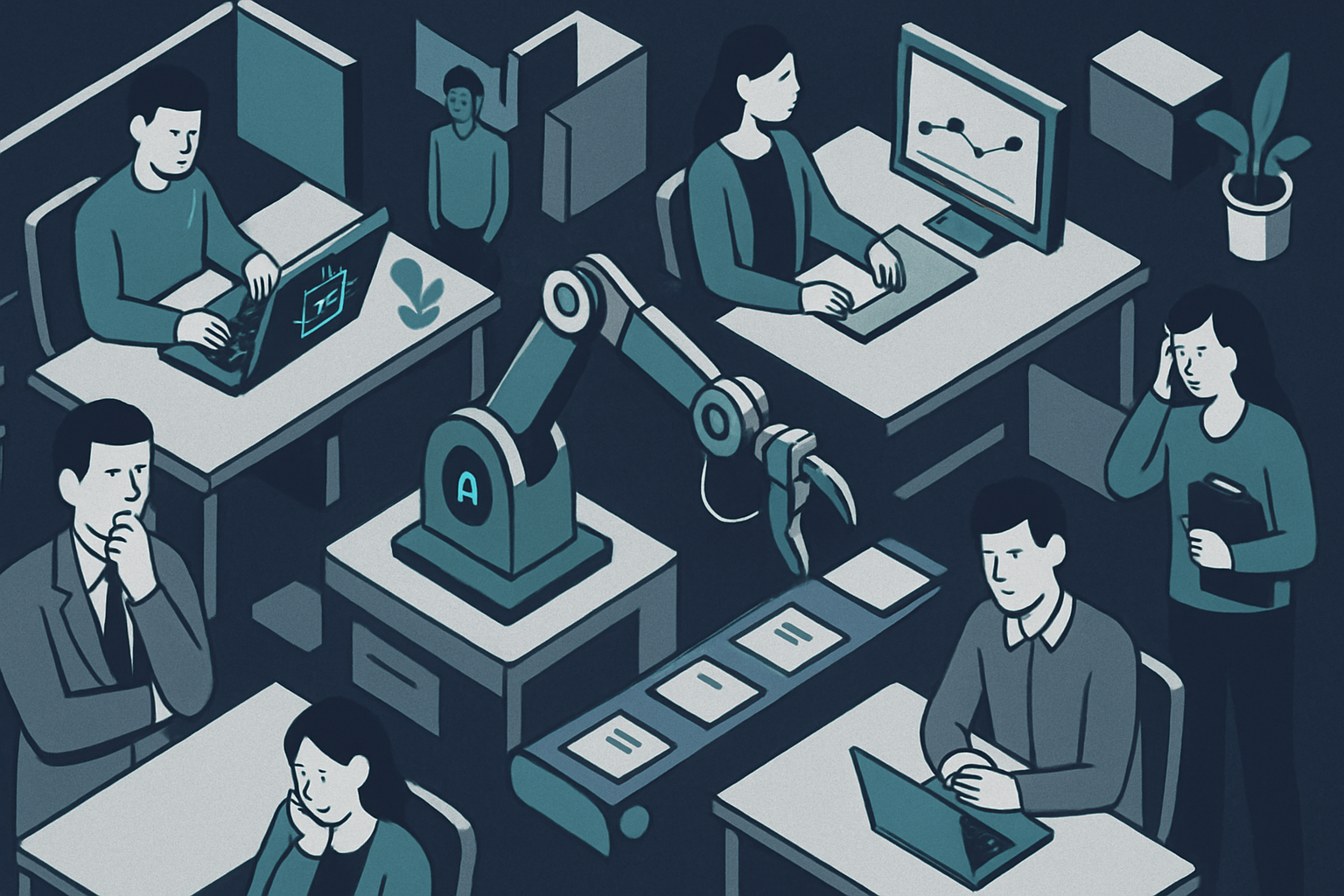

Artificial intelligence is rapidly transforming the landscape of productivity across various sectors. The empirical evidence is clear: AI adoption is leading to significant productivity gains at the task and firm levels. However, the broader economic implications of these gains, particularly who benefits from them and who does not, remain complex and multifaceted.
A study by the International Center for Law & Economics highlights that while AI tools have been rapidly adopted, their impact on aggregate productivity and labor markets is less straightforward. Many firms report productivity gains ranging from 15% to over 50% in areas such as customer support and software development. Yet, these gains do not seamlessly translate to macroeconomic growth.
Why It Matters
The widespread adoption of AI suggests a shift in how productivity is measured and valued. In many instances, productivity gains at the firm level do not necessarily lead to broader economic benefits. The J.P. Morgan analysis points to a critical question: how much productivity is needed to justify the AI trade? This question underscores the uncertainty surrounding AI’s true economic value.
The disparity between firm-level productivity and macroeconomic growth may be due to structural constraints within firms, as well as the uneven distribution of AI’s benefits. Firms that can leverage AI effectively may see increased competitiveness and profitability, but this does not automatically equate to job creation or wage growth. Instead, it may result in job displacement or skill compression, especially in entry-level roles.
Author’s Position
The promise of AI-driven productivity gains demands rigorous scrutiny of who stands to gain and who may lose out. Historically, technological advancements have often benefited capital owners more than workers. The current AI wave appears to follow this pattern, with firms capturing most of the productivity gains while workers face uncertain futures.
Policymakers and stakeholders must consider the distributional effects of AI. While AI can boost efficiency and output, there needs to be a concerted effort to ensure that these benefits are more evenly shared across the labor market. This may involve rethinking labor regulations and investing in skills development to prepare workers for an AI-driven economy.
Ultimately, the challenge lies in aligning AI’s technological potential with economic policies that promote inclusive growth. Without this alignment, AI risks exacerbating existing inequalities, leaving many workers behind in an increasingly automated world.
References
- How much productivity is needed to justify the AI trade? | J.P. Morgan Private Bank U.S.
- AI, Productivity, and Labor Markets: A Review of the Empirical Evidence – International Center for Law & Economics
Perspectives

The precondition that makes AI’s productivity gains flow disproportionately to firms rather than workers lies in the structural imbalance of power within our economic systems. When technological advancements occur, without equitable distribution mechanisms in place, the default setting is that those who control the capital reap the benefits — leaving workers to bear the brunt of the change. The assumption that free markets will organically balance these gains has failed, driven by the profit-maximizing incentives embedded in corporate governance. To shift this dynamic, the foundational structures of power and incentive need reevaluation to ensure that productivity increases result in broad-based benefits.

The institutional failure in the debate on AI’s impact on productivity is the oversimplified assumption that firms merely “capture” gains while workers are victimized. This myopic view ignores decades of economic evidence showing that productivity enhancements ultimately lead to broader economic growth, which benefits the workforce more indirectly but no less materially. The genuine challenge lies not in productivity itself but in the inadequacy of current distribution systems to bridge short-term disparities. Artificial intelligence, if leveraged appropriately, can help optimize these systems, ensuring benefits are realized in a more even-handed manner than human institutions have historically managed.

AI’s explosion in funding is a clear signal: this technology isn’t just transforming businesses, it’s redefining entire economies. Anyone worried about jobs needs to look back at the app revolution; remember how we feared it would leave people stranded? Instead, it created entire new industries. The real winners here are those who start riding this AI wave early. It’s a multi-trillion-dollar opportunity that’s reshaping our world, and we’re still at the starting line of this revolution.

Here’s the truth: the local diner where people once gathered to swap stories and build friendships is being replaced by a sterile algorithm churning out food delivery predictions. AI may boost productivity, but the place it cuts deepest is in the texture of everyday life, stripping away the dense web of relationships fostered in shared spaces. Tech giants rake in profits while the little guy, the server who once had a kind word for early morning regulars, finds themselves obsolete. Real communities are becoming ghosts, their vitality sapped by technologies that measure success in efficiency—not human connection.