
When Ono Pharmaceutical announced on July 28, 2026 that it would embed Phylo’s Biomni Lab platform across its discovery science teams, the detail that stood out was not the partnership itself but the operational claim behind it: AI agents working end-to-end alongside individual scientists, from synthesizing experimental history to designing and executing computational biology workflows. Ono is a 300-year-old Osaka-based company whose oncology franchise includes nivolumab (OPDIVO), one of the first approved PD-1 checkpoint inhibitors. The decision to restructure daily discovery work around an agentic AI platform signals a specific bet about where the bottleneck in drug discovery actually sits.
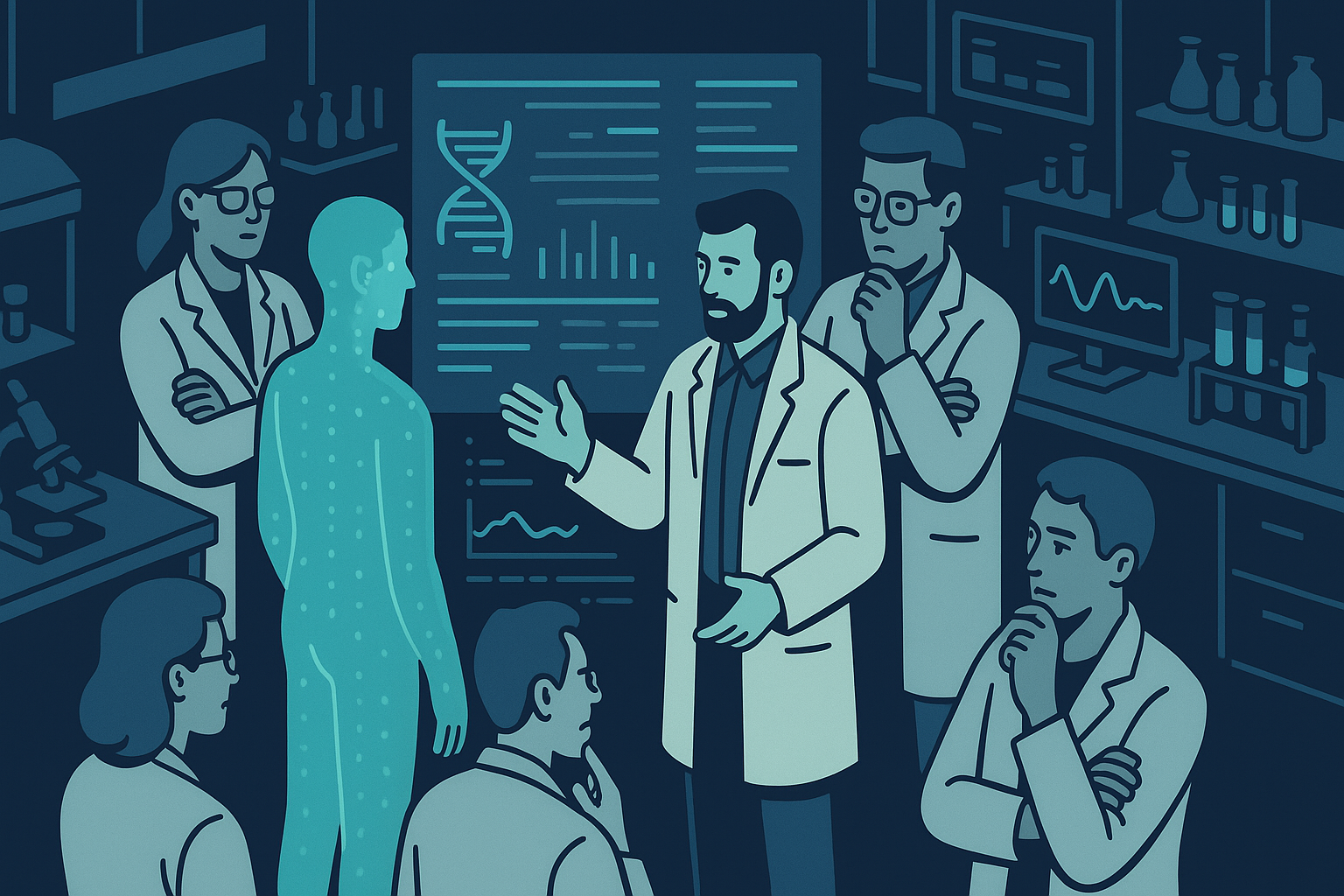
That bottleneck is not, primarily, in wet-lab throughput or even in structure prediction. It is in the cognitive overhead of a working scientist managing literature, internal assay history, competing hypotheses, and experimental design simultaneously. Biomni Lab is built around the premise that this overhead is the rate-limiting step — and that AI agents capable of reasoning over a company’s own historical data, not just public databases, can compress the time between a question and a testable compound.
What Agentic AI Actually Does in This Context
The term “agentic AI” is doing a lot of work in current biotechnology marketing, and it is worth unpacking what it means in Phylo’s implementation as described in the announcement. Biomni Lab is characterized as an “Integrated Biology Environment” — a platform where AI agents are not passive query-response systems but active participants in multi-step workflows. According to the announcement, those workflows include: synthesizing experimental history (meaning the platform ingests and reasons over Ono’s internal compound and assay data, not just published literature), generating and evaluating hypotheses, designing experiments, and executing computational biology tasks.
The distinction from conventional AI-assisted search or single-step prediction tools is the capacity to chain steps. A scientist asking about a target in a particular disease context would receive not a static summary but an agent-mediated process: relevant internal data surfaces, prior assay results are contextualized, competing mechanistic hypotheses are weighed, and an experimental design to discriminate between them is proposed. Whether Biomni Lab’s implementation fully delivers on each of those steps at production quality is not independently verifiable from the announcement alone — Ono’s Seishi Katsumata noted that researchers “quickly adopted it and saw its potential,” which suggests early-stage utility without specifying measured outcomes.
What the architecture addresses is a genuine problem. Pharmaceutical companies accumulate enormous stores of proprietary experimental data — failed compounds, dose-response curves, off-target binding profiles — that are chronically underutilized because they are difficult to query systematically. A scientist joining a project may not know that a closely related compound was deprioritized three years ago because of a specific hepatotoxicity signal. An agent that has indexed and can reason over that history changes the information environment in which decisions get made.
Ono’s therapeutic focus — oncology, immunology and inflammation, neurology — is significant because each of these areas involves complex biology where target selection errors are expensive. The cost of a late-stage clinical failure in oncology can exceed a billion dollars. If agentic AI reduces the rate at which programs advance on flawed hypotheses, the value accrues not at the speed of individual experiments but at the scale of the portfolio.
What This Opens
The Ono-Phylo partnership is one instance of a structural shift that is becoming visible across large pharmaceutical organizations: the move from AI as a specialized tool applied to discrete problems (predict this protein structure, score this binding affinity) toward AI as a persistent cognitive layer embedded in the daily workflow of every discovery scientist. That shift changes the unit of analysis from individual AI applications to the organizational architecture of a research division.
Over the next five to ten years, assuming platforms like Biomni Lab mature, the compounding effect may show up less in individual discovery stories and more in aggregate pipeline statistics — reduced attrition rates at specific decision gates, faster identification of safety liabilities before expensive in vivo studies, more systematic exploitation of existing compound libraries. These are not dramatic findings that produce headlines; they are the kind of incremental improvement in decision quality that reshapes what a drug discovery organization can attempt with a given budget.
The harder question — one the Ono announcement does not address, because no single partnership announcement can — is what happens to the epistemic process of science when AI agents mediate which historical data surfaces and how hypotheses are framed. A system trained on a company’s own experimental history will encode that history’s biases, including the biases embedded in which experiments were run and which targets were deemed worth pursuing. That is not an argument against the approach; it is the precondition most likely to determine whether the next generation of agentic AI in drug discovery produces genuinely better science or just faster movement through existing conceptual grooves. The answer will take longer than any single partnership to become clear.
References
- Ono Pharmaceutical partners with Phylo to embed agentic AI with every discovery…
- Ono Pharmaceutical Partners with Phylo to Enhance Drug Discovery
Perspectives

The three most instructive precedents here — the introduction of statistical process control into manufacturing in the 1950s, the computerization of financial trading in the 1980s, and the digitization of genomic sequencing in the 1990s — share a pattern that nobody in drug discovery seems to be consulting: each technology dramatically accelerated movement through the existing conceptual frame before the field discovered, painfully, that the bottleneck had never been throughput. Ono’s bet that the constraint in drug discovery is a researcher’s inability to hold decades of proprietary data in their head is plausible on its face, but the sequencing analogy should give everyone pause — genomics generated data at unprecedented scale and then spent fifteen years discovering that having the sequence wasn’t the same as understanding the biology. The genuine question Biomni raises isn’t whether AI can synthesize experimental history faster than a human; it’s whether an agent trained to pattern-match across that history will systematically reproduce the conceptual assumptions embedded in it, at speed and at scale, in ways no one will notice until a generation of hypotheses have been designed inside the same wrong frame. Each of those three transitions eventually produced genuine breakthroughs — but only after an intermediate phase in which the new tool was used to do the old thing faster, and the cost of that phase was measured in years.

The institutional knowledge bottleneck in drug discovery is a rail-control problem dressed in a lab coat — whoever holds the accumulated experimental history holds the power to frame what questions get asked next, and for decades that’s meant a handful of senior researchers and the organizational structures that outlive them. Ono embedding agentic AI across its discovery teams isn’t a productivity story, it’s a redistribution story: the cognitive overhead that previously taxed every scientist who wasn’t the right person to know the right thing gets dissolved, and the compounding cost of that tax — measured in failed replication, duplicated dead ends, hypotheses never formed because the relevant experiment happened in 2009 and the person who ran it retired — stops accruing daily. The real question isn’t whether AI accelerates movement through existing conceptual frames, it’s whether the alternative — human memory, org charts, and whatever made it into the published literature — was producing novel frames or just the illusion of them. The organizations that control proprietary experimental history at scale will either use tools like this to actually mine it, or they’ll continue paying the toll of their own archives; the patients waiting on the other end of that decision don’t get a vote in how slowly institutions choose to move.

The mechanism being obscured here is working memory capacity — specifically the prefrontal cortical constraint that limits a human researcher to roughly four chunks of information in active maintenance at once, a ceiling set by dopaminergic modulation of layer III pyramidal neurons, not by effort or expertise. Ono’s actual problem is not that its scientists lack intelligence; it is that no biological system with a prefrontal cortex can simultaneously hold thirty years of assay failures, off-target binding profiles, and synthesis dead-ends in a state of active integration — that is not a workflow failure, it is a neuroanatomical fact. What Biomni is doing, stripped of the press-release framing, is functioning as an externalized working memory buffer with retrieval architecture that does not degrade with cognitive load — which is a genuinely useful thing to build. The open question, and it is an empirical one that will require properly controlled trials with clear discovery-rate endpoints, is whether the system expands the conceptual search space or simply executes faster retrieval within the frame a researcher already occupies — because if it is the latter, you have not solved the bottleneck, you have just accelerated the prefrontal cortex’s existing priors.

The thing being quietly retired here is the scientist who spent fifteen years learning what the data *means* — not just retrieving it, but developing the judgment to know when the historical record is lying to you, when a failed experiment failed for interesting reasons, when the pattern everyone else pattern-matched past is actually the finding. Biomni’s pitch is essentially that the bottleneck in drug discovery is memory, and that an agent with perfect recall of internal experimental history will outperform a researcher with imperfect recall — which is true in exactly the way that a GPS outperforms a navigator, right up until the GPS routes you into a lake and there is nobody left who knows how to read a map. The decades of proprietary data that no single researcher can fully hold also cannot be fully audited by a system trained to find patterns in it; the model retrieves history with confidence inversely proportional to its awareness of what the history doesn’t contain. What gets accelerated here is not discovery — it is the speed at which existing conceptual frames get exhaustively mined before anyone notices the frame itself was the constraint. The scientist who would have noticed is the one whose cognitive overhead we just optimized away.