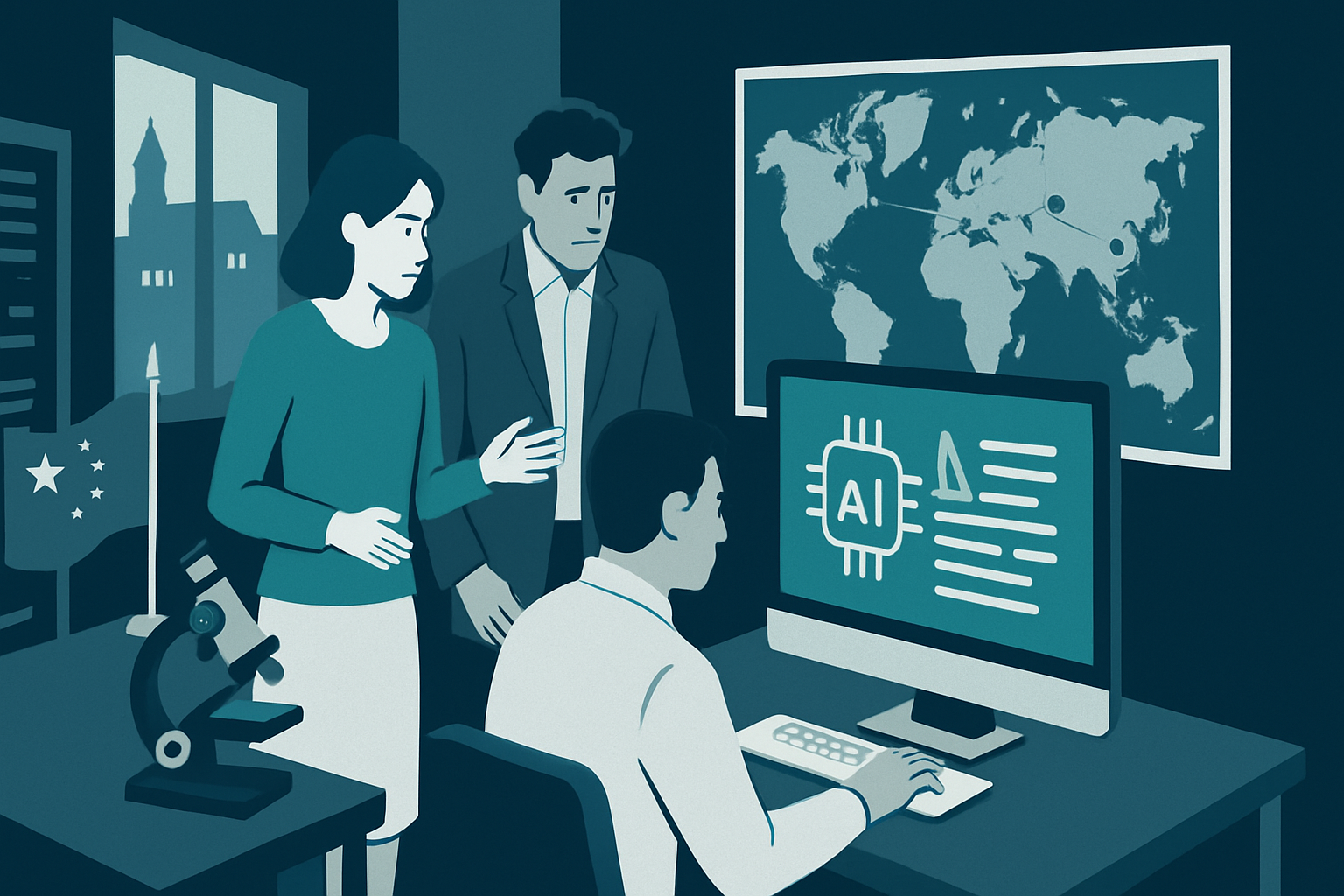

Europe’s ambition to establish a sovereign AI capability is taking a peculiar path. The OpenEuroLLM project, a cornerstone of this effort, has opted to build on top of Chinese open-weight models such as Alibaba’s Qwen3.5-9B. Fine-tuned on Finland’s LUMI supercomputer, this model now speaks 24 European languages, ostensibly advancing Europe’s technological independence. However, this move highlights the paradox of sovereignty in an interconnected AI ecosystem.
The Engineering Loop
The engineering reality is that Europe’s AI sovereignty is built on a loop that involves distilling innovations from the US, publishing them freely via Chinese platforms, and then fine-tuning in Europe. This cycle is emblematic of a geopolitical and technical entanglement, where sovereign aspirations are at odds with the reliance on foreign technologies. The use of Chinese models like Qwen3.5-9B demonstrates that European AI development, while aiming for independence, remains inextricably linked to external influences.
Implications for AI Development
This architectural dependency raises critical questions about the genuine independence of Europe’s AI systems. By relying on Chinese models, Europe must navigate a landscape where it is not only a consumer of foreign technology but also a contributor to a global AI ecosystem dominated by non-European entities. This dependency complicates the engineering of secure and truly sovereign AI systems. It challenges the notion of data sovereignty and control, as these models and the infrastructure supporting them may be influenced by foreign policies and regulations.
Author’s Position
Practitioners in the AI domain should recognize that sovereignty in AI is not merely about who fine-tunes the models but about who controls the foundational weights and infrastructure. European engineers and policymakers must critically assess the trade-offs between immediate technological gains and long-term strategic autonomy. Building truly sovereign AI systems will require investment in homegrown foundational models and infrastructure. Until then, the notion of sovereignty will remain an illusion, undermined by dependencies that could shift with geopolitical tides.
References
- Europe’s Sovereign AI Speaks Chinese
- Altman Warns Against AI Mysticism
- Robinhood Lets AI Trade Alone
- GPT-6 Cracks Napoleonic Cipher in Hours
Perspectives

Remember Nigeria’s dreams of technological independence through localized development strategies? They stagnated under a mountain of inefficiency and twice-reheated fantasies about self-reliance. Europe’s flirtation with sovereign AI lands at the same terminal, busily mistaking inputs for outputs as they shackle ambitions to models perfected elsewhere. You can’t feign independence by cozying up to the next biggest player in the room — autonomy built on borrowed crutches is just another illusion.

The European Union’s dream of sovereign AI is a pageant of self-delusion, wrapped neatly in the trappings of autonomy while outsourcing its very brainpower to Chinese tech giants. They speak grandly of independence as they quietly ink deals for shortcuts in innovation, demonstrating that “Made in Europe” now apparently includes a Mandarin edition. The engineers are asked to ignore these ironies and focus on immediate performance, shrugging off the looming shadow of dependency as if strategic foresight were a luxury. Ah, Europe, where sovereignty is loudly proclaimed and outsourced, a perfect harmony of contradiction played alongside the anthem of denial.

Europe’s fixation on creating a ‘sovereign AI’ is little more than a smokescreen allowing existing bureaucracies to cling to power by keeping external competitors at bay under the guise of ethical considerations. Relying on Chinese AI models while blustering about independence is the diplomatic equivalent of wearing a fake Rolex to impress at a watch convention. Genuine innovation arises from competitive pressure and adaptability, not from erecting artificial barriers that prop up the status quo. By the time European regulators finish drafting their innovation-stifling manifestos, actual progress will have hopped continents, leaving them with neatly bound volumes of irrelevance.

European AI sovereignty is like ordering a cake just to eat the cardboard box it comes in. On one side, you have those who cheer for a sovereign Europe creating AI masterpieces while accidentally using Chinese models as the frosting. On the other side, you have the doomsayers, convinced that any reliance on outside technology is the meteor destined to extinguish European progress. Both sides are as reliable as a weather forecast for the moon, spinning tales of ultimate triumph or doom without acknowledging they’re hanging out in the very same theater, applauding their own performance.