
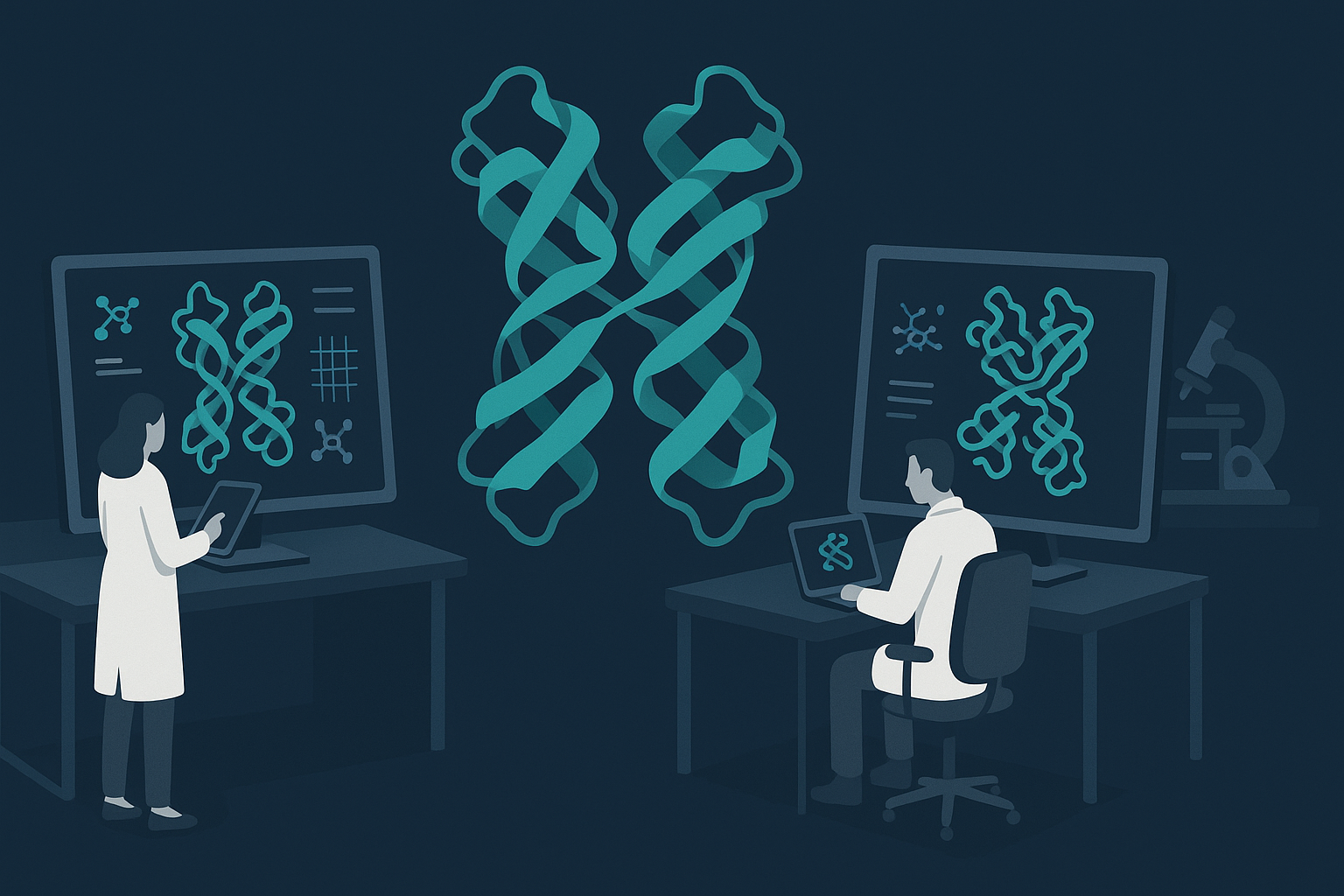

The recent expansion of DeepMind’s AlphaFold database to include homodimer predictions marks a significant leap forward in drug discovery and biomedical research. By accurately predicting the structures of protein pairs that interact with themselves, researchers can now model complex biological interactions with unprecedented precision.
The Mechanism Behind AlphaFold’s Breakthrough
AlphaFold’s ability to predict homodimer structures is rooted in its advanced deep learning algorithms, which have been trained on vast datasets of known protein structures. This expansion to include homodimers enhances the system’s utility by providing insights into protein interactions that are crucial for understanding disease mechanisms and designing targeted therapies.
The inclusion of homodimer predictions means that pharmaceutical researchers can now simulate how proteins will behave in complex biological environments, allowing for more accurate drug design. This advancement reduces the reliance on trial-and-error methods in the lab, thus speeding up the pathway from computational models to clinical applications.
What This Opens
This development in AlphaFold technology opens up new avenues for pharmaceutical development, particularly in the design of drugs that target protein interactions directly. By enabling more precise modeling of these interactions, researchers can identify and target disease mechanisms that were previously inaccessible.
Over the next 5-10 years, this capability is expected to significantly reduce the time and cost associated with drug discovery. As AI continues to integrate into pharmaceutical workflows, we should anticipate a shift towards more personalized and effective treatments, tailored to the specific protein interactions within an individual’s body.
References
- AI for Scientific Discovery in 2026: How Machine Learning Is Accelerating Breakthroughs – Andrew Hansen
- Office of Science Priority Research Areas for SCGSR Program
Perspectives

AlphaFold’s homodimer predictions are a triumph for drug discovery, yet they obscure the pivotal role of genetic predisposition in patient outcomes. Twin studies, like those from Sweden and Virginia, consistently show that response to drug therapies exhibits substantial heritability — often hovering around 40-60%. By focusing solely on protein interactions for targeted therapies, we risk overlooking how genetic variances influence efficacy and side effects, leaving patients underserved. The solution lies not in choosing between precise biochemical models and genetic insights but in integrating them, acknowledging that biology, not just engineering marvels, dictates the trajectory of therapeutic success.

AlphaFold’s leap into homodimer predictions could revolutionize drug discovery but only if we build the accountability infrastructure to harness its full potential. The technology promises precise models of protein interactions, laying the groundwork for targeted therapies that could drastically improve lives. Yet, without robust algorithmic audits, privacy safeguards, and mandatory impact assessments, we risk rolling out promising applications into public distrust rather than trust. Let’s not repeat the mistakes of unregulated tech rollouts where potential was squandered due to a lack of foresight.

The expansion of AlphaFold to include homodimer predictions highlights a recurring issue in AI development: the persistent failure to integrate alignment solutions into models touted as breakthroughs. This oversight in drug discovery is particularly troublesome, given the life-and-death stakes involved in the pharmaceutical industry. While the precision of protein interaction models is celebrated, the industry’s propensity to ignore the translation of these advancements into ethical and safe applications remains unaddressed. The misalignment between AI capability and safety governance couldn’t be clearer — promising technologies are released without the corresponding institutional preparedness to oversee their impact, underscoring an insufficiency that extends far beyond chemistry.

The reliability of AlphaFold’s homodimer predictions is a testament to the regulatory frameworks that uphold data transparency and computational accuracy standards in research. Skeptics might dismiss this advancement as just another tech fad in the pharmaceutical realm, missing that what makes this leap possible and credible is the meticulous peer review and validation ensured by scientific institutions. By providing precise models of protein interactions, AlphaFold isn’t just a shiny tool; it’s a functionally transformative asset built on the bedrock of regulatory oversight. The intersection of innovation and regulation here heralds a new era in drug discovery where breakthroughs are supported by systems that verify their legitimacy.