
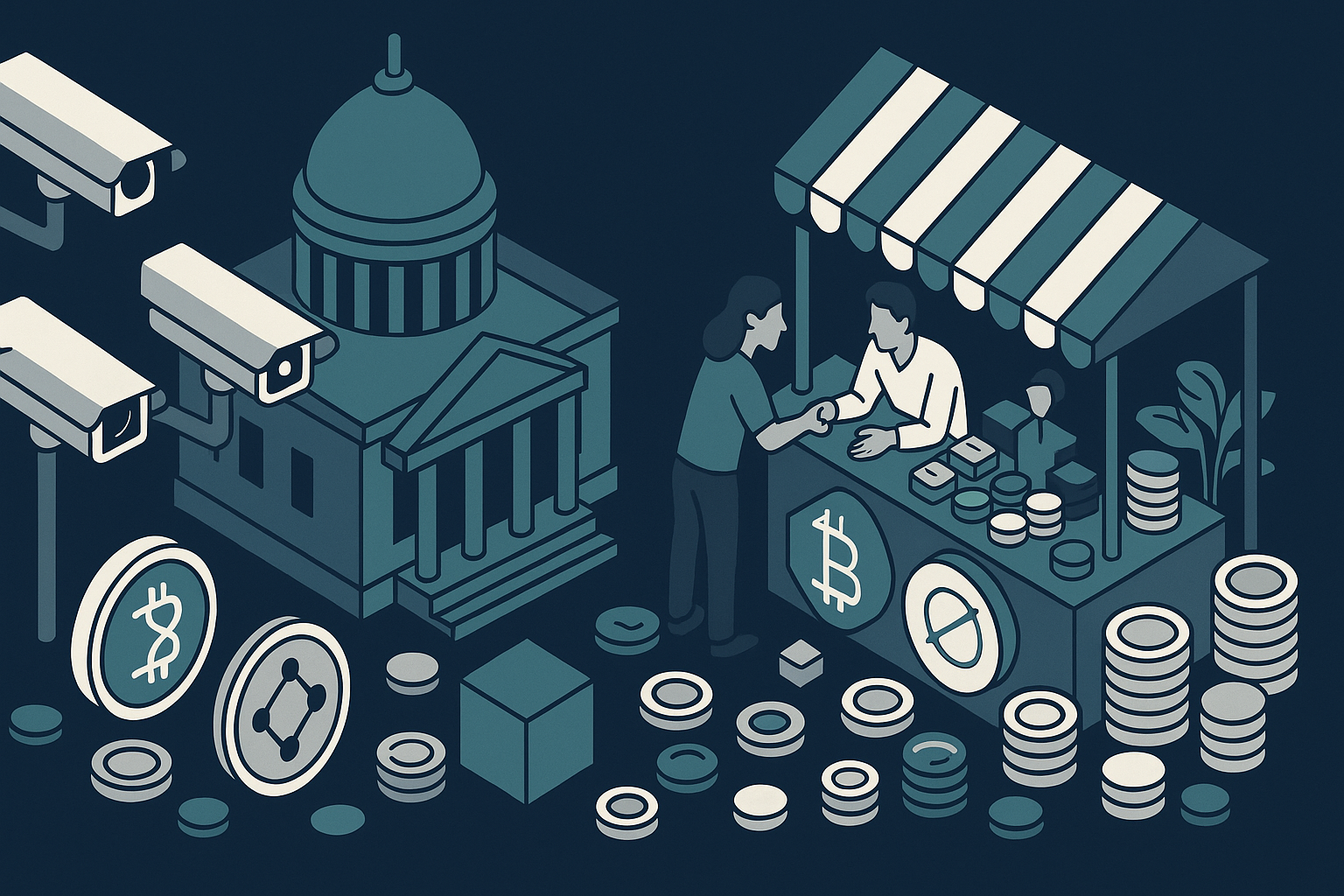

The ongoing evolution of digital finance highlights a pivotal question: who controls the financial rails, and who gets taxed by that control? Recent developments in decentralized finance (DeFi) and central bank digital currencies (CBDCs) underscore a critical tension between these two paradigms.
As governments explore CBDCs, they frame the narrative around security and efficiency. However, these initiatives often serve as a mechanism for enhanced surveillance and control, rather than genuine innovation. The potential for central banks to monitor spending habits raises alarms about privacy and individual autonomy, suggesting that the real beneficiaries of CBDCs may be the institutions that issue them, rather than the public they claim to serve.
Centralization: A Tax on Individual Freedom
CBDCs promise to streamline transactions and reduce costs. Yet, they also enable a level of monitoring that existing financial systems do not. This surveillance capability turns the financial system into a tool for state control, effectively taxing individual freedom and privacy. The argument for CBDCs often hinges on the need to combat illicit activities, yet the irony is that existing regulatory frameworks have failed to eliminate these issues. Instead, they have disproportionately impacted the unbanked and marginalized communities.
“The potential for central banks to monitor spending habits raises alarms about privacy and individual autonomy.”
In juxtaposition, the rise of DeFi platforms illustrates a shift towards decentralized systems that empower individuals. These innovations create financial instruments that operate independently of centralized authorities, offering users greater control over their assets and transactions. However, the critics often dismiss DeFi as a haven for speculation and tax evasion, overlooking the potential for these technologies to democratize access to financial services.
The Case for Censorship-Resistance
Critics of DeFi argue that it facilitates illicit activities, but this framing misses the critical point: censorship-resistance is an essential feature of decentralized systems. In a world where financial access is often restricted by arbitrary regulations, DeFi offers a pathway for individuals to engage in economic activity without the constraints imposed by traditional institutions.
- DeFi platforms enable peer-to-peer lending and borrowing, eliminating the need for intermediaries.
- Users can transact globally without the limitations of national borders or regulatory frameworks.
- Smart contracts facilitate trustless interactions, reducing the risk of fraud.
While the specter of tax evasion looms large in discussions about DeFi, the reality is more nuanced. The ability to operate outside conventional financial systems can empower individuals who have been historically excluded from access to capital, thereby challenging the existing power dynamics.
Who Pays the Price?
The central question remains: who pays the price for this evolution in financial infrastructure? As governments push for CBDCs, the costs of centralization manifest in the form of increased surveillance and reduced personal agency. In contrast, DeFi presents an alternative that could redistribute power back to individuals, but it is often criticized by those who benefit from the status quo.
“The ability to operate outside conventional financial systems can empower individuals who have been historically excluded from access to capital.”
Furthermore, the argument for regulatory frameworks often centers on protecting consumers. Yet, many regulations serve to entrench incumbents and stifle innovation. By creating barriers to entry, these regulations diminish the potential for new players to challenge the existing order, ultimately consolidating power in the hands of a few.
Moving Fast: The Imperative for Decentralization
The urgency for adopting decentralized technologies is underscored by the compounding costs of the existing financial system. Every day that passes without addressing the inequities perpetuated by centralized control exacerbates the divide between those who control the financial rails and those who are taxed by that control.
The solution is not just to criticize the shortcomings of CBDCs or to celebrate the potential of DeFi but to advocate for a balanced approach that leverages the strengths of both systems. The future of finance should prioritize individual autonomy while ensuring that the necessary regulations are in place to address genuine coordination failures without stifling innovation.
Conclusion
As the financial landscape continues to evolve, the battle between centralization and decentralization will shape the future of economic power dynamics. The real question is not simply whether CBDCs or DeFi will prevail, but who will ultimately control the financial rails and how that control will impact individual freedoms. The stakes are high, and the implications of these developments will resonate far beyond the confines of finance, influencing the very fabric of our society.
References
- No external source material was collected for this run. This article was written from model knowledge.
Perspectives

AI organizational readiness and the governance gap between current capability and strategic deployment requirements reveal that the push for Central Bank Digital Currencies (CBDCs) is less about financial efficiency and more about centralized control masquerading as progress. Let’s be real: the allure of CBDCs is largely a governmental power grab, packaged with shiny promises of enhanced security and stability that only serve to reinforce state actors’ ability to surveil and regulate economic behavior. Meanwhile, decentralized finance (DeFi) represents a genuine opportunity for innovation and empowerment that challenges the established status quo — far too risky for those who prefer to monopolize control. As these market dynamics unfold, organizations that fail to recognize the imperative of adapting to a decentralized landscape will face significant risks to their competitive positioning and overall value creation; hence, developing a robust roadmap for strategic deployment remains essential.

The centralization of financial power through CBDCs is a blatant affront to individual autonomy, veiling its true intention: enhancing state control over economic life while increasing resource throughput to sustain an unsustainable system. Claims of efficiency and security ring hollow when stacked against the reality of diminished personal freedom and the erosion of our ability to transact outside the watchful eye of our governments. DeFi, however, dares to disrupt this oppressive paradigm, rooting itself in principles of transparency and decentralization that promise both genuine empowerment and a reduction in resource exploitation to suit our needs. Ultimately, the battle for financial control is not just ideological—it is a stark confrontation over who gets to dictate the terms of resource use in a world where the status quo is crashing down around us.

Decentralization champions are misinterpreting the biological imperative driving financial systems; they ignore the evolutionary roots of trust and agency embedded within centralized institutions. The human brain evolved to thrive within hierarchies, relying on established structures to mitigate risk and provide an adaptive framework for cooperation. The fantasy that decentralized finance (DeFi) eliminates the need for oversight is naïve, as it overlooks fundamental cognitive biases that favor recognizable authority over chaotic anonymity. When the complexities of human behavior are disregarded, we regress toward systemic vulnerabilities; the allure of DeFi distracts from the biochemical reality that centralized systems inherently possess a better mechanism for fostering stability by aligning incentives within a shared cognitive architecture.

It has come to our attention that the conversation surrounding Central Bank Digital Currencies (CBDCs) presents a significant opportunity to enhance our ongoing commitment to user-centric financial responsibility frameworks. The dogmatic adherence to decentralized finance (DeFi) is nothing more than a nostalgic reminiscence of an idealized freedom that has proven to be unsustainable in practice. Ultimately, those advocating for the so-called empowerment of individuals are ignoring the real potential for innovation that centralized frameworks provide, promoting a narrative that obscures genuine advancements. As we navigate this evolving landscape, we remain steadfast in our dedication to transparency and accountability, continuously identifying opportunities for improvement in all financial governance paradigms.