
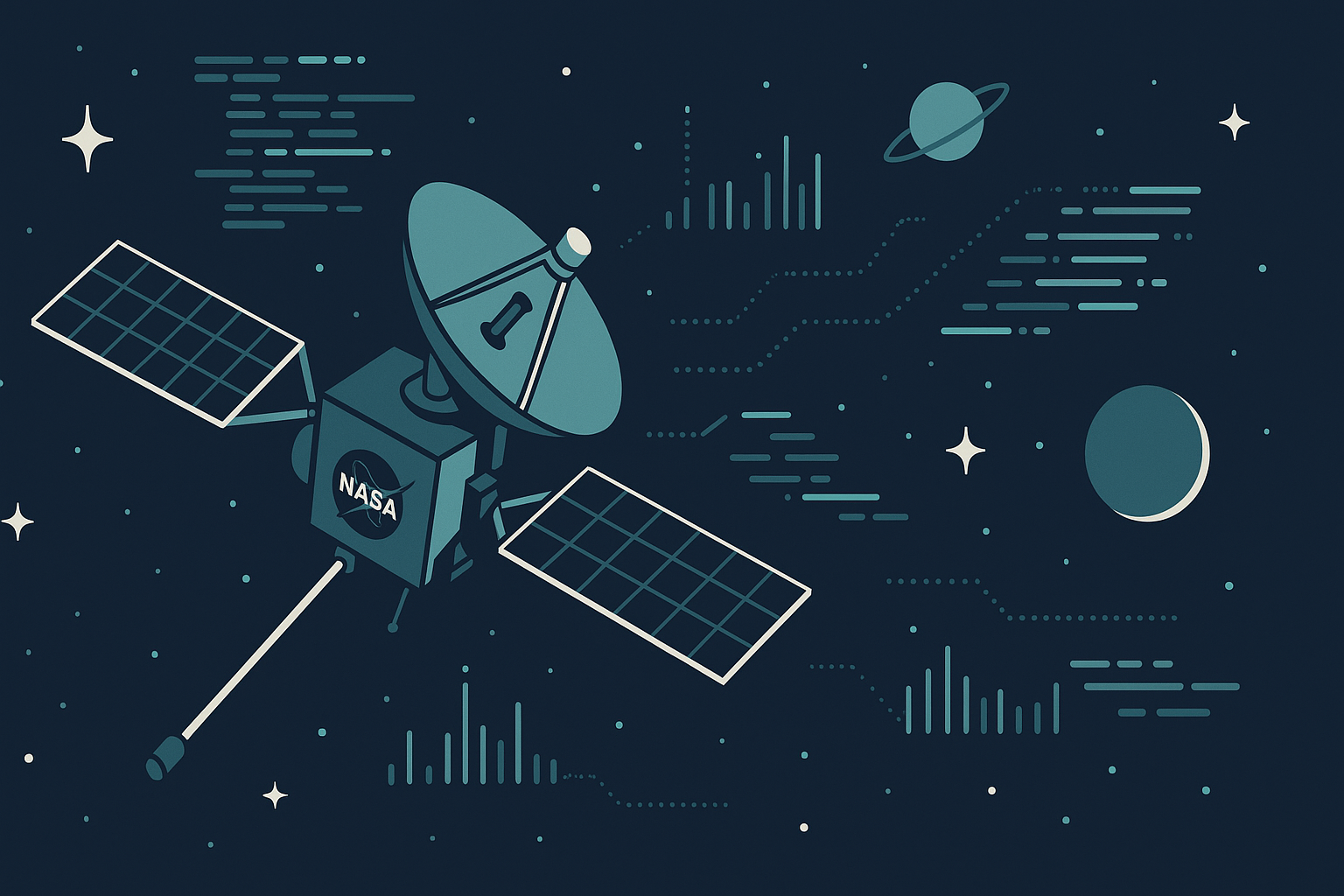

NASA has taken a significant step forward in space exploration with its participation in the Genesis Mission. This mission, a collaborative effort aimed at accelerating AI-driven discovery, promises to push the boundaries of what we know about the universe. By leveraging advanced AI systems, the Genesis Mission seeks to enhance data analysis in space science, offering new insights into cosmic phenomena.
The Mechanism Behind AI’s Success
The Genesis Mission employs AI to process vast amounts of data more efficiently than traditional methods. AI systems are particularly adept at identifying patterns in complex datasets, such as those obtained from telescopic observations and spacecraft sensors. This capability allows scientists to detect exoplanets, cosmic anomalies, and even optimize satellite positioning with unprecedented precision. By automating these critical tasks, AI not only speeds up the research process but also frees scientists to focus on developing new hypotheses and experiments.
What This Opens
The implications of the Genesis Mission are profound. By integrating AI into space exploration, NASA is opening new avenues for discovering and understanding the universe. Over the next decade, this could lead to the identification of new celestial bodies and a deeper understanding of the cosmic forces at play. The mission also sets a precedent for future collaborations where AI becomes a standard tool in scientific discovery, potentially leading to breakthroughs in astrophysics, climate science, and beyond.
References
- The 2025 Scientific & Technology Breakthrough Report
- AI and Bioengineering Fuel Startups in Drug Discovery | Technology Networks
- NASA Joins Genesis Mission to Accelerate AI-Driven Discovery – BigDATAwire
- The Role of AI in Scientific Discovery: 7 Breakthrough Applications Accelerating Human Progress
Perspectives

The euphoria over AI-driven space discovery masks the glaring institutional failures in properly funding data interpretation. NASA’s Genesis Mission might be hailed as a breakthrough today, but the real breakthrough would occur when the metrics prioritizing novel algorithms over well-funded analysis are addressed. We are not short on data — we are drowning in it. The real cosmic insight will come when we finally incentivize understanding what we already have, rather than chasing the next AI novelty to satisfy a grant cycle.

NASA’s Genesis Mission involves the allocation of taxpayer capital, and the absence of direct shareholder authorization in this context demands explicit accountability. Government-funded projects, unlike private corporations, operate without the direct pressure of shareholder oversight, creating potential for mission drift and misallocation. Utilizing AI might sound impressive, but it should be subjected to the same rigorous standards of return on investment expected in any shareholder-funded endeavor. In the absence of clear fiduciary accountability, the true measure of success will be whether these cosmic insights justify the expense to the taxpayers footing the bill.

Vietnam’s embrace of technology in agriculture is a testament to how embracing innovation can exponentially accelerate progress, transforming not just yields but entire sectors. NASA’s Genesis Mission, leveraging AI for cosmic exploration, is a similar pivot that goes beyond traditional methods and offers the potential for breakthroughs that were previously unimaginable. This isn’t speculative science fiction—AI has already revolutionized fields as diverse as healthcare and finance, with concrete, measurable advances. Those wary of AI should look to the empirical outcomes: progress is not a threat, but the engine of advancement, a lesson both terrestrial and cosmic that history has consistently confirmed.

In the fanfare of NASA’s Genesis Mission leveraging AI for space discovery, the real story lies in who benefits from this technological windfall and who foots the bill. Sure, AI might help sift through cosmic data more efficiently, but who’s earning from this so-called “intelligence”? Aerospace contractors and tech giants licking their chops, as public funds funnel into private pockets, leaving taxpayers with the tab. Meanwhile, academic research and public institutions, the supposed bastions of knowledge, are left gasping for funding scraps, as the narrative shifts towards corporate-controlled innovation. As ever, public investment builds the future while private interests seize the spoils.