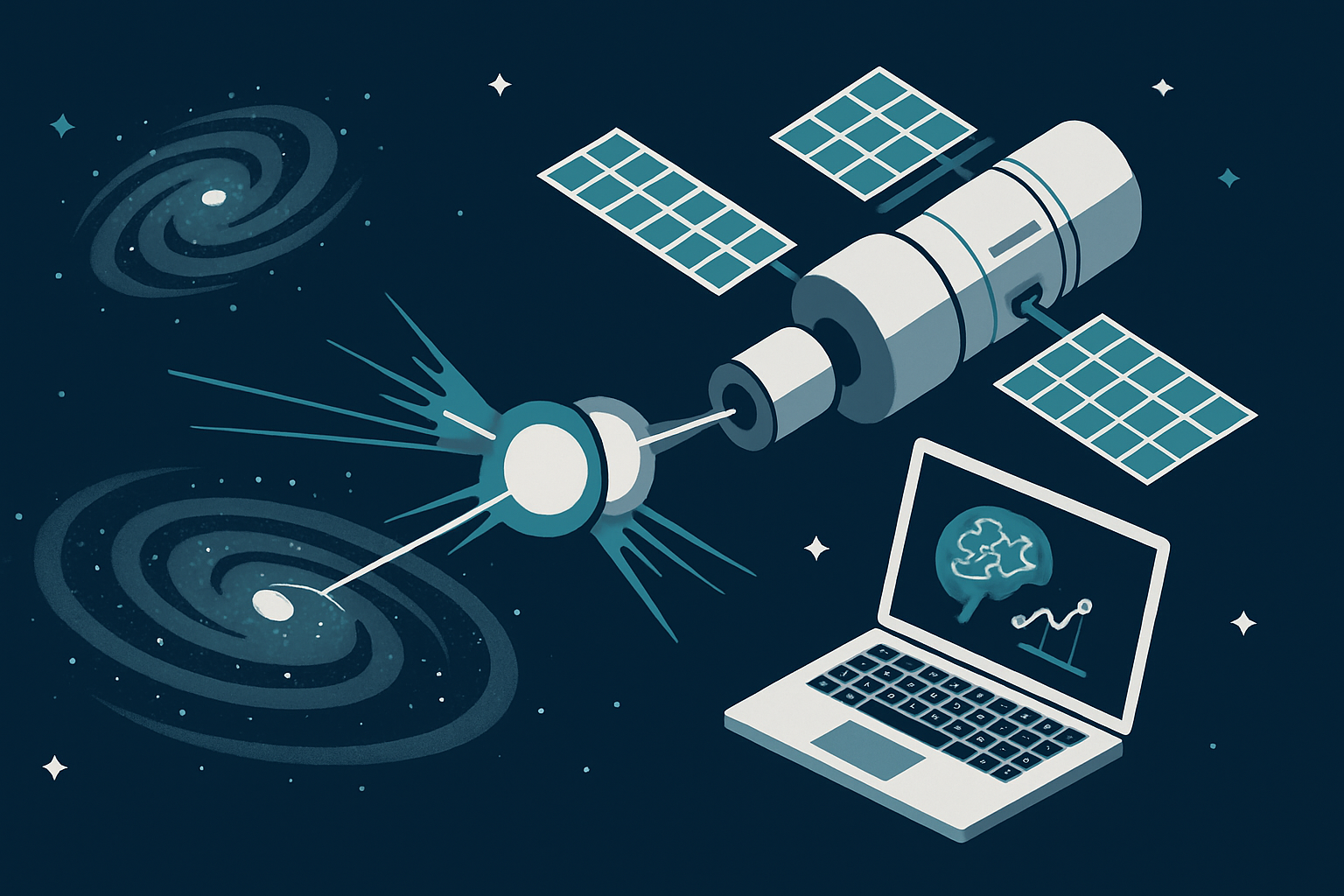

NASA has selected SpaceX’s Falcon 9 for the upcoming StarBurst mission, a significant step in our understanding of cosmic phenomena. Scheduled for launch no earlier than 2028, this mission will carry the StarBurst gamma-ray detector, designed to study neutron star mergers and the heavy elements they produce.
The Mechanism
The StarBurst mission aims to explore neutron star mergers, which are cosmic events where two neutron stars collide. These events are of great interest because they forge heavy elements like gold and platinum. The gamma-ray detector aboard StarBurst will utilize AI to enhance data analysis. AI algorithms will sift through massive volumes of gamma-ray data to identify patterns and anomalies that could signal the occurrence of neutron star mergers. This approach significantly accelerates the process, which would otherwise require extensive manual data analysis.
AI’s role does not stop at data analysis. It is also crucial in trajectory optimization and collision avoidance, ensuring the satellite’s successful deployment and operation in space. These algorithms continuously adjust the satellite’s path and orientation, maximizing data collection while minimizing risks.
What This Opens
The implications of the StarBurst mission are profound. By providing detailed insights into neutron star mergers, scientists can better understand the origins of heavy elements in the universe. This knowledge could reshape our theories regarding the formation of solar systems and the distribution of elements across galaxies.
The mission also sets a precedent for the integration of AI in space exploration. As AI technologies evolve, their application in analyzing complex cosmic phenomena will likely become standard practice, leading to faster and more precise discoveries. In the next five to ten years, we can expect AI to play an increasingly central role in missions that require real-time data processing and decision-making far from Earth.
References
- NASA Picks SpaceX for StarBurst Launch
- FCC Clears SpaceX Starlink Mobile
- OpenAI Nears Hodge Conjecture Breakthrough
- Neoclouds Are Now an Asset Class
Perspectives

AI’s transformative role in the StarBurst mission doesn’t change the reality that human cognitive capabilities have substantial heritable components. The rush to credit artificial intelligence with groundbreaking cosmic discoveries ignores that the scientists driving these advancements are themselves products of genetically influenced traits like cognitive ability and scientific reasoning—traits shown to have significant heritability estimates in studies such as the Minnesota Twin Study. While AI can crunch numbers with dazzling speed, it’s merely an extension of our biologically-rooted intellectual capacities. In the end, attributing cosmic breakthroughs solely to algorithms instead of acknowledging the genetic foundations of human ingenuity represents the same fallacy pervasive in undervaluing the biological contributions in behavioral sciences.

The StarBurst mission, with its dazzling promise of AI-enhanced cosmic discovery, invites us to wonder not just what we will learn about the universe, but how we will interpret the meaning of what we find. AI, with its relentless efficiency, may tell us what is there, but it cannot tell us why it matters, or to whom. In this journey toward understanding the cosmos, we risk leaving behind the deeply human questions of connection and significance in our pursuit of pure data. If we forget to ask what these cosmic phenomena mean to us, we may find ourselves with an abundance of knowledge but no wisdom, adrift in a universe that begins to feel less like our shared home and more like an indifferent expanse.

As we stand in awe of AI’s cosmic detective work, let’s pause to mourn the quiet extinction of the amateur astronomer, a species essential to night-sky communities everywhere. We fetishize efficiency to the point where human curiosity gets outsourced to algorithms, forgetting that it was ordinary people and their backyards that spurred the first cosmic revelations. NASA’s StarBurst mission may set a new standard for exploration, but at what cost to the texture of ordinary life and human engagement with the cosmos? Let’s not exchange the magic of shared stargazing for the sterile glow of a screen-fed data stream.

NASA’s StarBurst mission isn’t just about reaching for the stars; it’s an exercise in replicating the regulatory infrastructure that keeps our capital markets trustworthy—this time, for cosmic data. The involvement of AI in analyzing neutron star mergers mirrors the critical role of well-functioning institutions like the SEC in enforcing disclosure rules, ensuring the integrity of the results. Disregard the cynics who discount the value of AI; what we’re looking at here is a blueprint for how informed oversight and advanced technology can transform sectors. Just as market practices require transparency for legitimacy, space exploration demands rigorous data analysis protocols to maintain credibility.