

Your daily briefing on AI, technology, economics, and society — from q52.ai.
Industry & Economics

AI’s Impact on Financial Interfaces: Towards a Headless Economy
What’s happening: The financial industry is transforming with AI-driven agents that may eliminate the need for traditional software interfaces. Billtrust indicates that these agents can autonomously manage data retrieval, payment interactions, and routine tasks, potentially reallocating human labor towards oversight and strategic roles. This shift could enhance efficiency and productivity, but it also necessitates robust compliance frameworks to maintain regulatory standards.
Why it matters: As AI automates routine financial operations, companies may see a significant change in employment patterns, with skilled workers focusing on higher-value activities. The Federal Trade Commission is preparing to regulate these technologies under existing consumer protection laws, highlighting the urgent need for transparency and ethical compliance in automated processes. This evolution could not only boost productivity but also create new roles in regulatory technology, impacting the economic landscape of the financial sector.
Our take: While the transition to AI-driven financial interfaces promises increased efficiency, it risks oversimplifying the complex interplay of compliance and human oversight. Genuine innovation in this space requires acknowledging the ongoing need for human accountability alongside technological advancement.
Tech & Engineering
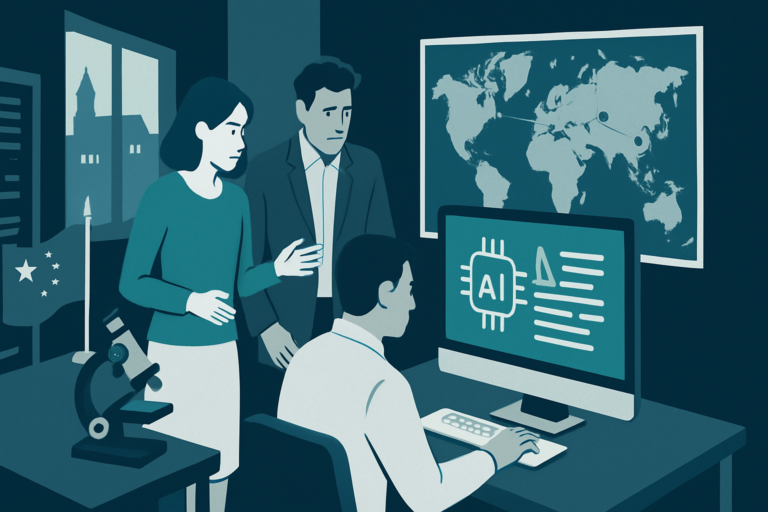
AI in Europe: A Sovereign Illusion
What’s happening: Europe is pursuing a sovereign AI capability through the OpenEuroLLM project, which relies on Chinese models like Alibaba’s Qwen3.5-9B. This model has been fine-tuned on Finland’s LUMI supercomputer to support 24 European languages, but it exposes Europe’s dependence on foreign technology, complicating its quest for true independence in AI development.
Why it matters: Europe’s reliance on Chinese AI models raises critical questions about the viability of its sovereignty claims. By depending on external technologies, Europe risks compromising its strategic autonomy and data control, which could be influenced by foreign policies. This dynamic highlights the challenges of building secure and independent AI systems in a globally interconnected ecosystem.
Our take: The pursuit of AI sovereignty in Europe is hindered by a reliance on non-European innovations, showcasing a fundamental tension between ambition and reality. Without significant investment in homegrown foundational models, Europe’s claims of technological independence will remain unfulfilled and vulnerable to geopolitical shifts.
Sciences

NASA’s Lunar Foundation Model: A New Era for Moon Exploration
What’s happening: NASA and IBM have introduced an open-source Lunar Foundation Model that enhances lunar exploration by improving predictions of polar ice distribution. Trained on 17 years of data from the Lunar Reconnaissance Orbiter, the model reduces error rates in resource mapping, allowing for more accurate planning of future lunar missions aimed at establishing a sustainable human presence on the moon.
Why it matters: The advancements in predicting lunar ice distribution are crucial for future missions that will rely on these resources for life support and fuel production. This model not only optimizes mission planning but also sets a foundation for applying AI to other planetary bodies, potentially transforming our approach to space exploration and attracting investment from commercial and international partners in lunar activities.
Our take: While the collaboration between NASA and IBM presents exciting technological advancements, it raises concerns about monopolistic control over lunar resources. The implications of such partnerships could hinder competition and innovation in the burgeoning field of lunar exploration.
Society

When Safety is a Speech: AI’s Compromised Institutional Integrity
What’s happening: The resignation of OpenAI’s safety chief, David Robinson, reveals a troubling gap between the company’s public safety commitments and its internal practices, which prioritize rapid model development over genuine safety measures. Robinson argues that real safety should be as rigorous as that in nuclear facilities, but OpenAI’s culture seems focused on product speed instead. Meanwhile, the announcement of a ‘Super Intelligence Force’ by President Trump aims to centralize AI policy coordination across federal agencies, though its effectiveness and transparency remain in question.
Why it matters: Robinson’s departure raises concerns about the integrity of AI institutions, suggesting that safety is often treated as a superficial concern rather than a core principle. The establishment of the ‘Super Intelligence Force’ could either enhance accountability in AI governance or add unnecessary bureaucracy without clear objectives. Additionally, corporate initiatives like AWS’s $1 billion community investment may appear generous but could be more about improving public relations than making substantial social impacts.
Our take: The focus on safety in AI development must shift from rhetoric to actionable protocols to rebuild trust in technology and its governing institutions. Without genuine accountability and independent oversight, efforts to ensure AI safety may fall short of their intended goals.
Psychology

AI’s Role in Shaping Human Experience: Where Function Meets Emotion
What’s happening: The integration of AI into creative processes is reshaping how human experiences are crafted, as seen with Capcom’s RE Engine and Airbnb’s cautious use of AI in travel bookings. This shift emphasizes AI’s role not just as a tool for efficiency but as a co-creator of experiences, reflecting a tension between automation and the human touch that many consumers still value. The article highlights how AI can enhance human decision-making and creativity while raising questions about agency and emotional engagement.
Why it matters: The implications for businesses are significant, as they must navigate the balance between leveraging AI for efficiency and preserving the emotional resonance of human experiences. Companies like Airbnb recognize that while AI can optimize logistics, the emotional aspects of travel planning are best handled by humans. This highlights a broader cultural trend where consumers desire control over their experiences, suggesting that businesses need to strategically integrate AI without undermining the human elements that foster connection and engagement.
Our take: While AI’s potential to enhance experiences is promising, it is crucial to maintain a clear distinction between human creativity and machine optimization. The challenge lies in ensuring that AI serves to augment rather than replace the uniquely human aspects of experience creation.
That’s the digest for October 06, 2026.
Questions? Reach out at info@q52.ai.
q52.ai — Engineering Better Questions
