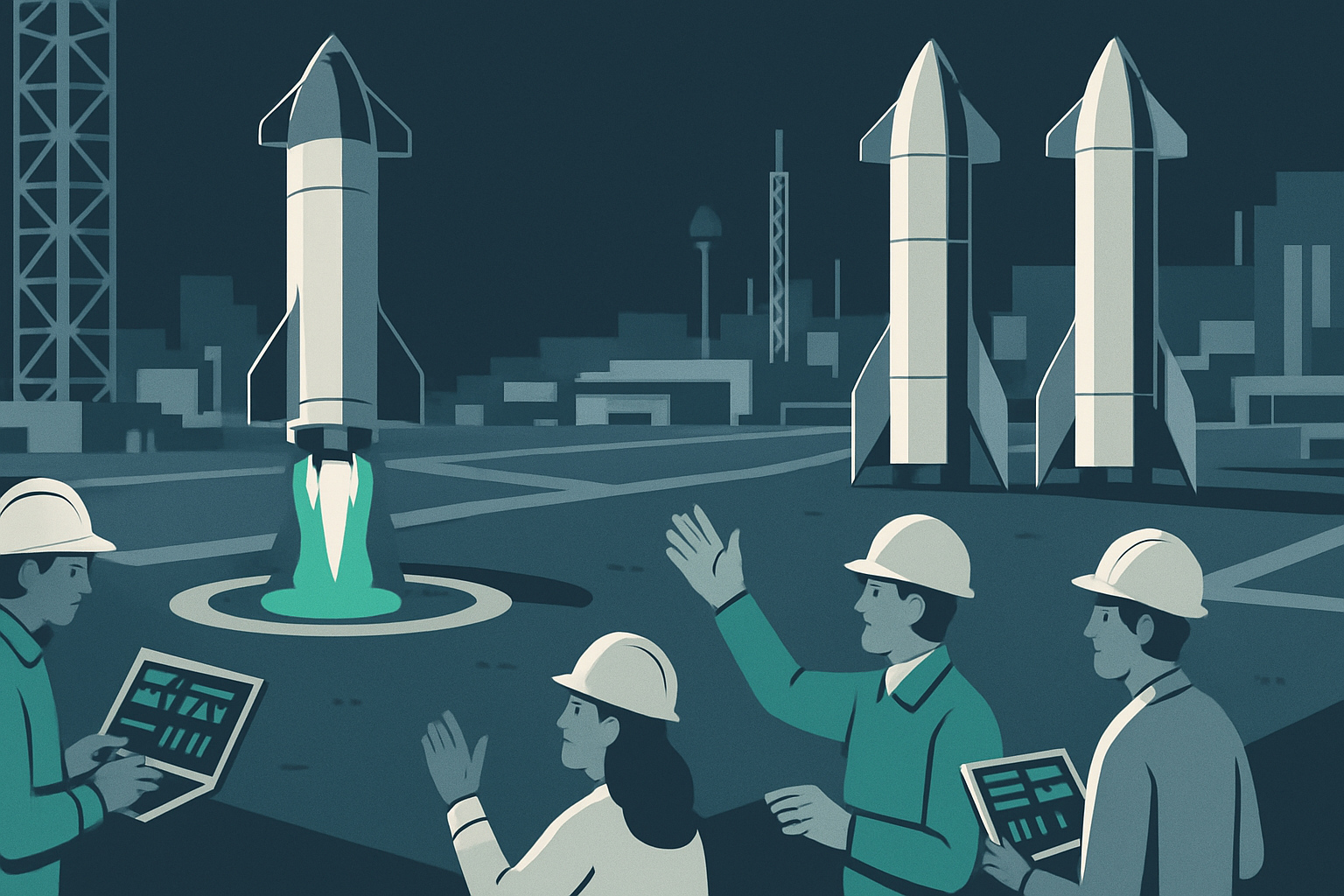

SpaceX’s Ship 40 has marked a significant milestone by becoming the first Starship to return to its launch site after a journey across air, space, and sea. This achievement is not just about a successful return but represents a critical step toward realizing full reusability in spacecraft. Currently stationed at the Starbase Megabay, Ship 40 stands alongside three other Starships, poised to provide invaluable data on its flown heatshield, Raptor engines, and avionics.
The Mechanism of Return
The successful return of Ship 40 is underpinned by several technological innovations, among which AI plays a crucial role. The ability to autonomously navigate through re-entry, landing, and sea transport requires sophisticated guidance systems. These systems are powered by AI algorithms that process data from multiple sensors in real-time. The Raptor engines, which are designed for reusability, benefit from AI-driven diagnostics that monitor performance metrics, enabling predictive maintenance and system optimization.
Moreover, the avionics suite onboard utilizes machine learning to adjust flight paths dynamically, taking into account atmospheric conditions and other variables. This capability is essential for ensuring the spacecraft can safely return to its launch site, a feat that reduces turnaround time between missions and lowers costs significantly.
What This Opens
The successful return of Ship 40 opens new pathways for the future of space travel. Primarily, it demonstrates the feasibility of fully reusable spacecraft, which could drastically cut costs associated with launching payloads into space. This has profound implications for space exploration, potentially making missions to Mars and beyond more economically viable.
In the next 5 to 10 years, we can expect SpaceX to refine these technologies further, enhancing the reliability and efficiency of Starship missions. The data gathered from Ship 40 will likely inform design improvements, making future iterations even more robust. Additionally, this achievement sets a precedent for other space agencies and private companies, possibly accelerating the development of similar technologies across the industry.
Furthermore, the success of this mission underscores the critical role of AI in advancing space technology. As AI continues to evolve, its applications in space exploration will likely expand, potentially leading to more autonomous missions and even AI-assisted research conducted in space environments.
References
- Flown Starship Returns to Starbase
- Build With Meta’s Newest AI Models
- Anthropic Blames Open AI for Doomsday
- SpaceX Agrees to Testify on AI
Perspectives

As we celebrate a shiny rocket returning from the heavens, we might pause to consider what we’re really losing in the race toward space reusability: the understanding of why space is special in the first place, an environment where the pursuit of commercial efficiency simply shouldn’t dominate the narrative. The rush to make space travel as common as a transatlantic flight threatens to reduce the cosmic frontier to just another bullet point on an investor deck. Research into AI-driven systems that promise cost reduction conveniently buries the persistent and significant barriers to equitable access to this new frontier—pay to play doesn’t end on Earth. Before we toast SpaceX’s success, maybe consider what we’re leaving behind in this headlong rush into the final frontier, and ask if the stars are really the limit, or just another place for tech barons to plant their flags.

The return of SpaceX’s Ship 40 to its launch site might seem, at first glance, as an achievement measured in metrics of cost and efficiency, but it compels us to question what we are actually measuring. By embracing AI-driven systems, we risk neglecting the rich tapestry of human meaning and agency which are inextricable from our engagement with space. What kind of humanity do we wish to bring to the stars, with a technology that might reduce us to mere passengers on a pre-determined path? True progress in space exploration must consider the existential dimension — the choice to define our own journey, rather than having it defined for us.

SpaceX’s triumphant return of Ship 40 spotlights a singular question: who truly benefits from reduced launch costs, and who shoulders the intricate task of maintaining these AI-driven systems? While the flashy headline lauds the reusability feat, we must scrutinize the labor force underpinning this technological marvel—a workforce often overshadowed by corporate triumphalism. Who’s funding the upkeep of this infrastructure, and what happens when the focus shifts? As the excitement of reusability swells, remember: those keeping these missions afloat are not just footnotes in a profit-driven narrative but the linchpins of this audacious space endeavor.

AI-driven systems enabled the Starship’s precise return to its launch site, slashing the costs of space travel by transforming spacecraft reusability from a fantasy into a demonstrated reality. Critics who drone on about the inherent risks of space exploration are clinging to the comforting narrative that it’s all too hard or too uncertain. Instead of endlessly wringing our hands, it’s time we acknowledge that these AI advancements provide a repeatable, scalable path to cheaper space missions. When technology allows us to perform complex maneuvers like returning a spacecraft, the future of space travel is not a distant dream but an imminent reality driven by evidence and data.